
Click the link below the picture
.
In 1988, in an elevator at a film festival in Havana, the director Oliver Stone was handed a copy of On the Trail of the Assassins, a newly published account of the murder of President John F. Kennedy. Stone admired Kennedy with an almost spiritual intensity and viewed his death on November 22, 1963 — 60 years ago this month — as a hard line in American history: the “before” hopeful and good; the “after” catastrophic. Yet he had never given much thought to the particulars of the assassination. “I believed that Lee Oswald shot the president,” he said. “I had no problem with that.” On the Trail of the Assassins, written by the Louisiana appellate judge Jim Garrison, proposed something darker. In 1963, Garrison had been district attorney of New Orleans, Oswald’s home in the months before the killing. He began an investigation and had soon traced the contours of a vast government conspiracy orchestrated by the CIA; Oswald was the “patsy” he famously claimed to be. Stone read Garrison’s book three times, bought the film rights, and took them to Warner Bros. “I was hot at the time,” Stone told me. “I could write my own ticket, within reason.” The studio gave him $40 million to make a movie.
The resulting film, JFK, was a scandal well before it came anywhere near a theater. “Some insults to intelligence and decency rise (sink?) far enough to warrant objection,” the Chicago Tribune columnist Jon Margolis wrote just as shooting began. “Such an insult now looms. It is JFK.” Newsweek called the film “a work of propaganda,” as did Jack Valenti, the head of the Motion Picture Association of America, who specifically likened Stone to the Nazi filmmaker Leni Riefenstahl. “It could spoil a generation of American politics,” Senator Daniel Patrick Moynihan wrote in the Washington Post.
Critics objected in particular to Stone’s ennoblement of Garrison, whose investigation was widely viewed, including by many conspiracy theorists, as a farce. And yet some of the response to the film looked an awful lot like a form of repression, a slightly desperate refusal to acknowledge that the official version of the Kennedy assassination had never been especially convincing. One week after the assassination and five days after Oswald himself was killed by nightclub owner Jack Ruby, President Lyndon Johnson convened a panel of seven “very distinguished citizens,” led by Chief Justice Earl Warren of the Supreme Court, to investigate. Ten months later, the Warren Commission concluded that Oswald, firing three shots from the sixth floor of the Texas School Book Depository, had killed Kennedy entirely on his own for reasons impossible to state. Notwithstanding JFK’s distortions — “It’s a Hollywood movie,” Stone pointed out — the film noted quite accurately that the Warren Commission seemed to be contradicted by its own evidence.
.
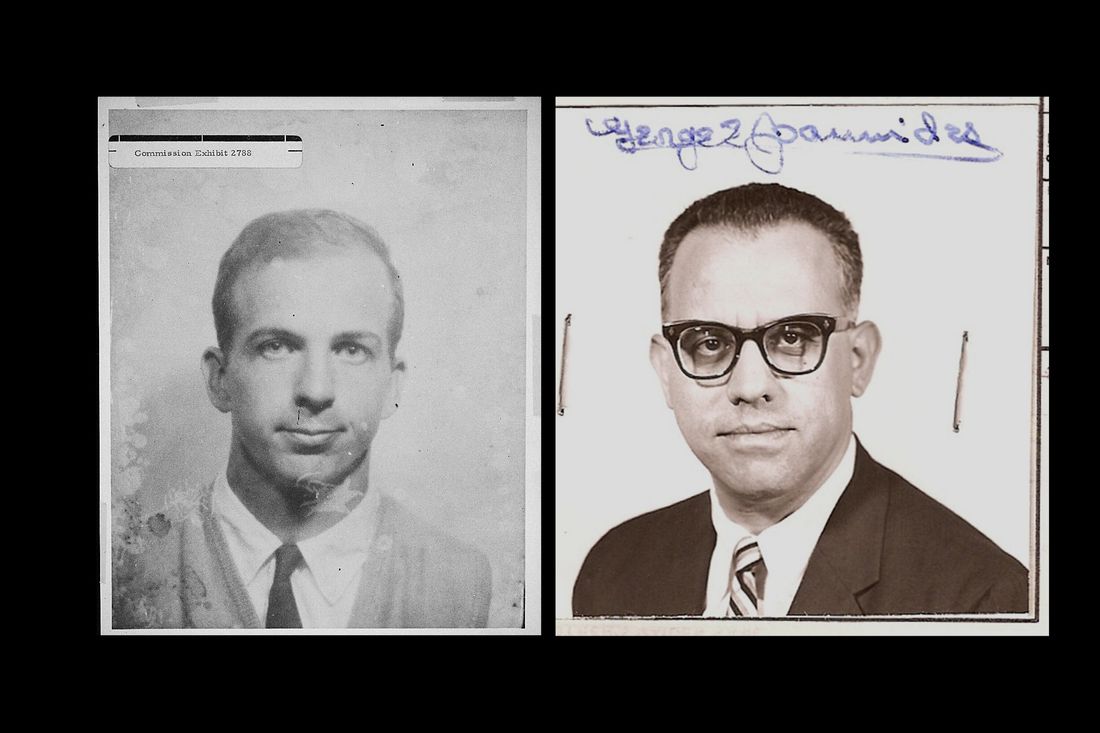 Lee Harvey Oswald and CIA officer George Joannides. Photo: JFK Assassination Records Collection (Oswald) & CIA FOIA files (Joannides)
.
.
Click the link below for the article:
.
__________________________________________
 James' World 2
Leave a comment