
Click the link below the picture
.
The U.S. Supreme Court will hear arguments next week in a pivotal firearms case that could have profound implications for how police and courts deal with domestic violence.
The question: Should people who are placed under domestic violence protection orders also lose access to their guns?
For many victim advocates, the answer is obvious. Women are five times more likely to be killed in a domestic violence incident when the abuser has access to a gun. Advocates argue that the gun restrictions tied to such orders are among the most powerful tools for domestic violence victims and that without them, more people will die.
For gun rights groups and their most ardent supporters, that is beside the point. They contend that people subject to protection orders haven’t been convicted of a crime and that taking their firearms away violates the Second Amendment. If the government can disarm them, they ask, who could the government disarm next?
Earlier this year, the U.S. Court of Appeals for the 5th Circuit sided with gun rights supporters, invalidating a federal law passed by Congress in 1994 that bars people under domestic violence orders from having firearms.
If the Supreme Court upholds that decision and rules that gun restrictions tied to restraining orders are unconstitutional, states would have fewer options to stop domestic abusers from possessing, and using, guns. And in conservative states, the aggressive rollback of gun control laws means that it is already easier for people to get guns to begin with.
.
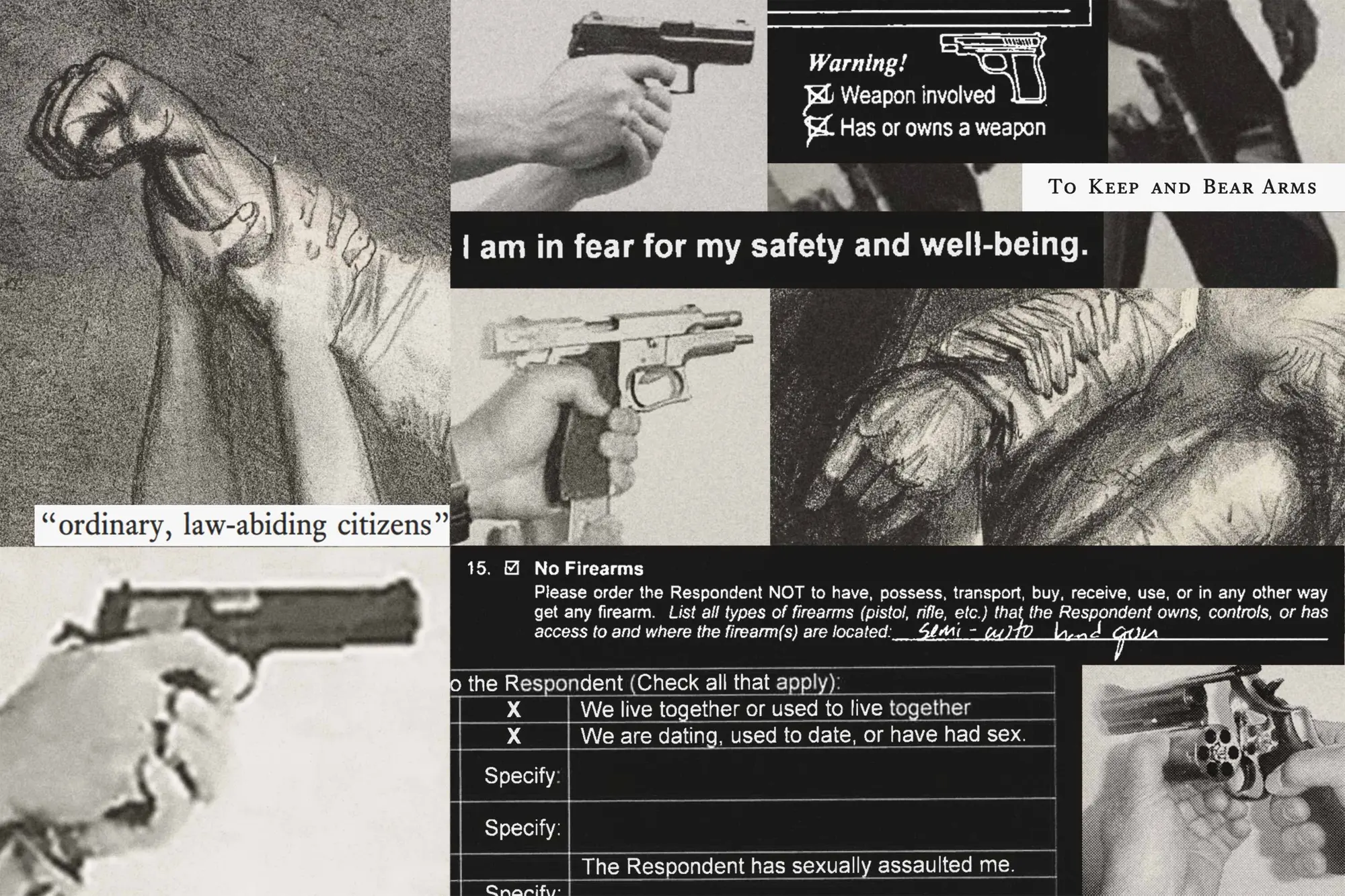 Photo illustration by Lisa Larson-Walker/ProPublica. Source images: Protective orders obtained by WPLN; lithograph by George Bellows via Wikimedia Commons; supremecourt.gov; California Department of Justice Firearms Safety Certificate Manual
.
.
Click the link below for the article:
.
__________________________________________
 James' World 2
Leave a comment