
Click the link below the picture
.
We all know the line: For more than 150 million years, dinosaurs ruled the Earth. We imagine bloodthirsty tyrannosaurs ripping into screaming duckbills, gigantic sauropods shaking the ground with their thunderous footfalls, and spiky stegosaurs swinging their tails in a reign of reptiles so magnificent, it took the unexpected strike of a six-mile-wide asteroid to end it. The ensuing catastrophe handed the world to the mammals, our ancestors, and relatives so that 66 million years later we can claim to have taken over what the terrible lizards left behind. It’s a dramatic retelling of history that is fundamentally wrong on several counts. Let’s talk about some of the worst rumors and what really happened in the so-called “Age of Dinosaurs.”
The oldest dinosaurs we know about are around 235 million years old, from the middle part of the Triassic Period. Those reptiles didn’t rule anything. From recent finds in Africa, South America, and Europe, we know that they were no bigger than a medium-sized dog and were lanky, omnivorous creatures that munched on leaves and beetles. Ancient relatives of crocodiles, by contrast, were much more abundant and diverse. Among the Triassic crocodile cousins were sharp-toothed carnivores that chased after large prey on two legs, “armadillodiles” covered in bony scutes and spikes, and beaked, almost ostrich-like creatures that gobbled up ferns.
Even as early dinosaurs began to evolve into the main lineages that would thrive during the rest of the Mesozoic, most were small and rare compared to the crocodile cousins. The first big herbivorous dinosaurs, which reached about 27 feet in length, didn’t evolve until near the end of the Triassic, around 214 million years ago. But everything changed at the end of the Triassic. Intense volcanic eruptions in the middle of Pangaea altered the global climate; the gases released into the air caused the world to swing between hot and cold phases. By then, dinosaurs had evolved warm-blooded metabolisms and insulating coats of feathers, leaving them relatively unfazed through the crisis, while many other forms of reptiles perished. Had this mass extinction not transpired, we might have had more of an “Age of Crocodiles”—or at least a very different history with a much broader cast of reptilian characters. The only reason the so-called Age of Dinosaurs came to be is because they got lucky in the face of global extinction.
It’s strange to talk about dinosaurs “dominating” an ocean world. While sea levels have risen and fallen over time, the seas make up about 71 percent of Earth’s surface and contain more than 330 million cubic miles of water. The claim that dinosaurs, as diverse as they were, were the dominant form of life on Earth only makes sense if we ignore that three-quarters of our planet is ocean.
.
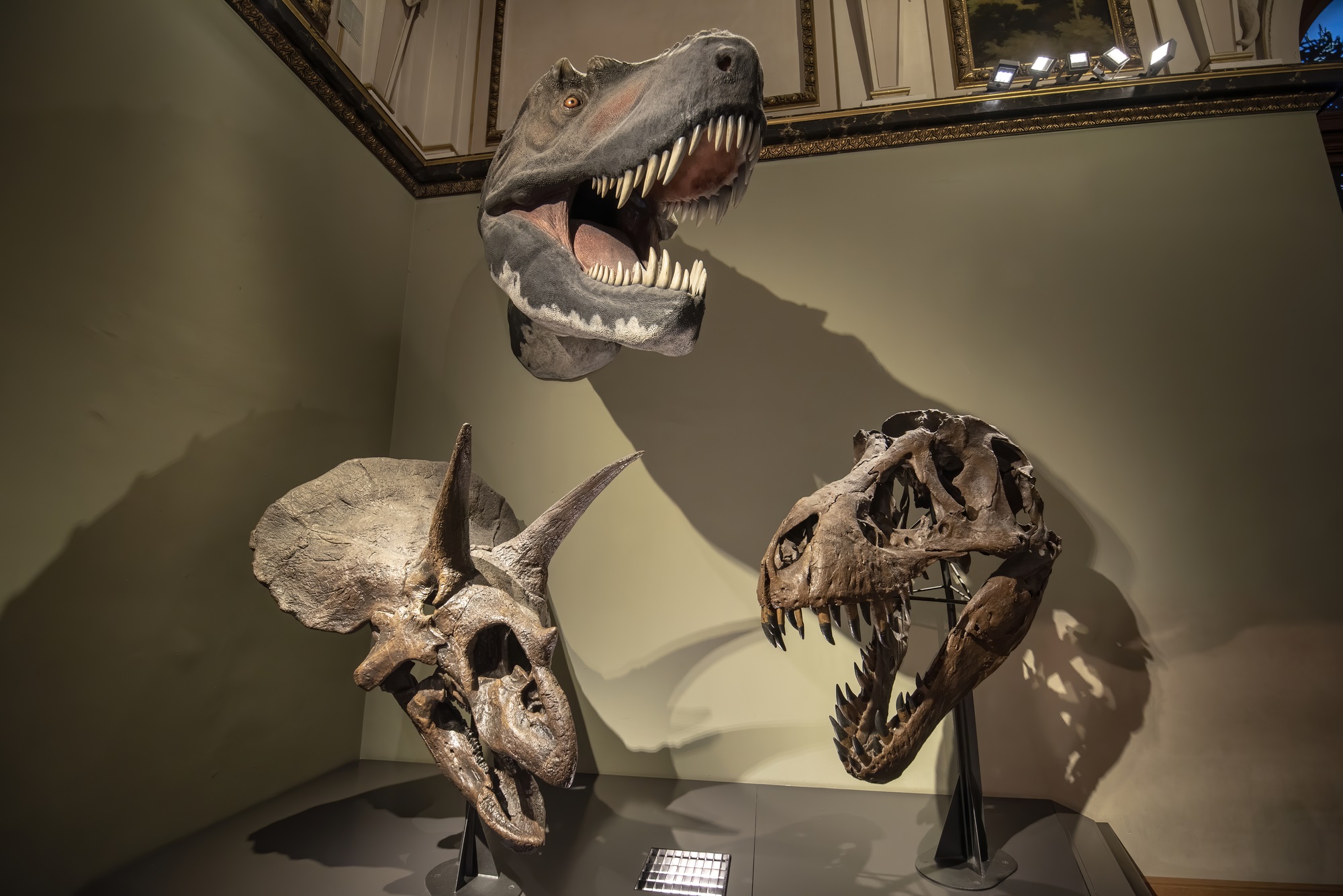 (Clockwise from top) A T. rex model, T. rex skull, and Triceratops skull on display at the Museum of Natural History in Vienna, Austria. DepositPhotos
.
.
Click the link below for the article:
https://www.popsci.com
.
__________________________________________
 James' World 2
Oct 07, 2023 @ 06:39:38
🤎
LikeLike
Oct 07, 2023 @ 08:26:45
Thank you!
LikeLike