
Click the link below the picture
.
Albert Einstein didn’t know about the existence of antimatter when he came up with the theory of general relativity, which has governed our understanding of gravity ever since. More than a century later, scientists are still debating how gravity affects antimatter, the elusive mirror versions of the particles that abide within us and around us. In other words, does an antimatter droplet fall down or up?
Common physics wisdom holds that it should fall down. A tenet of general relativity itself known as the weak equivalence principle implies that gravity shouldn’t care whether something is matter or antimatter. At the same time, a small contingent of experts argue that antimatter falling up might explain, for instance, the mystical dark energy that potentially dominates our universe.
As it happens, particle physicists now have the first direct evidence that antimatter falls down. The Antihydrogen Laser Physics Apparatus (ALPHA) collaboration, an international team based at CERN, measured gravity’s impact on antimatter for the first time. The ALPHA group published their work in the journal Nature today.
Every particle in the universe has an antimatter reflection with an identical mass and opposite electrical charge; the inverses are hidden in nature but have been detected in cosmic rays and used in medical imaging for decades. But actually creating antimatter in any meaningful amount is tricky because as soon as a particle of matter and its antagonist meet, the two self-destruct into pure energy. Therefore, antimatter must be carefully cordoned off from all matter, which makes it extra difficult to drop it or play with it any way.
“Everything about antimatter is challenging,” says Jeffrey Hangst, a physicist at Aarhus University in Denmark and a member of the ALPHA group. “It just really sucks to have to work with it.”
.
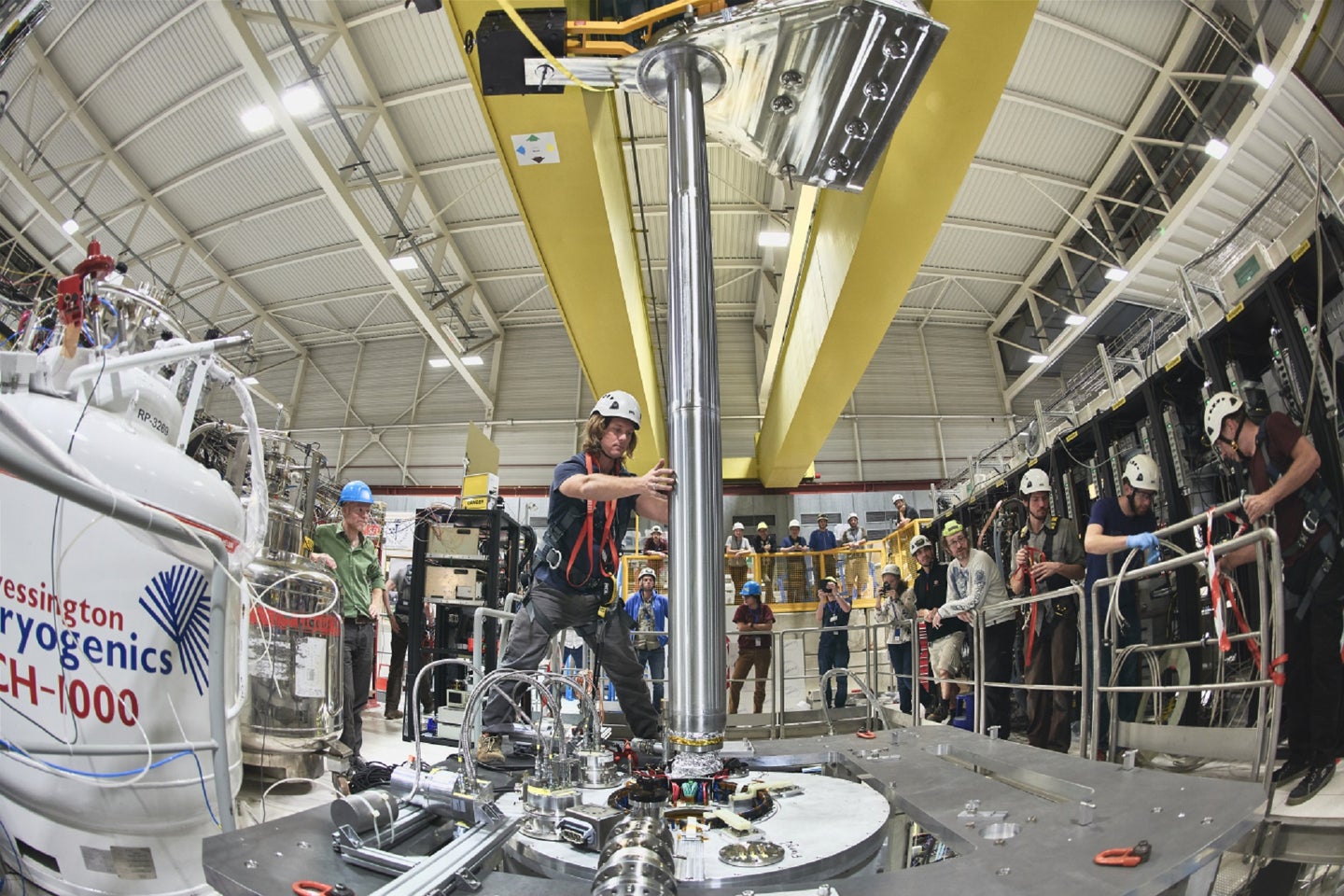 The hardest part of the ALPHA experiment was not making antimatter fall, but creating and containing it in a tall vacuum chamber. CERN
.
.
Click the link below for the article:
.
__________________________________________
 James' World 2
Leave a comment