
Click the link below the picture
.
To fully appreciate the modern-day marvel that is the National Weather Service, it’s useful to start with numbers. There’s 6.3 billion. (The number of observations the agency collects and analyzes every day.) There’s 1.5 million. (The number of forecasts it issues each year.) There’s 184 and 100,000. (The number of weather balloons NWS releases every day, including on weekends and holidays, and the number of feet said balloons can rise into the atmosphere.) And there’s 90 percent. (The average accuracy of a five-day forecast.)
There’s also zero. That’s the approximate number of minutes a typical American like you or me spends wondering about the weather information we access every single day via print newspapers or public radio stations or the hour-by-hour forecasts delivered courtesy of the phones we carry. The ubiquitousness of those updates, the fact that we don’t consider them at all, is a testament to just how much modern meteorology has spoiled us and—probably more than anything else—a tribute to the National Weather Service’s success.
This blasé attitude would have astounded the colonists who arrived in the New World from Europe during the seventeenth century and found North American weather to be, in a word, hellish. They sent letters home describing the climate in apocalyptic terms. When it rained, wrote one colonist in New Sweden, on the Delaware River, “the whole sky seems to be on fire, and nothing can be seen but smoke and flames.” “Intemperate” was how a missionary from Rhode Island described it. “Excessive heat and cold, sudden violent changes of weather, terrible and mischievous thunder and lightning, and unwholesome air” created an environment that was “destructive to human bodies.”
The harshness of the weather—with its extreme seasons and severe storms—wasn’t just an unpleasant surprise. It was also confusing. Among the various, sketchy assumptions that the Europeans had brought with them to their new home was the idea that a location’s climate was directly correlated to its latitude. By the colonists’ logic, the seasons in Newfoundland should resemble those in Paris, and crops grown in Spain should thrive in Virginia. Instead, the olive trees imported from the Mediterranean died in the frozen ground during the mid-Atlantic winters, and the beer went sour in the summer heat. American settlers could have consulted with the resident experts—the Native Americans, who had lived in the eastern part of the continent for thousands of years and knew more about the local climate than anyone else. But they generally didn’t. (“Descriptions of local indigenous knowledge in early colonial narratives,” the historian Sam White noted in his book A Cold Welcome, “are mostly conspicuous by their absence.”)
.
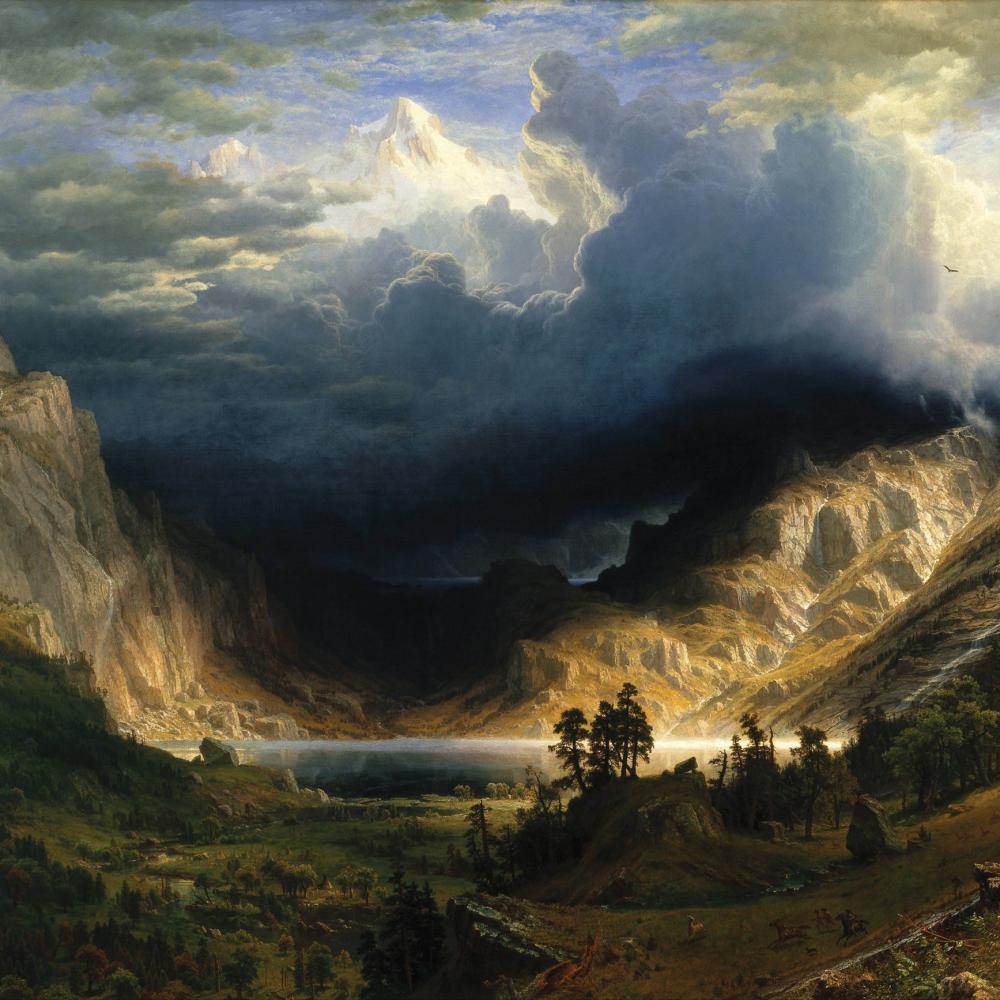
The exact mechanism by which storms formed was once a subject of fierce debate among American scientists. ―Albert Bierstadt, A Storm in the Rocky Mountains, Mt. Rosalie. detail (1866), Wikimedia
.
.
Click the link below for the article:
.
__________________________________________
 James' World 2
Leave a comment