
Click the link below the picture
.
On an overcast spring morning in 2012, Federica Bertocchini was tending to her honeybees close to where she lived in Santander, on Spain’s picturesque northern coast. One of the honeycombs “was plagued with worms,” says the amateur apiarist, referring to the pesky larvae of wax moths that have a voracious — and destructive — appetite.
Bertocchini picked out the worms, placed them in a plastic bag, and carried on with her beekeeping chores. When she retrieved the bag a few hours later, she noticed something strange: It was full of tiny holes.
The scientist’s interest was piqued. Had the hungry worms simply chewed up the plastic, or had they changed its chemical makeup too? Quick tests in her lab confirmed, surprisingly, the latter: Something in the worms’ saliva had degraded the plastic. “From that point, the research started,” says Bertocchini, a developmental biologist formerly with the Spanish National Research Council.
She is now the co-founder of Plasticentropy — one of the numerous startups and research groups that have sprouted in recent years seeking bio-inspired means to recycle plastic. This biological recycling, as it’s called, could offer more effective and environmentally friendly alternatives to some of today’s problem-riddled recycling methods.
The effort has scientists scouring landfills, auto-wrecking yards, and other sites teeming with plastic pollution in search of organisms that might be able to break down plastic into its component pieces. By taking these microbes and enhancing their polymer-munching abilities in the lab, scientists hope to find an efficient way of reclaiming the building blocks of plastics. They would then use these subunits to manufacture new materials, thus creating an “infinite recycling” loop.
.
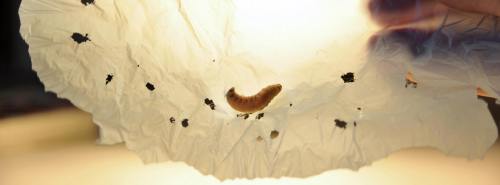 Discoveries that certain plastics can be broken down by enzymes, such as those in the saliva of the waxworm moth (Galleria mellonella) larva shown here, have propelled the biological recycling movement. CREDIT: CESAR HERNANDEZ / CSIC
.
.
Click the link below for the article:
.
__________________________________________
 James' World 2
Leave a comment