
Click the link below the picture
.
Most creatures sleep, but until now, REM (rapid eye movement) sleep, the phase of sleep in which dreams occur, was thought to be exclusive to vertebrates. Octopuses appear to be the first invertebrates to show they are also capable of this
When it comes to neural function, studies have found these cephalopods are more like us than we think (pun somewhat intended). Having no spine hasn’t stopped them from evolving a complex nervous system. A 2022 study found that parts of their brains, the frontal and vertical lobes, work much like the hippocampus and limbic lobe in humans and other vertebrates. The hippocampus is critical to learning and memory, while the limbic lobe controls complex emotional reactions, such as the fight-or-flight response that is triggered by stress or fear.
Now it seems that octopuses have even more in common with us. In studying their sleep behavior, a team of researchers at the Okinawa Institute of Science and Technology observed both periods of quiet sleep, or NREM sleep (also known as slow wave sleep), and bursts of neural activity, during which the animals’ eyes and tentacles twitched while their skin changed color. Neural activities like these, which are similar to the waking state, only happen during REM sleep. Because they can transition between NREM and REM sleep, octopuses are the only known invertebrates that have two phases of sleep.
“If the functions ascribed to two-stage sleep are truly general, then one may expect to find neural and behavioral correlates of two-stage sleep widely among animals showing complex cognitive abilities,” the research team, led by neuroethologist Sam Reiter of the University of Okinawa, wrote in a recent study.
You awake?
To pursue this study, Reiter’s team needed to check that the octopuses were, in fact, asleep. They waited until the animals appeared asleep. When their eight-legged subjects were lying flat on the bottoms of the tanks, the team stimulated them to see if there would be a delayed reaction. The octopuses’ reaction to this stimulation was much slower than when they were awake. When the team was positive that the animals were asleep, they began observations.
.
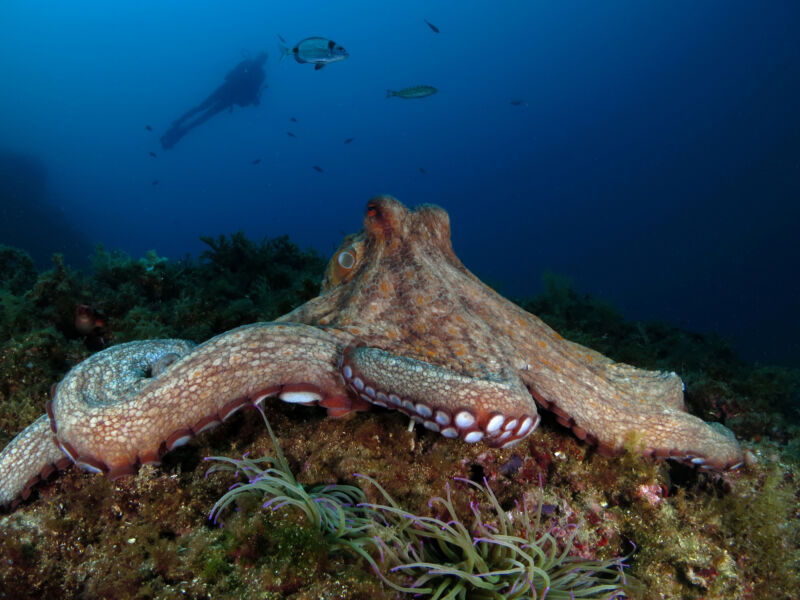 Imagen Rafael Cosme Daza
.
.
Click the link below for the article:
.
__________________________________________
 James' World 2
Jul 09, 2023 @ 10:22:34
Interesting article no wonder vegans don’t eat fish either 🤔 God created humans as seed eaters Amen . 🙏
LikeLike
Jul 09, 2023 @ 23:44:01
There seem to be differences of opinion on that!
LikeLike