
Click the link below the picture
.
Charles Bridge is a medieval stone arch bridge that crosses the Vltava river in Prague, Czech Republic. Its construction started in 1357 under the auspices of King Charles IV and finished in the early 15th century. The bridge replaced the old Judith Bridge built 1158–1172 that had been badly damaged by a flood in 1342. This new bridge was originally called Stone Bridge (Kamenný most) or Prague Bridge (Pražský most), but has been referred to as “Charles Bridge” since 1870.
As the only means of crossing the river Vltava until 1841, Charles Bridge was the most important connection between Prague Castle and the city’s Old Town and adjacent areas. This land connection made Prague important as a trade route between Eastern and Western Europe.
A UNESCO World Heritage site, the bridge is 516 meters (1,693 ft) long and nearly 10 meters (33 ft) wide. Following the example of the Stone Bridge in Regensburg, it was built as a bow bridge with 16 arches shielded by ice guards. It is protected by three bridge towers, two on the Lesser Quarter side (including the Malá Strana Bridge Tower) and one on the Old Town side, the Old Town Bridge Tower. The bridge is decorated by a continuous alley of 30 statues and statuaries, most of them baroque-style, originally erected around 1700, but now all have been replaced by replicas.
The bridge is currently undergoing a twenty-year process of structural inspections, restoration, and repairs. The process started in late 2019 and is expected to cost 45–60 million CZK (USD 1.9–2.6 million).
Throughout its history, Charles Bridge has suffered several disasters and witnessed many historic events. Czech legend has it that construction began on Charles Bridge at 5:31am on 9 July 1357 with the first stone being laid by Charles IV himself. This exact time was very important to the Holy Roman Emperor because he was a strong believer in numerology and felt that this specific time, which formed a palindrome (1357 9/7 5:31), was a numerical bridge, and would imbue Charles Bridge with additional strength. The bridge was completed 45 years later in 1402. A flood in 1432 damaged three pillars. In 1496 the third arch (counting from the Old Town side) broke down after one of the pillars lowered, being undermined by the water (repairs were finished in 1503). A year after the Battle of White Mountain, when the 27 leaders of the anti-Habsburg revolt were executed on 21 June 1621, the Old Town Bridge Tower served as a deterrent display of the severed heads of the victims to stop Czechs from further resistance. During the end of the Thirty Years’ War in 1648, the Swedes occupied the west bank of the Vltava, and as they tried to advance into the Old Town the heaviest fighting took place right on the bridge. During the fighting, they severely damaged one side of the Old Town bridge tower (the side facing the river) and the remnants of almost all gothic decorations had to be removed from it afterward. During the late 17th century and early 18th century, the bridge gained its typical appearance when an alley of baroque statues was installed on the pillars. During a great flood in 1784, five pillars were severely damaged and, although the arches did not break down, the traffic on the bridge had to be greatly restricted for some time. Wikipedia
.
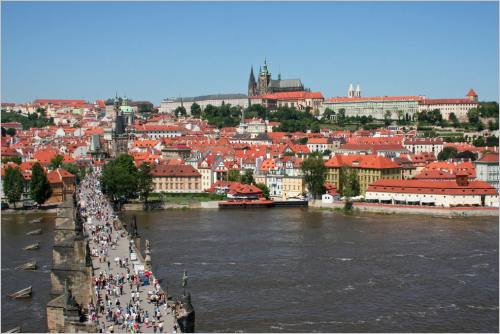 An image of the Charles Bridge Prague
.
.
Click the link below for images:
.
__________________________________________
 James' World 2
Jan 29, 2022 @ 03:54:24
So beautiful ❤️
LikeLiked by 1 person