
Click the link below the picture
.
Düsseldorf is the capital city of North Rhine-Westphalia, the most populous state of Germany. It is the second-largest city in the state and the seventh-largest city in Germany, with a population of 617,280.
Düsseldorf is located at the confluence of two rivers: the Rhine and the Düssel, a small tributary. The -dorf suffix means “village” in German (English cognate: thorp); its use is unusual for a settlement as large as Düsseldorf. Most of the city lies on the right bank of the Rhine (unlike Cologne, which is on the river’s left bank). Düsseldorf lies in the centre of both the Rhine-Ruhr and the Rhineland Metropolitan Region. It neighbours the Cologne Bonn Region to the south and the Ruhr to the north. It is the largest city in the German Low Franconian dialect area (closely related to Dutch).
Mercer’s 2012 Quality of Living survey ranked Düsseldorf the sixth most livable city in the world. Düsseldorf Airport is Germany’s third-busiest airport after those of Frankfurt and Munich, serving as the most important international airport for the inhabitants of the densely populated Ruhr, Germany’s largest urban area. Düsseldorf is an international business and financial centre, renowned for its fashion and trade fairs, and is headquarters to one Fortune Global 500 and two DAX companies. Messe Düsseldorf organises nearly one fifth of premier trade shows. As second largest city of the Rhineland, Düsseldorf holds Rhenish Carnival celebrations every year in February/March, the Düsseldorf carnival celebrations being the third most popular in Germany after those held in Cologne and Mainz.
There are 22 institutions of higher education in the city including the Heinrich-Heine-Universität Düsseldorf, the university of applied sciences (Hochschule Düsseldorf), the academy of arts (Kunstakademie Düsseldorf, whose members include Joseph Beuys, Emanuel Leutze, August Macke, Gerhard Richter, Sigmar Polke, and Andreas Gursky), and the university of music (Robert-Schumann-Musikhochschule Düsseldorf). The city is also known for its influence on electronic/experimental music (Kraftwerk) and its Japanese community. Düsseldorf is classified as a GaWC Beta+ world city.
When the Roman Empire was strengthening its position throughout Europe, a few Germanic tribes clung on in marshy territory off the eastern banks of the Rhine. In the 7th and 8th centuries, the odd farming or fishing settlement could be found at the point where the small river Düssel flows into the Rhine. It was from such settlements that the city of Düsseldorf grew. The first written mention of Düsseldorf (then called Dusseldorp in the local Low Rhenish dialect) dates back to 1135. Under Emperor Friedrich Barbarossa the small town of Kaiserswerth to the north of Düsseldorf became a well-fortified outpost, where soldiers kept a watchful eye on every movement on the Rhine. Kaiserswerth eventually became a suburb of Düsseldorf in 1929. In 1186, Düsseldorf came under the rule of the Counts of Berg. 14 August 1288 is one of the most important dates in the history of Düsseldorf. On this day the sovereign Count Adolf VIII of Berg granted the village on the banks of the Düssel town privileges. Before this, a bloody struggle for power had taken place between the Archbishop of Cologne and the count of Berg, culminating in the Battle of Worringen. Wikipedia
.
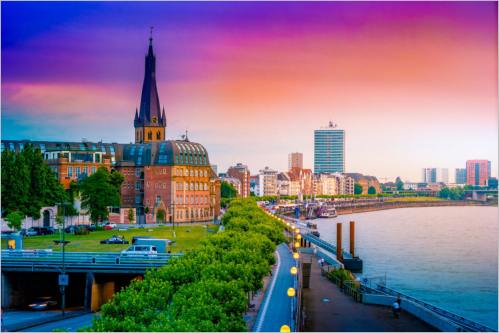 An image from Dusseldorf, Germany
.
.
Click the link below for images:
.
__________________________________________
 James' World 2
Leave a comment