
Click the link below the picture
.
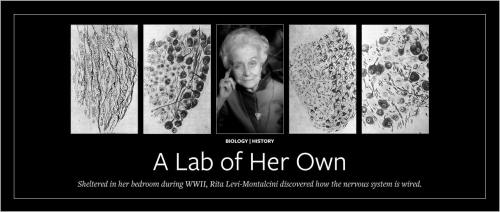
On a cold, dry Tuesday in December 1940, Rita Levi-Montalcini rode a train from the station near her home in Turin, Italy, for 80 miles to Milan to buy a microscope. Milan had not seen bombings for months. On her return to the Turin train station, two police officers stopped her and demanded to see inside the cake-sized box that she was carrying. With wartime food rationing, panettone cakes were only available illegally. The officers found her new microscope instead. They let her go. Just a week after her trip, British bombers hit Milan.
Levi-Montalcini was a 31-year-old scientist who had been working at the University of Turin. Despite her father’s disapproval, she had trained in medicine, inspired by seeing a nanny succumb to cancer. In 1938, the Italian dictator Mussolini banned Jews from positions in universities. Levi-Montalcini was not raised in the Jewish religion, but her Jewish ancestry would have been evident from her surname. Mussolini’s ban had pushed Levi-Montalcini to leave Italy for Belgium in 1939, where she did research using fertilized chicken eggs as a source of material for her research topic: the developing nervous systems of vertebrate embryos. Levi-Montalcini also spent time with her older sister Nina, whose family was in Belgium as well. Rita wrote home to her mother of an “infinite desire to embrace you again,” but research at the university in Turin would have been impossible had she returned home. Her passion for research alternated with her frustration with challenges. When Hitler invaded Poland in September, launching war, her worst frustrations were realized. The “whole world was in danger,” Levi-Montalcini later wrote. In December 1939, she returned to Italy.
.
 .
.
.
Click the link below for article:
.
__________________________________________
 James' World 2
Leave a comment