
Click the link below the picture
.
Cappadocia is a historical region in Central Anatolia, largely in the Nevşehir, Kayseri, Aksaray, Kırşehir, Malatya, Sivas and Niğde provinces in Turkey.
Since the late 300s BC, the name Cappadocia came to be restricted to the inland province (sometimes called Great Cappadocia), Upper Cappadocia, which alone will be the focus of this article. Lower Cappadocia is focused to elsewhere.
According to Herodotus, in the time of the Ionian Revolt (499 BC), the Cappadocians were reported as occupying a region from Mount Taurus to the vicinity of the Euxine (Black Sea). Cappadocia, in this sense, was bounded in the south by the chain of the Taurus Mountains that separate it from Cilicia to the east by the upper Euphrates, to the north by Pontus, and to the west by Lycaonia and eastern Galatia.
The name, traditionally used in Christian sources throughout history, continues in use as an international tourism concept to define a region of exceptional natural wonders, in particular characterized by fairy chimneys and a unique historical and cultural heritage.
The earliest record of the name of Cappadocia dates from the late 6th century BC when it appears in the trilingual inscriptions of two early Achaemenid kings, Darius I and Xerxes, as one of the countries (Old Persian dahyu-) of the Persian Empire. In these lists of countries, the Old Persian name is Katpatuka. It was proposed that Kat-patuka came from the Luwian language, meaning “Low Country”. Subsequent research suggests that the adverb katta meaning ‘down, below is exclusively Hittite, while its Luwian equivalent is zanta. Therefore, the recent modification of this proposal operates with the Hittite katta peda-, literally “place below” as a starting point for the development of the toponym Cappadocia. The earlier derivation from Iranian Hu-aspa-dahyu ‘Land of good horses’ can hardly be reconciled with the phonetic shape of Kat-patuka. A number of other etymologies have also been offered in the past.
Herodotus tells us that the name of the Cappadocians was applied to them by the Persians, while they were termed by the Greeks “White Syrians” (Leucosyri), who were most probably descendants of the Hittites. One of the Cappadocian tribes he mentions is the Moschoi, associated by Flavius Josephus with the biblical figure Meshech, son of Japheth: “and the Mosocheni were founded by Mosoch; now they are Cappadocians”. Wikipedia
.
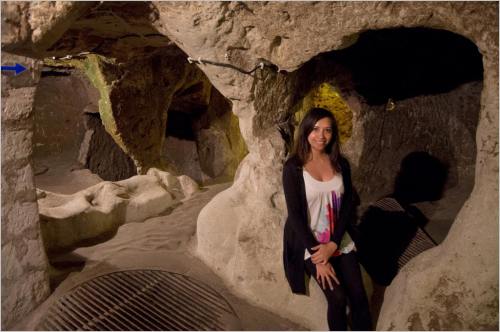 An image from Underground City Cappadocia Turkey
.
.
Click the link below for images:
.
__________________________________________
 James' World 2
Oct 07, 2021 @ 19:55:06
Oct 11, 2021 @ 14:48:38
This is so cool 😍, 😎
LikeLike
Oct 11, 2021 @ 18:46:10
Yes, I’d like to see Cappadocia also! Thanks for the visit.
LikeLike