
Click the link below the picture
.
‘I got a couple of billion dollars rolling around through here,” Al Putre says, gesturing downward toward the floors below. We are sitting in the conference room next to his office, which is on one of the upper levels of a blocky, nearly unmarked building in southwest Queens. (He has asked me not to reveal where it is more precisely — “Call it a secret location. They like that” — although you can probably figure it out with Google.) On your way there, you pass mostly businesses that sell steel pipe and cinder blocks from behind barbed wire, plus the odd strip club. Every nickel’s worth of cash that comes into the MTA, and every MetroCard that goes out, passes through this building and thus under Putre’s eye. Although the agency’s income is down a lot owing to the pandemic, the amount of cash that passes through most years, give or take, is about $1.5 billion.
Putre talks fast — and I mean fast — in a Queens accent that is on the endangered-species list, and has a high-and-tight graying haircut that would not be out of place in a precinct house. He’s been with the MTA for 34 years, and in charge of the division of revenue — the money rooms and their associated operations — since 1999. On the day we meet, he’s a couple of days from retirement. He started in the era of subway tokens in cloth sacks and overnight runs of the money train; he wraps up his career managing a digital river of electronic payments and the launch of OMNY, the system that will soon replace the MetroCard. What he clearly loves, even more than the job or the agency or the piles of cash is a system. Ask him about the change that riders drop into the farebox on the bus, which gets picked up at the depots and brought to the money room, and here’s what he’ll tell you, in the space of 90 seconds, incorporating a quick hallway encounter with a colleague:
“We suck all the money out of fareboxes via a Keene vacuum system. There’s only one other agency in the world I’m aware of that does that. Philly was at one time, but I’m not even sure if they do anymore. You need to have high volumes of coins and large numbers of buses. We fit that bill — Hey, partner, how are you? You’ll see the vaults here: They look old, they are old, but they last very, very well. They’re durable. And the system is set up so it’s sealed. So from the moment a bus pulls in, the money gets vacuumed out via a port, and that port is connected to a vacuum hose and a probe. The probe takes the data from the farebox, sends it up to the AFC [automated fare collection]. The vacuum sucks it up into the ceiling to a shaker-sorter, a sifter. The coin goes into the vaults by denomination. Why is that important? You can count separated coin extremely fast, 10,000 pieces per minute. If you get the coin unseparated and you have to sort it, the speed goes down to 2,500 pieces per minute, and it wears the machines out. The TA separating this coin makes this operation smooth as silk. You’ll see what I mean.”
.
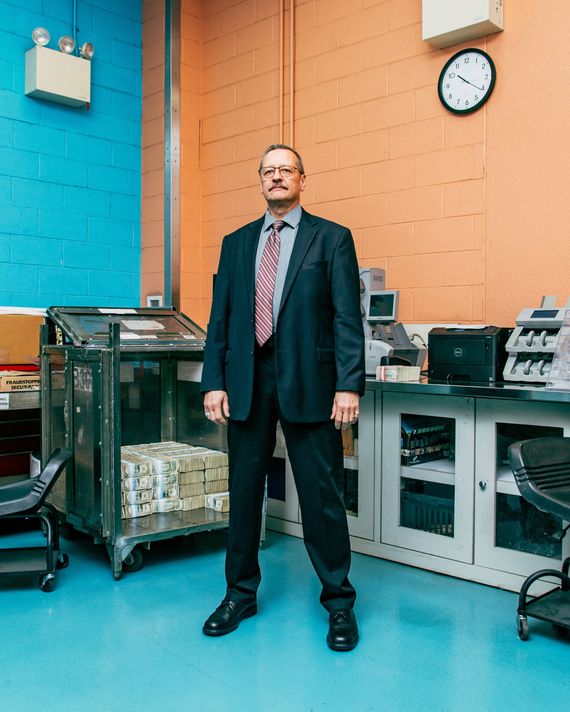 The MTA’s Al Putre, in his final week on the job. Photo: DeSean McClinton-Holland
.
.
Click the link below for the article:
.
__________________________________________
 James' World 2
Leave a comment