Home

How to Kill Mosquitoes: What Works and What Doesn’t

Leave a comment

Click the link below the picture

.

Mosquitoes bite, suck your blood, and leave you with itchy bumps and possibly a horrible infection. Mosquito-borne pathogens include malaria, West Nile virus, Zika virus, Chikungunya virus, and dengue. No wonder so many of us want to learn how to kill mosquitoes for good.

While you might fantasize about living in a mosquito-free world, eradicating them would actually be disastrous for the environment. Adult mosquitoes are food for other insects, birds, and bats, while larval mosquitoes support aquatic ecosystems. The best we can hope for is to limit their ability to transmit disease, repel them, and kill them within the confines of our yards and homes.

Mosquito-killing products bring in the big bucks, so it should come as no surprise that there is a wealth of misinformation out there. Before you get sucked into buying a product that simply won’t work, get educated about what does and does not kill these blood-sucking pests.

Key Takeaways: How to Kill Mosquitoes

  • The best way to kill and control mosquitoes is to consistently apply more than one method. Some methods may only target adults, while others may only target larvae.
  • Effective ways to kill mosquitoes include removing breeding grounds, encouraging predators, applying an agent containing BTI or IGR, and using traps.
  • Insect repellents and bug zappers don’t kill mosquitoes.
  • Pesticide-resistant mosquitoes may survive spraying, plus the chemical kills other animals and may persist in the environment.

How Not to Kill Mosquitoes

First things first when learning how to kill mosquitoes: You need to understand the difference between repelling them and killing them. Repellents make a location (like your yard or skin) less attractive to mosquitoes, but don’t kill them. So, citronella, DEET, smoke, lemon eucalyptus, lavender, and tea tree oil might keep the insects at bay, but won’t control them or get rid of them in the long run. Repellents vary in effectiveness, too. For example, while citronella may deter mosquitoes from entering a small, enclosed area, it doesn’t really work in a wide-open space (like your backyard).

There are a host of methods that actually do kill mosquitoes, but aren’t great solutions. A classic example is a bug zapper, which kills only a few mosquitoes, yet attracts and kills beneficial insects that keep the mozzy population down. Similarly, spraying pesticides is not an ideal solution because mosquitoes can become resistant to them, other animals get poisoned, and the toxins can cause lasting environmental damage.

Source Reduction

Many species of mosquitoes required standing water to breed, so one of the most effective methods of controlling them is to remove open containers and repair leaks. Dumping containers of standing water kills the larvae living in them before they get a chance to mature.

However, removing water may be undesirable or impractical in some cases. Further, some species don’t even need standing water to reproduce! The Aedes species, responsible for transmitting Zika and dengue, lays eggs out of water. These eggs remain viable for months, ready to hatch when sufficient water becomes available.


Biological Methods

A better solution is to introduce predators that eat immature or adult mosquitoes or infectious agents that harm mosquitoes without affecting other wildlife.

Most ornamental fish consume mosquito larvae, including koi and minnows. Lizards, geckos, dragonfly adults and naiads, frogs, bats, spiders, and crustaceans all eat mosquitoes.

Adult mosquitoes are susceptible to infection by the fungi Metarhizium anisoplilae and Beauveria bassiana. A more practical infectious agent is the spores of the soil bacterium Bacillus thurigiensis israelensis (BTI),. Infection with BTI makes the larvae unable to eat, causing them to die. BTI pellets are readily available at home and gardening stores, easy to use (simply add them to standing water), and only affect mosquitoes, black flies, and fungus gnats. The treated water remains safe for pets and wild animals to drink. The disadvantages of BTI are that it requires reapplication every week or two and it doesn’t kill adult mosquitoes.

Chemical and Physical Methods

There are several chemical methods that target mosquitoes without the risks to other animals that come with spraying pesticides.

Some methods rely on chemical attractants to lure mosquitoes to their doom. Mosquitoes are attracted to carbon dioxide, sugary scents, heat, lactic acid, and octenal. Gravid females (those carrying eggs) may be attracted to traps laced with a hormone released during the egg-laying process.

The lethal ovitrap is dark, water-filled container, typically with a small opening to prevent larger animals from drinking the water. Some traps use chemicals to bait the traps, while others simply provide a convenient breeding ground. The traps may be filled with predators (e.g., fish) or with dilute pesticide to kill larvae (larvicide) and sometimes adults. These traps are highly effective and affordable. The disadvantage is that multiple traps must be used to cover an area (about one every 25 feet).

Another chemical method is the use of an insect growth regulator (IGR), added to water to inhibit larval development. The most common IGR is methoprene, which is supplied as a time-release brick. While effective, methoprene has been shown to be mildly toxic to other animals. 

Adding a layer of oil or kerosene to water kills mosquito larvae and also prevents females from depositing eggs. The layer alters the surface tension of the water. Larvae can’t get their breathing tube to the surface for air, so they suffocate. However, this method kills other animals in the water and makes the water unfit for consumption.

Physical Methods

You don’t have to be an expert to know how to kill mosquitoes with this method. One example of a physical method of killing mosquitoes is swatting them with your hand, a fly swatter, or an electric swatter. Swatting works if you’ve only got a few mosquitoes, but it’s not particularly helpful if you’re being swarmed. While bug zappers aren’t ideal outdoors because they can unnecessarily kill beneficial insects, electrocuting indoor insects isn’t generally considered objectionable. Just remember, you need to bait a bug zapper to attract mosquitoes because they don’t care about the pretty blue light.

Because mosquitoes are not strong fliers, it’s also easy to suck them onto a screen or into a separate trap using a fan. Mosquitoes caught using a fan die from dehydration. Screen traps may be made at home by fastening window screening fabric over the back of a fan.

The Bottom Line

If you’re serious about killing mosquitoes, you’ll probably need to use a combination of methods to control them. Some of the most effective strategies target either the larvae or the adult. Others kill mosquitoes at all stages of their life cycle, but may miss some of the insects.

If you live in a wetland area and get a significant influx of mosquitoes from outside your property, you won’t be able to kill all of the local population. Don’t despair! Scientists are developing ways to make mosquitoes sterile or lay eggs that won’t mature. In the meantime, you’ll need to combine repellents with lethal measures to enjoy the outdoors.

.

https://www.thoughtco.com/thmb/YJ-Z-ZfdwudoPH8jpcgOXa1A4vQ=/750x0/filters:no_upscale():max_bytes(150000):strip_icc()/dead-mosquito---2-157293242-5a9edac0fa6bcc0037220151.jpgMost people believe the only good mosquito is a dead mosquito. doug4537 / Getty Images

https://www.thoughtco.com/thmb/OWo6fLVA8x7n91BzAXHATqnVbCU=/750x0/filters:no_upscale():max_bytes(150000):strip_icc()/tombstone-drawn-by-dead-mosquito-489008121-5a9fe6986bf0690036c5dce9.jpgYou may need to use a combination of methods to kill mosquitoes. Stefano Petreni / EyeEm / Getty Images

.

.

Click the link below for the complete article:

https://www.thoughtco.com/how-to-kill-mosquitoes-4160066

.

__________________________________________

Gaza Peace Talks Take Place Just Ahead of 2nd Anniversary of Oct. 7

2 Comments

Click the link below the picture

.

As Israel prepared to mourn on the second anniversary of the Oct. 7 Hamas-led attack, talks to end the devastating war in Gaza were expected to continue on Tuesday in Egypt, with the focus on a hostages-for-prisoners swap proposed by the Trump administration.

The grim anniversary falls on Sukkot, a Jewish harvest festival. Most businesses across Israel will be closed for the holiday, and the government has delayed formal commemorations until later this month. As a consequence, the mood is expected to be subdued.

Some relatives of hostages gathered outside Prime Minister Benjamin Netanyahu’s residence on Monday night to hold a holiday prayer service and to call for an end to the conflict.

Einav Zangkauer, whose son Matan is a captive in Gaza, addressed President Trump in a video from the event. “Please end this nightmare,” she said. “Please make it happen.”

She was referring to a plan to end the war and bring home the hostages that President Trump unveiled last month, being discussed in Egypt this week. And Ms. Zangkauer was expressing a sentiment shared by many.

“Everyone wants it to happen,” President Trump said on Monday evening at a briefing in the White House, speaking of his peace proposal. “Even Hamas.”

But much still remains unresolved.

The indirect talks between Israel and Hamas, mediated by the United States, Qatar, and Egypt, are likely to focus on two aspects of Mr. Trump’s 20-point proposal: exchanging Israeli-held Palestinians for captives, and an Israeli pullback from parts of Gaza.

Israel believes that about 20 hostages are still alive in Gaza, and also seeks the remains of about 25 others. Secretary of State Marco Rubio told Fox News Sunday that Hamas had “agreed to the president’s hostage release framework.”

Under that plan, the hostages will be exchanged for 250 Palestinians prisoners serving life sentences and 1,700 Gazans jailed by Israel during the war. For every hostage whose remains are released, Israel will also release the remains of 15 Gazans.

While the plan calls for the release of the hostages within 72 hours of Israel agreeing to it, that would be logistically difficult, experts say. And the two sides have yet to agree on which Palestinian prisoners will be released.

The White House press secretary, Karoline Leavitt, told reporters at a briefing on Monday that the teams were in Egypt to discuss that exchange. “They’re going over the list of both the Israeli hostages and also the political prisoners who will be released, and those talks are underway,” she said.

“All sides of this conflict agree that this war needs to end,” she said, “and agree to the 20-point framework that President Trump proposed.” The talks, she added, were an “incredible achievement.”

On Friday, Hamas said it was willing to release the hostages. But Hamas has not addressed major points in the American peace plan, among them demands that it has objected to in the past. The proposal, for example, calls on the group to disarm and for it to have no role in the governance of Gaza — both key Israeli positions that Hamas has long rejected.

Questions also remain about the withdrawal of Israeli forces from positions in Gaza.

In a social media post on Saturday, Mr. Trump said that Israel had already agreed to an initial withdrawal line within Gaza for the first phase of the deal.

“When Hamas confirms, the Ceasefire will be IMMEDIATELY effective, the Hostages and Prisoner Exchange will begin, and we will create the conditions for the next phase of withdrawal,” he pledged.

But Hamas may still seek to negotiate those lines.

In previous talks on ending the conflict, Hamas agreed to Israeli troops withdrawing into a buffer zone near Gaza’s border with Israel. But Mr. Trump’s plan would leave Israeli forces deeper in Gaza, and Hamas has signaled that it may object to elements of the plan.

In a speech to Israelis over the weekend, Prime Minister Benjamin Netanyahu tried to cast the Trump plan as a victory. He said the stage for a possible deal to end to the war had been set by his decision to keep up the pressure on Hamas with a devastating military campaign, which drew condemnation from much of the world. He also cited diplomatic efforts.

Members of Mr. Netanyahu’s far-right coalition have long objected to a deal and have threatened to dissolve his government if he agrees to one. The prime minister has sought to appease them, but he is also under pressure from many Israelis who want a hostage deal and an end to the conflict, as well as from the international community, not least Mr. Trump.

On Saturday, Mr. Trump posted images of Israelis rallying in Tel Aviv for a hostage deal. He added no comments, but the images appeared to speak for themselves.

Defying Mr. Trump does not appear to be an option, even for Mr. Netanyahu. By Saturday, the Israeli military was limiting its actions to what Israeli officials called defensive operations and responses to immediate threats.

Hamas, too, is under pressure to end the war.

Many Palestinians in Gaza see the Trump proposal as their best hope after nearly two years of extreme privation and repeated displacement. Much of Gaza has been destroyed, tens of thousands of Palestinians have been killed, including thousands of children, and Mr. Trump has said that Israel will have a green light to destroy Hamas if the group does not agree to a deal.

Mr. Trump demanded on social media that Israel stop bombing Gaza to allow the agreement with Hamas to move forward. The Israeli military instructed its forces to focus on defense, curbing military operations in the Gaza Strip, according to Israeli officials.

The fighting on the ground has nonetheless continued. The Israeli military said that it launched multiple attacks on Sunday against what it described as militants threatening troops. Emergency workers in Gaza said that they had been unable to reach some of those killed because they were in combat zones.

Israel and Hamas have held indirect talks off and on throughout the war, with negotiations generally falling apart. Mr. Rubio conceded on Sunday that the war was not yet over and that there was work to be done, but he said this time could be different.

“What gives you hope here is that at least there is now a framework for how all this can come to an end,” he said.

Ms. Leavitt on Monday declined to give a deadline for the discussions but said “the Administration is working very hard to move the ball forward as quickly as we can.”

.

.

.

Click the link below for the complete article:

https://www.nytimes.com/2025/10/06/world/middleeast/israel-gaza-hamas-peace-talks.html

.

__________________________________________

ONE BATTLE AFTER ANOTHER (2025) – My rating: 9.5/10

Leave a comment

One Battle After Another is an action thriller produced, written, and directed by Paul Thomas Anderson. It is inspired by the 1990 novel Vineland by Thomas Pynchon. One Battle After Another tells the gripping story of an ex-revolutionary forced to confront his past as he sets out to rescue his daughter from a corrupt military […]

ONE BATTLE AFTER ANOTHER (2025) – My rating: 9.5/10

King Houegbadja, King in the Kingdom of Dahomey from Around 1645 until 1685

Leave a comment

King Houegbadja, King in the Kingdom of Dahomey from Around 1645 until 1685

Alabama Troopers Attack Black People Registering to Vote in Selma

2 Comments

Alabama Troopers Attack Black People Registering to Vote in Selma

NIH Funds New Autism Studies on Genes and Environment as Trump Focuses on Tylenol

Leave a comment

Click the link below the picture

.

Scientists moved a step closer to understanding the complex causes of autism this week. Although all of the headlines went to US President Donald Trump’s poorly evidenced statements that the painkiller acetaminophen is linked to the neurodevelopmental condition, his White House autism event brought welcome — and largely overlooked — news to scientists: the US National Institutes of Health (NIH) is investing US$50 million in an unusual autism-research effort.

Trump and Jayanta Bhattacharya, director of the NIH, announced on 22 September that 13 research groups will receive funding under the Autism Data Science Initiative (ADSI), a Trump administration programme to fund studies that explore how interacting genetic and environmental factors contribute to autism. “This is where the field needs to be going in searching for the complex causes of autism,” says Helen Tager-Flusberg, who studies autism at Boston University, Massachusetts.

The funded projects range from studies on environmental exposures during pregnancy to experiments on brain cells. Funding was also awarded to efforts to replicate the projects’ results and so ensure that they are robust.

Researchers, although pleased by the aims of the funded work and the rigour of the methods, have some concerns about the project. Several ADSI-funding recipients say that they are expected to complete their projects relatively quickly — within three years instead of the usual five — and some say that they are alert to political interference with their results. Trump prompted fierce pushback from scientists with his statements about acetaminophen earlier this week, given the lack of convincing evidence to support a link with autism. “We should wait until the research happens before announcing an answer,” says Jason Stein, a neuroscientist at the University of North Carolina, Chapel Hill, who received an ADSI grant.

“This is not political interference, but rather a bold, science-driven effort to deliver meaningful answers more quickly,” said a spokesperson for the US Department of Health and Human Services (HSS), which oversees the NIH.

Quick turnaround

The NIH announced the ADSI in May and invited researchers to submit grant applications for research into the causes of autism, its growing prevalence, and potential interventions. Some researchers expressed concern that applicants had only a month to submit proposals — much less time than usual — and it was unclear who was reviewing the grants and with what criteria. Some worried that the funding would be channelled to researching the discredited idea promoted by Trump’s health secretary, Robert F. Kennedy Jr, that vaccines are linked to autism. “Some people thought: maybe we should steer clear of this,” says Judith Miller, a psychologist who studies autism at the Children’s Hospital of Philadelphia in Pennsylvania.

In the end, nearly 250 research teams applied, and no awards were granted to projects that focus explictly on autism and vaccines.

Several of the projects will involve exposomics: the study of the array of environmental factors to which a person is exposed. Miller is leading a three-year, $4.3-million project combining genome and exposome data to seek factors associated with autism. The project will draw on previously collected data on more than 100,000 children, including about 4,000 autistic children, and connect those to maternal-health records. The research team plans to use information on where participants live to add in data on air quality, access to green spaces, and other environmental markers. “We haven’t been able to bring this type of data all together in a clinical population,” before, Miller says.

Replication requirement

Stein and his team, by contrast, are examining autism using brain organoids grown from the stem cells of autistic and non-autistic children. The researchers plan to expose the tissue to substances that epidemiological studies have linked to autism — such as valproic acid, a drug used to treat epilepsy — and examine how this affects gene activity.

The team expects to be asked by the NIH to look at acetaminophen or other substances, too, says Joseph Piven, a psychiatrist at University of North Carolina, Chapel Hill, who is also working on the organoid project. “As long as they have some detectable level of epidemiological evidence, I think that’s a valid question to go forward,” he says.

The ADSI is building in replication efforts from the start. Judy Zhong, a population-health scientist at Weill Cornell Medicine in New York City, has received around $5 million from the ADSI for a centre that will require other ADSI-funded investigators to hand over their computer models so that their results can be independently replicated. “It is very unusual,” Zhong says.

Collaborative approach

But researchers are still worried about political interference in autism research. Some point to the announcement earlier this month that the HHS would award a contract to Rensselaer Polytechnic Institute in Troy, New York, to search for an association between vaccines and autism in databases. “Is this the best use of funds to support another investigation, on what appears to be a largely settled question?” says Craig Newschaffer, an autism researcher at Pennsylvania State University in University Park.

Some researchers would like to see more funding for research that helps autistic people to lead healthy and fulfilling lives — a primary focus of only 2 of the 13 ADSI grants. Katharine Zuckerman, a paediatrician at Oregon Health & Science University in Portland, will be using her $4.25-million grant to look for factors in childrens’ lives — such as regular doctor’s visits or attending quality schools — that correlate with outcomes that autistic people say are important to them, such as sleep or good mental health. Like the other ADSI projects, this will be done in consultation with the autism community.

“Looking at the cause of autism is important, but I think that it’s also important that we address the concerns of autistic people who are here today and what we could do to improve their lives,” Zuckerman says.

.

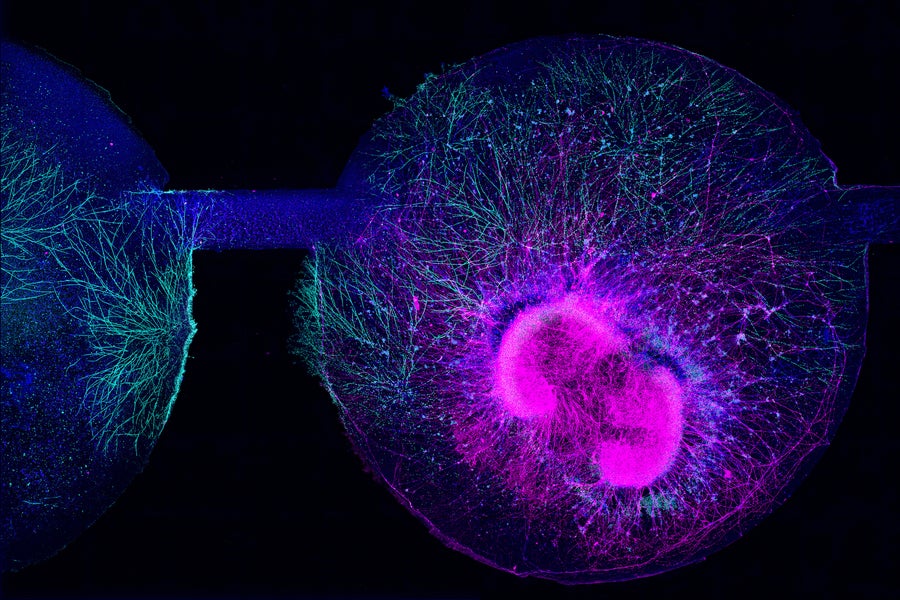
https://static.scientificamerican.com/dam/m/1774977d8a31ddb6/original/brain-organoid.jpg?m=1758909843.8&w=900

Confocal light micrograph of a synaptic conjugation between three-dimensional (3D) human embryonic stem cell (hESC)-derived brain organoids grown on an organ-on-chip (OOC) system. An OOC is a multi-channel 3D microfluidic cell culture. Organoids are miniature, simplified versions of organs grown in the laboratory. These organoids are being grown to study neural tube formation and neuronal development.  Arthur Chien/Science Source

.

.

Click the link below for the complete article:

https://www.scientificamerican.com/article/nih-funds-new-autism-studies-on-genes-and-environment-as-trump-focuses-on/?_gl=1*1clmc1m*_up*MQ..*_ga*MTM5NjE1MzQ4NC4xNzU5NzM2NDY2*_ga_0P6ZGEWQVE*czE3NTk3MzY0NjUkbzEkZzAkdDE3NTk3MzY0NjUkajYwJGwwJGgw

.

__________________________________________

How Entrepreneurs Can Spot Opportunities in Unlikely Place

Leave a comment

Click the link below the picture

.

Key Takeaways

  • Breakthrough ideas rarely follow a straightforward path. They often emerge from connecting unexpected skills and experiences.
  • If you’re looking to apply your skills and past knowledge to new frontiers, you should draw on your background, stay focused on the mission, and curate expertise early.

Most founder stories begin with a business plan, a pitch deck, or a stint in a Silicon Valley accelerator. Mine started in a garage, working as a mechanic before moving into large-scale solar construction. That unconventional path gave me a perspective I believe many entrepreneurs share: The best ideas rarely follow a straightforward path. They come from connecting unexpected skills and experiences. Whether you build in energy, finance or technology, the real opportunity lies in spotting links that others overlook.

As industries evolve, founders are increasingly asked to combine insights from different fields. The next breakthrough can come from anywhere. My story is one version of that pattern: years in construction, side ventures in cycling and crypto, as well as a growing conviction that blockchain and renewable energy could merge into something bigger. The important point is that these connections are available to anyone willing to look for them

NFTs beyond the hype

For me, the clearest connection between seemingly separate paths came in the form of NFTs. They showed how a digital tool could unlock real-world solutions when applied differently.

For many, NFTs are shorthand for speculation and hype. They recall headlines of digital art selling for millions during a bubble, but at their core, NFTs are simply verifiable certificates of ownership. They are secure, transparent and impossible to counterfeit. Those qualities give them value far beyond collectibles.

Renewable energy is a prime example. Historically, solar infrastructure has been locked behind institutional walls. You needed significant capital, specialized contracts, and relationships in a closed network. By linking NFTs to renewable projects, individuals could hold digital certificates that represent direct participation in the infrastructure powering their communities. Instead of being abstract shareholders in a utility, people could have verifiable claims tied to specific assets — be it a solar farm in Spain or a wind project in Japan.

This points to a broader principle for founders: Technologies often outgrow the reputations they start with. Something like NFTs, which were dismissed as frivolous in one context, can become transformative in another. The pattern is common. Artificial intelligence was once a niche academic field before becoming the backbone of entire industries. Cloud computing was once seen as insecure and unreliable, but today no modern business can operate without it. Hype cycles can distract, but they can also be early signals of where long-term value will emerge. Leaders must learn to separate noise from substance and recognize when a tool is finally ready for serious application.

Blockchain as an equalizer

Blockchain itself grew from speculation, but its biggest benefit lies in offering access. Traditional finance and infrastructure projects often operate like exclusive clubs, requiring large amounts of money, insider knowledge, and legal support. Blockchain lowers these barriers. It makes processes transparent, allows direct participation, and removes unnecessary intermediaries.

In renewable energy, that means individuals and small groups can help finance and accelerate the transition alongside corporations and governments. Participation is no longer limited to the few who already sit inside the system. That is the equalizing force blockchain brings — and it is the type of structural change founders should be looking for in their own industries.

Advice for founders

From my own journey, three lessons stand out for anyone looking to apply their expertise to new frontiers:

1. Draw on your background, however unconventional. Skills picked up in unrelated fields often prove essential later. Steve Jobs famously credited a college calligraphy class with shaping the typography of the Macintosh. In my case, running construction sites taught me how to manage risk, coordinate teams, and solve problems under pressure — skills that proved invaluable when I later moved into blockchain. Founders often underestimate their own experience, but the truth is that most breakthroughs are not born from a blank slate. They are built on layers of past knowledge, applied in new ways.

2. Stay focused on the mission. Every industry has hype cycles, but blockchain is especially noisy. New tokens, fads, and shortcuts appear daily. The temptation to chase quick wins is strong, but they rarely build lasting businesses. Innovation requires a clear mission and the patience to execute it. Founders who withstand the noise are those who anchor themselves to a long-term vision. That discipline not only creates stronger companies, but it also builds credibility with partners, regulators, and investors who are looking for stability in a volatile field.

3. Curate expertise early. Great founders are not experts in everything; they are curators of expertise. To bring my project to life, I brought in specialists from day one. Identifying gaps early and filling them before they become roadblocks is essential. It saves time, prevents costly mistakes, and accelerates execution. The best founders see themselves less as lone visionaries and more as architects — assembling the right team and letting them excel in their respective domains.

.

Entrepreneur

.

.

Click the link below for the complete article:

https://www.entrepreneur.com/growing-a-business/how-entrepreneurs-can-spot-opportunities-in-unlikely-places/497258

.

__________________________________________

On the ‘S.N.L.’ Season Premiere, Trump Warns: ‘Daddy’s Watching’

Leave a comment

Click the link below the picture

.

How will the renewed scrutiny of late-night comedy affect “Saturday Night Live,” its approach to political satire and its lampooning of the Trump administration? Judging from the 51st season premiere of “S.N.L.,” the answer so far is: not much.

“S.N.L.” began its new season this weekend in customary fashion, with a sketch that featured the cast member James Austin Johnson in his recurring role as President Trump.

This time, he was interrupting a speech by Defense Secretary Pete Hegseth to warn that he was “keeping my eye on ‘S.N.L.,’ making sure they don’t do anything too mean about me,” and to remind them: “Daddy’s watching.”

Should you need a refresher, a few things happened during the “S.N.L.” offseason: the show parted ways with five of its cast members, including longtime performers like Heidi Gardner and Ego Nwodim, and it hired five new featured players, among them the comedian Kam Patterson and Ben Marshall, a creator and star of its Please Don’t Destroy videos.

Bad Bunny, the season premiere host, was announced as the Super Bowl LX halftime show headliner, drawing the ire of government officials like Kristi Noem, the secretary of homeland security, who said that “ICE enforcement” would attend the Super Bowl and would be “all over” the event.

And — oh yes — the category of late-night TV comedy became unexpectedly volatile: In July, CBS announced that “The Late Show With Stephen Colbert” would go off the air next May, citing economic factors. And Disney pulled the ABC late-night show “Jimmy Kimmel Live!” for a few broadcasts in September, amid controversy over remarks that Kimmel made on the show about the fatal shooting of Charlie Kirk, the right-wing activist.

“S.N.L.” addressed some of these controversies in its opening sketch, in which the Weekend Update co-anchor Colin Jost played Secretary Hegseth, speaking to U.S. military officers at Marine Corps Base Quantico in Northern Virginia. (“Thanks to failed liberal policies, our Army has never been gayer,” Jost said in his speech. “And yet, it’s also never been fatter. Make that make sense.”)

Jost’s lecture was soon overtaken by Johnson, who declared that “S.N.L.” had “better be careful, because I know late-night TV like the back of my hand.” As he said this, Johnson turned over his hand to show what looked like a bruise noticeably disguised by makeup.

“Not looking great right now,” he said, quickly clasping that hand with the other. “Oops! Don’t look at that. Gonna cover this up for the rest of my life.” Johnson also warned that “S.N.L.” would have to be on its “best behavior” or else it would have to answer to his “attack dog,” the F.C.C. chairman, Brendan Carr. (Mikey Day played Carr in a brief appearance, boogieing onto the stage to Rockwell’s “Somebody’s Watching Me.”)

As its 51st season got underway, Johnson said that “S.N.L.” should have “called it at 50, right?”

“It’s so sad to see something get old and confused and yet still demand your constant attention,” he said. “Oh well.”

Bad Bunny (who was also the musical guest of the “S.N.L.” season finale in May) used his own opening monologue to comment on his recent three-month residency in San Juan and the announcement that he would be performing at the Super Bowl halftime show. “I’m very happy and I think everyone is happy about it,” he said. “Even Fox News.” He then played a montage of Fox News hosts whose words had been edited together to say, “Bad Bunny is my favorite musician, and he should be the next president.”

Speaking to the audience in Spanish at one point, Bad Bunny said in part that his Super Bowl gig was exciting “to all the Latinos and Latinas in the whole world” and marked a milestone that no one could take away or erase.

.

https://static01.nyt.com/images/2025/10/05/arts/05CUL-SNL-RECAP-PIX1/05CUL-SNL-RECAP-PIX1-jumbo.png?quality=75&auto=webp

James Austin Johnson, returning as President Trump and stealing the spotlight from Defense Secretary Pete Hegseth (Colin Jost), who was lecturing a gathering of generals and admirals.Credit…NBC Universal, via YouTube

.

.

Click the link below for the complete article:

https://www.nytimes.com/2025/10/05/arts/television/snl-recap-bad-bunny-kpop-demon-hunters.html

.

__________________________________________
King Dakodonou, Reigned Early Kingdom of Dahomey 1620-1645, Present-Day Benin

Leave a comment

King Dakodonou, Reigned Early Kingdom of Dahomey 1620-1645, Present-Day Benin

White Louisiana Official Denies Marriage License for Interracial Couple

Leave a comment

White Louisiana Official Denies Marriage License for Interracial Couple

Older Entries Newer Entries

Amor Entre Estrellas

¡Bienvenido de vuelta viajero!

Heart of Loia `'.,°~

so looking to the sky ¡ will sing and from my heart to YOU ¡ bring...

Michael Ciullo

CEO and Founder of Nsight Health

MRS. T’S CORNER

https://www.tangietwoods

Nelson MCBS

Catholic News, Prayers, HD Images, Rosary, Music, Videos, Holy Mass, Homily, Saints, Lyrics, Novenas, Retreats, Talks, Devotionals and Many More

Global geopolitics

Decoding Power. Defying Narratives.

Talk Photo

A creative collaboration introducing the art of nature and nature's art.

Movie Burner Entertainment

The Home Of Entertainment News, Reviews and Reactions

Le Notti di Agarthi

Hollow Earth Society

C r i s t i a n a' s Fine Arts ⛄️

•Whenever you are confronted with an opponent, conquer him with love.(Gandhi)

TradingClubsMan

Algotrader at TRADING-CLUBS.COM

Comedy FESTIVAL

Film and Writing Festival for Comedy. Showcasing best of comedy short films at the FEEDBACK Film Festival. Plus, showcasing best of comedy novels, short stories, poems, screenplays (TV, short, feature) at the festival performed by professional actors.

Bonnywood Manor

Peace. Tranquility. Insanity.

Warum ich Rad fahre

Take a ride on the wild side

Madame-Radio

Découvre des musiques prometteuses (principalement) dans la sphère musicale française.

Ir de Compras Online

No tiene que Ser una Pesadilla.

Kana's Chronicles

Life in Kana-text (er... CONtext)

Cross-Border Currents

Tracking money, power, and meaning across borders.

Jam Writes

Where feelings meet metaphors and make questionable choices.

emotionalpeace

Finding hope and peace through writing, art, photography, and faith in Jesus.

WearingTwoGowns.COM

The Community for Wounded Healers: Former Medical Students, Disabled Nurses, and Faith-Fueled Pivots

...

love each other like you're the lyric to their music

Luca nel laboratorio di Dexter

Comprendere il mondo per cambiarlo.

Tales from a Mid-Lifer

Mid-Life Ponderings

Creative

Travel,Tourism, Life style "Now in hundreds of languages for you."

freedomdailywriting

I speak the honest truth. I share my honest opinions. I share my thoughts. A platform to grow and get surprised.

The Green Stars Project

User-generated ratings for ethical consumerism

Cherryl's Blog

Travel and Lifestyle Blog

Sogni e poesie di una donna qualunque

Questo è un piccolo angolo di poesie, canzoni, immagini, video che raccontano le nostre emozioni

My Awesome Blog

“Log your journey to success.” “Where goals turn into progress.”

pierobarbato.com

scrivo per dare forma ai silenzi e anima alle storie che il mondo dimentica.

Thinkbigwithbukonla

“Dream deeper. Believe bolder. Live transformed.”

Vichar Darshanam

Vichar, Motivation, Kadwi Baat ( विचार दर्शनम्)

Komfort bad heizung

Traum zur Realität

Chic Bites and Flights

Savor. Style. See the world.

ومضات في تطوير الذات

معا نحو النجاح

Broker True Ratings

Best Forex Broker Ratings & Reviews

Blog by ThE NoThInG DrOnEs

art, writing and music by James McFarlane and other musicians

fauxcroft

living life in conscious reality

Srikanth’s poetry

Freelance poetry writing

JupiterPlanet

Peace 🕊️ | Spiritual 🌠 | 📚 Non-fiction | Motivation🔥 | Self-Love💕