Home

How Trump and His Advisers Miscalculated Iran’s Response to War

Leave a comment

Click the link below the picture

.

On Feb. 18, as President Trump weighed whether to launch military attacks on Iran, Chris Wright, the energy secretary, told an interviewer he was not concerned that the looming war might disrupt oil supplies in the Middle East and wreak havoc in energy markets.

Even during the Israeli and U.S. strikes against Iran last June, Mr. Wright said, there had been little disruption in the markets. “Oil prices blipped up and then went back down,” he said. Some of Mr. Trump’s other advisers shared similar views in private, dismissing warnings that — the second time around — Iran might wage economic warfare by closing shipping lanes carrying roughly 20 percent of the world’s oil supply.

The extent of that miscalculation was laid bare in recent days, as Iran threatened to fire at commercial oil tankers transiting the Strait of Hormuz, the strategic choke point through which all ships must pass on their way out of the Persian Gulf. In response to the Iranian threats, commercial shipping has come to a standstill in the Gulf, oil prices have spiked, and the Trump administration has scrambled to find ways to tamp down an economic crisis that has triggered higher gasoline prices for Americans.

The episode is emblematic of how much Mr. Trump and his advisers misjudged how Iran would respond to a conflict that the government in Tehran sees as an existential threat. Iran has responded far more aggressively than it did during last June’s 12-day war, firing barrages of missiles and drones at U.S. military bases, cities in Arab nations across the Middle East, and on Israeli population centers.

U.S. officials have had to adjust plans on the fly, from hastily ordering the evacuation of embassies to developing policy proposals to reduce gas prices.

After Trump administration officials gave a closed-door briefing to lawmakers on Tuesday, Senator Christopher S. Murphy, Democrat of Connecticut, said on social media that the administration had no plan for the Strait of Hormuz and did “not know how to get it safely back open.”

Inside the administration, some officials are growing pessimistic about the lack of a clear strategy to finish the war. But they have been careful not to express that directly to the president, who has repeatedly

declared that the military operation is a complete success.

Mr. Trump has laid out maximalist goals like insisting that Iran name a leader who will submit to him, while Secretary of State Marco Rubio and Defense Secretary Pete Hegseth have described narrower and more tactical objectives that could provide an off-ramp in the near term.

Karoline Leavitt, the White House press secretary, said the administration “had a strong game plan” before the war broke out, and vowed that oil prices would drop after it ended.

“The purposeful disruption in the oil market by the Iranian regime is short term, and necessary for the long-term gain of wiping out these terrorists and the threat they pose to America and the world,” she said in a statement.

This article is based on interviews with a dozen U.S. officials, who asked for anonymity to discuss private conversations.

Mr. Hegseth acknowledged on Tuesday that Iran’s ferocious response against its neighbors caught the Pentagon somewhat off guard. But he insisted that Iran’s actions were backfiring.

“I can’t say that we anticipated necessarily that’s exactly how they would react, but we knew it was a possibility,” Mr. Hegseth said at a Pentagon news conference. “I think it was a demonstration of the desperation of the regime.”

Mr. Trump has displayed growing frustration over how the war is disrupting the oil supply, telling Fox News that oil tanker crews should “show some guts” and sail through the Strait of Hormuz.

Some military advisers did warn before the war that Iran could launch an aggressive campaign in response, and would view the U.S.-Israeli attack as a threat to its existence. But other advisers remained confident that killing Iran’s senior leadership would lead to more pragmatic leaders taking over who might bring an end to the war.

When Mr. Trump was briefed about risks that oil prices could rise in the event of war, he acknowledged the possibility but downplayed it as a short-term concern that should not overshadow the mission to decapitate the Iranian regime. He directed Mr. Wright and Treasury Secretary Scott Bessent to work on developing options for a potential spike in prices.

But the president did not speak publicly about these options — including political risk insurance backed by the U.S. government, and the potential of U.S. Navy escorts — until more than 48 hours after the conflict started. The escorts have not yet taken place.

Mr. Wright, the energy secretary, caused a market commotion Tuesday when he posted on social media that the Navy had successfully escorted an oil tanker through the Strait of Hormuz. His post drove up stocks and reassured oil markets. Then, when he deleted the post after administration officials said no escorts had taken place, markets were once again thrust into turmoil.

Efforts to resume shipments have been complicated by intelligence that Iran was preparing to lay mines in the strait, one U.S. official said. The Iranian operation was only in its earliest stages, but the preparatory efforts spooked the Trump administration. The U.S. military said on Tuesday evening that its forces had attacked 16 Iranian mine-laying vessels near the strait.

As the conflict has roiled global markets, Republicans in Washington have grown concerned about rising oil prices damaging their efforts to sell an economic agenda to voters ahead of the midterm elections.

Mr. Trump, both publicly and privately, has been arguing that Venezuelan oil could help solve any shocks coming from the Iran war. The administration announced on Tuesday a new refinery in Texas that officials said could help increase oil supply, ensuring that Iran does not cause any long-term damage to oil markets.

The confidence that White House officials had that the shipping lanes could stay open is surprising given that Mr. Trump authorized a military campaign last year against the Houthis, a Yemeni group backed by Iran, that had used missile and drone attacks to bring maritime commerce in the Red Sea to a halt.

In a social media post last March announcing he had authorized military strikes against the Houthis, Mr. Trump said that the attacks had cost the global economy billions of dollars, and that “no terrorist force will stop American commercial and naval vessels from freely sailing the Waterways of the World.”

But since the start of the war in Iran, Mr. Trump has not offered a consistent message. In private, his aides have said they feel frustration over his lack of discipline in communicating the objectives of the military campaign to the public.

Mr. Trump has said both that the war could go on for more than a month and that it was “very complete, pretty much.” He also said the United States would “go forward more determined than ever.”

Mr. Rubio and Mr. Hegseth, however, appear to have coordinated their messaging for now on three discrete goals that they began laying out in public remarks on Monday and Tuesday.

“The goals of this mission are clear,” Mr. Rubio said at a State Department event on Monday before Mr. Trump held his own news conference. “It is to destroy the ability of this regime to launch missiles, both by destroying their missiles and their launchers; destroy the factories that make these missiles; and destroy their navy.”

The State Department even laid out the three goals in bullet-point fashion, and highlighted a video clip of Mr. Rubio stating them on an official social media account.

The presentation by Mr. Rubio, who is also the White House national security adviser, appeared to be setting the stage for the president to bring an end to the war sooner rather than later. In his news conference, Mr. Trump boasted of how the U.S. military had already destroyed Iran’s ballistic missile capability and its navy. But he also warned of even more aggressive action if Iranian leaders tried to cut off the world’s energy supply.

Matthew Pottinger, who was a deputy national security adviser in the first Trump administration, said in an interview that Mr. Trump had indicated he could decide to pursue ambitious war goals that would take weeks at least.

“In his press conference, I could hear him circling back to a rationale for fighting a bit longer given that the regime is still signaling it won’t be deterred and is still trying to control the Strait of Hormuz,” said Mr. Pottinger, now the chair of the China program at the Foundation for Defense of Democracies, a group that advocates a close U.S. partnership with Israel and confrontation with Iran.

“He doesn’t want to have to fight a ‘sequel’ war,” Mr. Pottinger added.

The search for pathways out of the war has gained urgency since the weekend, as global oil prices surge and as the United States burns through costly munitions. Pentagon officials said in recent closed-door briefings on Capitol Hill that the military used up $5.6 billion of munitions in the first two days of the war alone, according to three congressional officials. That is a far larger amount and munitions burn rate than had been publicly disclosed. The Washington Post reported on the figure on Monday.

Iranian officials have remained defiant, saying they will use their leverage over the world’s oil supply to force the United States and Israel to blink.

“Strait of Hormuz will either be a Strait of peace and prosperity for all,” Ali Larijani, Iran’s top national security official, said in a social media post on Tuesday. “Or it will be a Strait of defeat and suffering for warmongers.”

.

https://static01.nyt.com/images/2026/03/10/multimedia/10dc-iran-planning-hmpg/10dc-iran-planning-hmpg-jumbo.jpg?quality=75&auto=webpIn response to Iranian threats, commercial shipping has come to a standstill in the Gulf, and oil prices have spiked. Credit…Benoit Tessier/Reuters

.

.

Click the link below for the complete article:

https://www.nytimes.com

.

__________________________________________

#11 Black History Photo (Between 1860-1870)

Leave a comment

#11 Black History Photo (Between 1860-1870)

True me.. Tap-2431..

Leave a comment

You cannot harvest a garden you haven’t planted. If you want a peaceful life, you must first plant the seeds of kindness toward yourself. We spend so much energy trying to fix the external “output” of our lives while ignoring the “input” of our inner dialogue. Peace is a slow-growing plant; it requires the consistent […]

True me.. Tap-2431..

Quote of the Day: Calm

Leave a comment

Today’s Quote of the Day from The Sage reflects on quarrels and the power of calmness. By staying as cool as a cucumber, many arguments quickly lose their heat and reveal themselves as unimportant. A gentle reminder that clarity and composure often resolve conflict far better than anger ever can.

Quote of the Day: Calm

THE HOUSEMAID (2025) – My rating: 8.5/10

Leave a comment

The Housemaid is an erotic psychological thriller film directed by Paul Feig. It is based on the 2022 novel by Freida McFadden. The film follows a young woman with a troubled past who becomes the live-in maid for a wealthy family whose household hides dark secrets. The Housemaid premiered at the Axa Equitable Center in […]

THE HOUSEMAID (2025) – My rating: 8.5/10

Mumps infections reveal that vaccine-preventable illnesses are resurging in the U.S.

Leave a comment

Click the link below the picture

.

Mumps is back. The viral respiratory infection has been detected in at least 34 people across 11 U.S. states, according to the most recent Centers for Disease Control and Prevention data. And at least one state, Maryland, has issued an alert about the disease, which has caused at least 26 reported cases in the state as of February 19, CNN reported.

Mumps, which causes painful mouth swelling, is preventable with two doses of the measles, mumps, and rubella (MMR) vaccine. But vaccination rates in children have fallen as antivaccine sentiment has grown in the wake of the COVID pandemic, leading to a massive spike in measles outbreaks in the past year.

Mumps infects the salivary glands below the ears. The virus spreads via respiratory droplets and saliva through coughing, sneezing, talking, or sharing eating utensils. It can take two to four weeks for people to show symptoms after they are infected. Aside from the jaw swelling, mumps can cause other viral symptoms, such as fever, headache, and muscle ache. While children tend to have either mild disease or even no symptoms at all, in teenagers and adults, mumps tends to be more severe. There is no specific treatment for mumps, but rest, hydration, and pain relievers such as ibuprofen can help people recover.

One of the most painful complications of mumps is orchitis, or swelling of the testicles, which can harm fertility. The disease can also cause oophoritis or mastitis, which respectively mean inflammation in the ovaries or breasts. In rare cases, mumps can also result in meningitis—inflammation of the lining of the brain and spinal cord—or encephalitis, which is inflammation of the brain itself. Additionally, the illness can cause permanent hearing loss. Unvaccinated individuals are both more likely to be infected with mumps and more likely to have complications from the virus.

Since the first mumps vaccine came out in 1967, there has been a 99 percent decrease in cases of the disease in the U.S. But it still causes outbreaks, especially in places where people are in close contact, such as in schools, universities, and prisons.

To protect against mumps, children are recommended to receive two doses of the MMR vaccine, the first at 12 to 15 months of age and the second at four to six years old. Two doses are 86 percent effective at preventing mumps; a single dose is 72 percent effective. Vaccinated people can still get infected, especially as immunity from the shots wanes over time, but if they do, they typically have a milder infection.

.

https://static.scientificamerican.com/dam/m/764070fc74d393f2/original/GettyImages-2216284321_resized.jpeg?m=1772818038.155&w=900

Illustration of the human mumps virus, a member of the Paramyxoviridae family. RUSLANAS BARANAUSKAS/SCIENCE PHOTO LIBRARY/Getty Images

.

.

Click the link below for the complete article:

https://www.scientificamerican.com/article/mumps-infections-reveal-that-vaccine-preventable-illnesses-are-resurging-in/

.

__________________________________________

The Four House Democrats Who Voted Against the War Powers Resolution to Rein in Trump on Iran

Leave a comment

Click the link below the picture

.

Four Democrats split from the rest of their party to vote down the War Powers Resolution, which would have halted President Donald Trump from continuing strikes against Iran without first gaining Congressional approval.

Much like it was in the Senate the day before, the measure was defeated in the Republican-led House of Representatives Thursday evening with a 212-219 vote.

With voting largely representing party lines, all but two GOP lawmakers moved against the measure—Representatives Thomas Massie of Kentucky, a lead sponsor of the resolution, and Warren Davidson of Ohio.

“The Constitution is clear… Our Constitution provides Congress initiatory powers of war,” said Massie during a rousing debate on the House floor. Massie has broken ranks from President Donald Trump and strayed from party lines on other key topics, such as the row over Greenland, often earning him the wrath of the Commander-in-Chief.

However, it’s arguably the Democrat votes that have garnered the most discussion. 

Some Democratic members of the House who had previously stated an intention to vote against the War Powers Resolution, which was first introduced by Massie and Democrat Ro Khanna of California in June last year, reversed course. The impact of Trump joining forces with Israel last weekend to launch surprise strikes on Iran and the widening war that has since emerged prompted some to change their position.

“When it appeared we might preemptively vote on the War Powers Resolution while the U.S. and Iran were in the middle of negotiations, I said I would be a ‘no’ vote because I believed that calling up the resolution at that time could undermine negotiations and telegraph to the Ayatollah that we weren’t applying maximum pressure and that he could delay a deal,” Rep. Jared Moskowit z of Florida said as he explained his change of heart. “A lot has changed in a week.”

While Moskowitz argued that “no one will miss” Iran’s Supreme Leader Ali Khamenei, who was killed in early strikes, and implored that Iran must be prohibited from ever having a nuclear weapon, he pointed to mounting concern over the lack of Congressional oversight.

“Over the last year, we have seen a ludicrous increase in the speed of Congress’ abdication of authority to the Executive Branch,” he argued. “We must begin to claw back that prerogative. We must reestablish our Article I authority, which grants Congress all legislative powers.”

Rep. Josh Gottheimer also changed course by voting to pass the resolution, voicing concern over, what he described as, the lack of a “coherent explanation of what precipitated this war.”

“What I have heard publicly and in classified briefings are shifting justifications and objectives from Administration officials and the President,” he said, adding that he hopes his questions will be answered in the coming weeks, ahead of the next vote during the week of March 23.

But four Democratic lawmakers did vote against the War Powers Resolution on Thursday, defying party leadership. Here’s who they are—and the reasons they offered for their votes:

Rep. Jared Golden of Maine

Rep. Jared Golden, who serves on the House Armed Services Committee, the Seapower and Projection Forces Subcommittee, and the Intelligence and Special Operations Subcommittee, has voted in favor of the Trump Administration’s position in a few recent votes. In February, he voted against a proposal from his party colleague to block Trump’s tariffs on Canada, the only Democrat to do so. He also voted last November against the majority of his party to end the record-long government shutdown.

Golden once again went against party lines on Thursday, instead sponsoring an alternative resolution alongside Rep. Gottheimer that would give Trump a 30-day window (instead of the current 60 days he has to make his case for ongoing operations) to end military action.

“The President has not provided sufficient clarity for why this action was necessary at this exact moment. But servicemembers are actively engaged in hostilities, our allies are under attack, and the Iranian regime is more desperate than ever to reassert its power,” said Golden, in a statement released after the vote.

“While I do not believe that an abrupt about-face is a good course of action given the reality on the ground, that should not be construed as my approval. While conflict requires that we remain flexible to shifting circumstances, at this time I would not support Congressional authorization or funding for sustained combat operations.”

Golden argued that Trump has “so far acted within the authorities given to him by Congress through the War Powers Act of 1973,” but warned that could change. “This is not an illegal war—but it could become one,” he said.

Rep. Greg Landsman of Ohio

Rep. Greg Landsman co-sponsored the alternative measure put forward by his colleagues, but also voted against the War Powers Resolution.

He was critical of the Trump Administration’s attack on Iran, alongside Israel, but argued that the current operation still needs to be concluded. 

“I think it’s important to say, look, this is not good policy. What’s better policy is to allow the military and our allies to finish this particular operation, which is targeted, just the missiles, the launchers, and the ships. That’s it. And then be done,” he told C-SPAN.

Rep. Henry Cuellar of Texas

Rep. Henry Cuellar, in a statement shared with TIME, said he voted no on the resolution because he believes “Congress must exercise oversight responsibly while ensuring our military can protect American lives and interests.”

“I’m supporting a more responsible approach that provides clear oversight and stability. That’s why I helped introduce legislation that directs the President to end military action within 30 days unless Congress provides authorization,” he added, highlighting his support of the alternative resolution.

Cuellar emphasized he does not support an “endless war” and said Congress has a responsibility to “ensure that the use of military force is carefully reviewed, limited in scope, and guided by clear objectives.”

It isn’t the first time Cuellar has moved against the majority of his party, as he previously voted alongside many Republicans to end the government shutdown in November.

Rep. Juan Vargas of California

Rep. Juan Vargas voted against the resolution, in a move that set him aside from other San Diego representatives such as Scott Peters, Sara Jacobs, and Mike Levin, who all moved to rein in Trump’s military action in Iran.

Vargas has not yet released a statement detailing his vote, nor has he expressed support for the alternative war powers resolution.

.


House Of Representatives Votes On War Powers ResolutionAnna Moneymaker—Getty Images

.

.

Click the link below for the complete article:

https://time.com/7382846/democrats-who-voted-against-war-powers-resolution-iran-conflict-trump/

.

__________________________________________

Unlike in Past Conflicts, Most Americans Oppose Iran Attacks

Leave a comment

Click the link below the picture

.

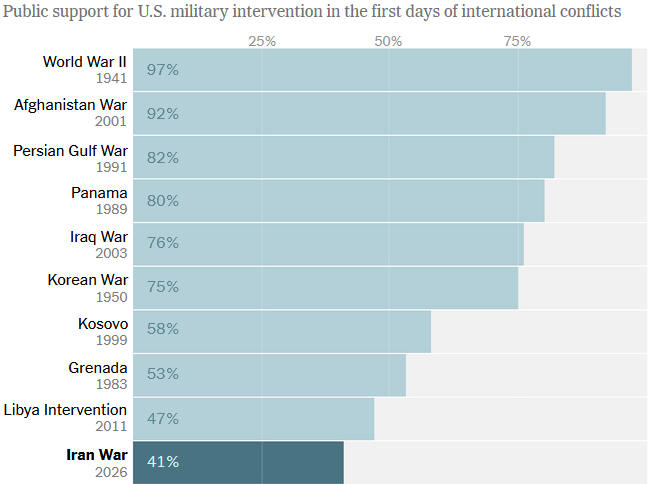
In the days after President Trump launched U.S. forces in an attack against Iran, support for the strikes is far lower than what it has been at the beginnings of previous foreign conflicts.

So far, polls have found that most Americans oppose the Iran attacks. Support ranges from 27 percent in a Reuters/Ipsos poll to 50 percent in a Fox News poll. The wide variation suggests that public opinion is still taking shape as more Americans learn details of the attacks and the aftermath.

But even the highest level of public support for this conflict falls far lower than that at the start of most other conflicts, including World War II, the Korean War, and the Iraq War.

In the days after the United States was attacked at Pearl Harbor and subsequently declared war against Japan, 97 percent of the public supported the move, according to Gallup. And in the days after President George W. Bush put troops on the ground in Afghanistan, 92 percent of Americans were on board in a Gallup poll.

As unpopular as the Iraq War ultimately became, 76 percent of Americans approved of the decision to go to war in a poll taken the day after the conflict began.

A part of this difference in support, said Sarah Maxey, an associate professor of international relations at Loyola University of Chicago, is the way previous presidents have taken the time to sell wars to the public.

“Before the Iraq War in 2003, we had a whole year of why this mattered, why we exhausted other operations, why we needed this,” said Ms. Maxey, who studies public opinion around war and foreign conflicts. “We have not had many foreign conflicts without a clear communication strategy beforehand.”

But there are also larger forces at play.

At the beginning of wars, presidents typically experience what researchers call the “rally around the flag effect,” where support swells, even among those who otherwise disapprove of the president.

As polarization has grown over the last 30 years and Americans have drifted further apart politically, that effect has diminished.

“People from the opposing party of the president have been the source of most of the rally, but Democrats are not going to rally behind Trump,” said Matthew Baum, a professor at Harvard University who studies public opinion on foreign policy.

“For this president, to the extent that he has any rally from his base, he has a base who thinks they hired him to get him out of wars,” he added.

Support for wars typically wanes over time, as casualties increase and Americans start to feel the costs of war.

Near the start of the Vietnam War, a 60 percent majority of Americans did not see the war as a mistake. But as the number of casualties grew, so did the public’s doubts. By 1969, a majority of the public said the war was a mistake. That number continued to grow as the war went on. (There is no polling on public approval of the Vietnam War at the start of the conflict.)

Popular sentiment about the Iraq War plummeted soon after it began, with just 43 percent of Americans supportive of the war by the end. That drop in support, though, occurred across both parties.

But long gone are the days of a unified national front.

“To the extent that politics used to stop at the water’s edge, that’s no longer the case,” Mr. Baum said.

.

.

.

Click the link below for the complete article:

https://www.nytimes.com/2026/03/10/us/politics/polls-wars-us-support.html

.

__________________________________________

#10 Black History Photo (1860-1870)

Leave a comment

#10 Black History Photo (1860-1870)

It’s time to speak out against the unchecked growth of satellite mega constellations

Leave a comment

Click the link below the picture

.

I remember the first time I saw a satellite. I was a teenager, standing in my mildly light-polluted suburban yard and doing my usual stargazing. The satellite was a faint “star” moving slowly and smoothly across the sky, and as I watched it, I felt a mix of awe and wonder that such a thing could be seen—and that humans could put an object into orbit at all.

That was a lifetime ago, and I now look back on that evening with more discomfiture than nostalgia; my adolescent naivete feels almost embarrassing.

That’s because, these days, seeing one of those celestial travelers fills me with dread. We are firmly in the era of the satellite constellation—groups of dozens of similar satellites—and are currently entering the era of the mega constellation, wherein groups of thousands of satellites swarm the skies. The clusters of satellites started small, but, like a viral outbreak, they grew almost without us noticing—and now we’re dealing with a pandemic.

I wrote about this problem for Scientific American in May 2023. At the time, there were 7,500 active satellites orbiting Earth; more than half of them were SpaceX Starlink satellites that provided Internet service. In a little under three years, the number of just Starlink satellites in orbit has reached nearly 10,000. Today, there are literally more Starlink satellites up there than the sum total of all other operational satellites.

This ratio will almost certainly get more skewed toward Starlink, too; back in 2019, when the first Starlink satellites were launched, SpaceX filed with the Federal Communications Commission (FCC) for up to 30,000 additional satellites.

Does that sound bad? Well, there may come a day, all too soon, when we’re nostalgic for such a small a number of satellites cluttering the sky. On January 30, 2026, SpaceX filed for permission to launch as many as one million more satellites.

Yes, one million.

SpaceX’s plan is for this sprawling mega constellation to become a distributed network operating as an orbital data center, similar to ground-based data centers that provide the information processing backbone of the Internet. In this case, instead of having equipment capable of all that processing power stored in massive warehouses, each satellite in orbit would do a small part of the number crunching and then beam the final results back to the ground.

In principle, such plans could ease the insatiable power demands and environmental effects of ground-based centers. In 2023, data centers in just the U.S. consumed a staggering 176 million megawatt-hours of energy—a little more than 4 percent of the nation’s annual electricity usage and enough to power 16 million homes for a year. Many of these centers are powered by fossil fuels that add greenhouse gases into the atmosphere that worsen global warming. These centers also need to be cooled, and they typically consume vast amounts of water to do so. And as the use of computationally-intensive artificial intelligence soars, so, too, will the appetite for ever more power—and the potential for ever greater environmental harm.

Exporting most of that “compute” to orbit, SpaceX claims, is how to break this vicious cycle. And there is some truth to that: the satellites will be solar powered, easing the electricity demand on Earth. They also won’t need water to cool their hot chips but will instead rely on large radiators to vent heat—a slower, less efficient method, but the best one available in the near-vacuum of space. Currently in-use Starlink satellites already cool themselves this way, and the heat load for a satellite used to process data would be roughly the same as one used to provide Internet, so this isn’t the showstopper problem many people assume it to be.

So, if you don’t look too deep, large-scale orbital data centers might make sense. Scratching the surface of this idea, however, shows just how colossally terrible it is.

First, those satellites need to get to space. As astrophysicist Jonathan McDowell, my friend and colleague, points out, SpaceX claims that its Starship rocket can (once it passes testing) take 150 metric tons to low-Earth orbit, but there are good reasons to think the real operational capacity will prove be more like 100 metric tons. Assuming that low-Earth orbit is in fact where all the satellites will go (and many will undoubtedly need to fly higher), and that they each are two metric tons, that means Starship can launch around 50 satellites at a time—so creating this mega constellation even under very optimistic assumptions would require some 20,000 Starship launches.

It gets worse: these satellites will fail after a few years and will need to be replaced. In the end, upkeep for this notional million-satellite mega constellation could take on the order of 10 Starship launches per day, forever.

The environmental effect of all this wouldn’t be trivial. A single Starship launch emits 76,000 metric tons of carbon dioxide equivalent, for example, leaving aside issues of noise pollution and potential damage to nearby habitats. Twenty thousand launches would have an immense effect, including more damage to our critical ozone layer. The fiery atmospheric reentries of satellites would be a source of pollution, too, dumping significant amounts of vaporized metal and plastic into our planet’s fragile upper atmosphere. At least one Starlink satellite is already burning up like this every day, based on when these satellites started entering orbit, and their planned replacement cycles—and orbital data centers could make this reentry rate skyrocket.

As if this weren’t enough, a proliferation of mega constellations also carries risks for the orbital environment itself. The volume of satellites already over our head is huge, but the numbers of proposed satellites are so vast that space traffic management to avoid collisions would become an even more massive task. Even a single collision in orbit can become catastrophic; these satellites are moving at speeds many times faster than a rifle bullet, and a direct hit from one creates a cloud of shrapnel. That debris spreads, hitting other satellites and creating even more debris, resulting in a violent cascade called the Kessler syndrome. Triggering this syndrome is already a real concern, despite orbital decay naturally “cleaning” low-Earth orbit over time. Increasing the numbers of satellites by several thousandfold could make this threat apocalyptically worse.

And as an astronomer, I can’t help but worry over the effect on my beloved field. A study published last December in Nature showed that if there were roughly half a million satellites in orbit, at least one would contaminate essentially every observation taken by the Hubble Space Telescope. Ground-based telescopes would also be severely affected; they already are now! Vaporized debris from reentries will also add to sky glow, making it more difficult to see faint cosmic objects. Even simple stargazing from your backyard would be affected. In a very real sense, by launching so many satellites, we risk losing the sky.

Keep in mind that SpaceX is not the only one crowding the sky. China has filed to launch 200,000 satellites for its own network. Other countries and companies will no doubt follow suit; Amazon and Blue Origin already plan on launching thousands of satellites each as well. Even more concerning is a new company, called Reflect Orbital, that wants to launch thousands of giant space mirrors into orbit to provide “sunlight on demand” anywhere on Earth. The beams would be far brighter than the full moon and, even if carefully pointed, would scatter in the atmosphere to be very bright off-beam, disrupting wildlife and effectively destroying the sky’s remaining natural beauty by erasing the stars from our sight. These mirrors are a truly terrible idea.

That’s the common theme here, in fact. Even ignoring the deeply disturbing environmental and light pollution from all these launches and reentries, there is another effect. Our night sky—and it is ours—is a natural wonder, a cosmic park we need to preserve, not exploit with a laissez-faire attitude. This careless exploitation of the heavens above is a real danger to us all.

.

https://static.scientificamerican.com/dam/m/2ee5a500a54116fc/original/2XCRY0H_WEB.jpg?m=1719272145.488&w=900

Light trails from satellites in low-Earth orbit fill the sky in this composite long-exposure photograph, which was captured over a 30-minute period. Alan Dyer/VWPics/Alamy Stock Photo

.

.

Click the link below for the complete article:

https://www.scientificamerican.com/article/rampant-growth-of-satellite-mega-constellations-could-ruin-the-night-sky/

.

__________________________________________

Older Entries Newer Entries

Amor Entre Estrellas

¡Bienvenido de vuelta viajero!

Heart of Loia `'.,°~

so looking to the sky ¡ will sing and from my heart to YOU ¡ bring...

Michael Ciullo

CEO and Founder of Nsight Health

MRS. T’S CORNER

https://www.tangietwoods

Nelson MCBS

Catholic News, Prayers, HD Images, Rosary, Music, Videos, Holy Mass, Homily, Saints, Lyrics, Novenas, Retreats, Talks, Devotionals and Many More

Global geopolitics

Decoding Power. Defying Narratives.

Talk Photo

A creative collaboration introducing the art of nature and nature's art.

Movie Burner Entertainment

The Home Of Entertainment News, Reviews and Reactions

Le Notti di Agarthi

Hollow Earth Society

C r i s t i a n a' s Fine Arts ⛄️

•Whenever you are confronted with an opponent, conquer him with love.(Gandhi)

TradingClubsMan

Algotrader at TRADING-CLUBS.COM

Comedy FESTIVAL

Film and Writing Festival for Comedy. Showcasing best of comedy short films at the FEEDBACK Film Festival. Plus, showcasing best of comedy novels, short stories, poems, screenplays (TV, short, feature) at the festival performed by professional actors.

Bonnywood Manor

Peace. Tranquility. Insanity.

Warum ich Rad fahre

Take a ride on the wild side

Madame-Radio

Découvre des musiques prometteuses (principalement) dans la sphère musicale française.

Ir de Compras Online

No tiene que Ser una Pesadilla.

Kana's Chronicles

Life in Kana-text (er... CONtext)

Cross-Border Currents

Tracking money, power, and meaning across borders.

Jam Writes

Where feelings meet metaphors and make questionable choices.

emotionalpeace

Finding hope and peace through writing, art, photography, and faith in Jesus.

WearingTwoGowns.COM

The Community for Wounded Healers: Former Medical Students, Disabled Nurses, and Faith-Fueled Pivots

...

love each other like you're the lyric to their music

Luca nel laboratorio di Dexter

Comprendere il mondo per cambiarlo.

Tales from a Mid-Lifer

Mid-Life Ponderings

Creative

Travel,Tourism, Life style "Now in hundreds of languages for you."

freedomdailywriting

I speak the honest truth. I share my honest opinions. I share my thoughts. A platform to grow and get surprised.

The Green Stars Project

User-generated ratings for ethical consumerism

Cherryl's Blog

Travel and Lifestyle Blog

Sogni e poesie di una donna qualunque

Questo è un piccolo angolo di poesie, canzoni, immagini, video che raccontano le nostre emozioni

My Awesome Blog

“Log your journey to success.” “Where goals turn into progress.”

pierobarbato.com

scrivo per dare forma ai silenzi e anima alle storie che il mondo dimentica.

Thinkbigwithbukonla

“Dream deeper. Believe bolder. Live transformed.”

Vichar Darshanam

Vichar, Motivation, Kadwi Baat ( विचार दर्शनम्)

Komfort bad heizung

Traum zur Realität

Chic Bites and Flights

Savor. Style. See the world.

ومضات في تطوير الذات

معا نحو النجاح

Broker True Ratings

Best Forex Broker Ratings & Reviews

Blog by ThE NoThInG DrOnEs

art, writing and music by James McFarlane and other musicians

fauxcroft

living life in conscious reality

Srikanth’s poetry

Freelance poetry writing

JupiterPlanet

Peace 🕊️ | Spiritual 🌠 | 📚 Non-fiction | Motivation🔥 | Self-Love💕