
Mable Butler, County First Black American Commissioner, Civil Rights Activist
Assorted human interest posts.
December 11, 2025
December 10, 2025
Business, Food For Thought, Human Interest, Political, Science, Technical amazon, business, Business News, current-events, Future, Hotels, human-rights, medicine, mental-health, research, Science, Science News, technology, Technology News, travel, vacation Leave a comment

Click the link below the picture
.
In 2018, at a Dubai resort next to the blue-green waters of the Persian Gulf, Amin Nasser, CEO of Saudi Aramco, stood before an audience of hundreds of petrochemical executives to set out his vision for the future of the world’s largest oil company. The goals he described weren’t primarily about energy. Instead, he announced plans to pour $100 billion into expanding production of plastic and other petrochemicals.
Nasser predicted that with a growing global population wielding more purchasing power every year, petrochemicals—compounds derived from petroleum and other fossil fuels and of which plastics and their ingredients constitute as much as 80 percent—would drive nearly half of oil-demand growth by mid-century. About 98 percent of virgin plastics are made from fossil fuels. In sectors that include packaging, cars, and construction, he said, “the tremendous growth in chemicals demand provides us with a fantastic window of opportunity.”
In the years since Nasser’s 2018 speech, Saudi Aramco, owned mainly by the government of Saudi Arabia, has acquired a majority stake in the country’s petrochemical conglomerate SABIC. Together, the companies have bought into huge Chinese plastic projects and built petrochemical plants from South Korea to the Texas coast. Aramco aims to turn more than a third of its crude into petrochemicals by the 2030s—a near tripling in 15 years.
Although the industry has framed its plans to pivot to plastic as a response to consumer demand for a material central to modern life, another factor is clearly at play: As the looming dangers of climate change are pushing the world away from fossil fuels, the industry is betting on plastic to protect its profitability. Ramping up plastic and petrochemical output, according to Nasser, will “provide a reliable destination for Saudi Aramco’s future oil production.” As one industry analyst observed of the company’s strategy, “the big picture imperative is to avoid being forced to leave barrels in the ground as demand for transportation fuels declines.”
Even ExxonMobil has acknowledged that electric vehicles’ widespread adoption will probably reduce cars’ need for oil. In one market forecast, the company, already the world’s largest producer of single-use plastics, assured investors that its plans to increase petrochemical production by 80 percent by 2050 will help the industry to pump and sell even more oil at mid-century than it does today.
But there is growing public awareness that all the plastic made for packaging and goods from the absurd to the essential comes at steep costs: the health impacts of the chemicals it contains, the emissions from its production, the mountains of waste that have built up as it is discarded, and the microplastics found everywhere from the most remote corners of the planet to our brains. Some governments have begun enacting legislation, such as bans on certain single-use items, but efforts to deliver more sweeping change hit a wall with the collapse in August of contentious negotiations on a global plastic-pollution treaty. More than 70 nations had pushed for limits on the amount of plastic produced to reduce the flow of waste into the environment. The industry has lobbied heavily against such caps, arguing that improved waste management and recycling are the solution, even though only a small percentage of plastic is currently recycled, and many types cannot be recycled by conventional means.
Companies “know they can’t hold their finger in the dike” of an energy transition, says Judith Enck, a former U.S. Environmental Protection Agency official and president of Beyond Plastics, an advocacy group based at Bennington College. “They have to find a gigantic new market, and they have landed on plastic.”Plastic production has been rising steadily since the end of World War II, when companies poured resources into finding and promoting peacetime uses for a material whose military applications—from nylon parachutes to polyethylene insulation for radar sets—had proved invaluable. Consumers snapped up the flood of new goods and disposable packaging, and the annual output of plastic has climbed from two million metric tons in 1950 to more than 500 million today. A cumulative 8.3 billion metric tons had been produced by 2015, according to a landmark study that was the first to quantify the total amount of plastic created. According to Roland Geyer, an industrial ecologist at the University of California, Santa Barbara, who co-authored the study, the total has since risen past 10 billion metric tons. About three quarters of all that plastic has become waste, Geyer’s team reported: 9 percent was recycled, 12 percent was incinerated, and 79 percent ended up in landfills or the environment. If current trends continue, 1.1 billion metric tons of plastic will be made annually by 2050—and the cumulative total will be enough, Geyer says, to cover the U.S. in an ankle-deep layer.
Today, half of all plastic goes into single-use items, which are often tossed away almost as soon as they’re acquired. A million plastic bottles are purchased each minute, according to the United Nations’ environment agency, and five trillion plastic bags are used every year. In 2016, Americans alone used more than 560 billion plastic utensils and other disposable food-service items.
Plastic, of course, is not just in throwaway packaging. It is a defining, inescapable part of modern life, widely used in construction, clothing, electronic goods, and cars. It plays a key role in health care as a component in gloves, syringes, tubing, and IV bags, not to mention artificial joints, limbs, and hearts. It is also not just one material: there are thousands of types and subtypes, each with its own combination of chemicals that yields desired properties—varying degrees of hard or soft, rigid or flexible, opaque or transparent. One analysis found that 16,000 different chemicals are used in making plastics, including additives such as stabilizers, plasticizers, dyes, and flame retardants. More than 4,000 of those substances pose health or environmental dangers, and safety information was lacking for another 10,000, the researchers estimate.
By design, plastic does not readily decompose. Instead, it fragments into increasingly minuscule pieces—reaching down to the nanoscale—that have been found just about everywhere scientists have looked. They suffuse the air we breathe, the water we drink, and the food we eat. They’ve been detected in blood, semen, breast milk, bone marrow, and placentas. Scientists are only beginning to explore what this omnipresence means for the health of humans and the environment, but the signs are worrying. One recent study found microplastics in tissue from human kidneys, livers, and brains, and a study of 12 dementia patients’ brains showed greater accumulations than those of people without the disease. Other research found the tiny particles in the neck-artery plaque of nearly 60 percent of patients tested; three years later, the rates of heart attacks, strokes, and death were 4.5 times higher among people whose samples contained microplastics.
.
 Ross Woodhall/Getty Images/Image Source
.
.
Click the link below for the complete article:
.
__________________________________________
December 10, 2025
Business, Food For Thought, Human Interest, Political, Science, Technical amazon, business, Business News, current-events, Future, Hotels, human-rights, medicine, mental-health, research, Science, Science News, technology, Technology News, travel, vacation Leave a comment

Click the link below the picture
.
Buying toys this time of year can be so overwhelming. Everywhere you look, there’s some new, must-have toy being shoved in your face, and it’s incredibly hard to quiet the noise. You want to give your kids toys they’re excited about, but so many options means you’re bound to give them gifts that they are bored with 36 hours after opening the box. This year’s Romper Toy Box is all about toys that are made to last. Some are heirloom quality, some are sturdy and built to take a beating, and some are just the kind of simple toy we’ve forgotten about — the kind of toy that your kids can spend hours playing with.
From pretend play to activity sets, STEM kits, and more, this list has plenty of toys you won’t regret buying for your kids. There are varying price points, as well, and a lot of these are also chosen with you, the parent, in mind. Do you really need toys in your house that take two adults to set up, with 800 small pieces, only for your kids to be over it after 10 minutes?
I think every parent is looking for a toy that will unlock their child’s creativity, their love of play, and actually hold their attention — and that’s what Romper Toy Box 2025 is all about.
There are a million dollhouse options out there, but I love one that’s built to last, like The Dollhouse from Blueberry and Third. It comes completely blank, so you can decorate it however you want with paint, wallpaper, and accessories, and it’s built in a 1:12 scale, so you can add in your own furniture and dolls. It’s also enormous and just so classic. A great, heirloom-quality toy this Christmas.
I know it’s not new anymore, but my son has used his Yoto daily for over a year, and it still looks and works like it’s brand new. This year, we’re asking grandparents for the Yoto Club membership so my son can pick a new card or two each month (we keep them all in this inexpensive little organizer for compact storage and easy travel). We love the classic bedtime stories and the daily kids’ podcasts they put out, and that it’s nice screen-free background noise when we’re playing and drawing together.
I had a microscope set as a kid, and I still remember the countless hours I spent looking at the slides it came with and making my own from leaves, bugs, and feathers I found outside. For the curious kids in your life, it’s a top tier gift.
.
 We may receive a portion of sales if you purchase a product through a link in this article.
.
.
Click the link below for the complete article:
.
__________________________________________
December 10, 2025
Business, Food For Thought, Human Interest, Political, Science, Technical amazon, business, Business News, current-events, Future, Hotels, human-rights, medicine, mental-health, research, Science, Science News, technology, Technology News, travel, vacation Leave a comment

Click the link below the picture
.
Where Things Stand
Defense bill: The House on Wednesday approved a $900 billion defense policy bill that would give U.S. troops a raise and codify much of President Trump’s national security agenda. It also seeks to curb his pullback from Europe and mandate more Pentagon consultation with Congress, including sharing unedited videos of attacks on suspected drug boats that officials have so far been unwilling to show lawmakers. The bill goes next to the Senate, which is also expected to approve it overwhelmingly, sending it to Mr. Trump for his signature. Read more ›
Gold card: The Trump administration launched a website that opens up applications for a “gold card,” an expedited visa that the federal government plans to sell for at least $1 million to visitors who provide a “substantial benefit” to the country. It costs a nonrefundable $15,000 processing fee, then $1 million to “receive U.S. residency in record time” and become lawful permanent residents. Read more ›
National Guard deployment: A federal judge said the Trump administration must end its deployment of California National Guard troops in Los Angeles. The Trump administration is expected to appeal the order, which was stayed until Monday. Read more ›
House Gives Bipartisan Approval to $900 Billion Defense Bill
The House on Wednesday approved a $900 billion defense policy bill that would codify much of President Trump’s national security agenda but seek to curb his move to withdraw from Europe and to mandate more Pentagon consultation with Congress.
The 312-112 vote on the legislation, which would provide a 3.8 percent pay raise to U.S. troops, reflected bipartisan support for what is commonly regarded as a must-pass bill. It goes next to the Senate, which is also expected to approve it overwhelmingly, sending it to Mr. Trump for his signature.
The House just approved 312-122 the final version of the annual defense policy bill, sending the must-pass, $900 billion legislation to the Senate, where lawmakers in that chamber are expected to vote next week on sending it to President Trump’s desk. The legislation would codify much of the president’s national security agenda, but also includes last-minute additions to exert congressional authority over decisions like troop withdrawals and the military campaign against suspected drug boats.
Trump administration opens applications for million-dollar visas.
The Trump administration debuted a website on Wednesday that opens up applications for a “gold card,” an expedited visa that the federal government plans to provide to people who pay at least $1 million.
To apply for the card, people have to pay a nonrefundable $15,000 processing fee, according to the site. After applicants are vetted and approved by the Department of Homeland Security, they will then have to pay $1 million to “receive U.S. residency in record time” and become lawful permanent residents.
Judge Emil Bove faces an ethics complaint for attending a Trump rally.
Judge Emil Bove III, a federal appeals court judge who made his career as a stalwart supporter of President Trump, is now facing a complaint over his attendance at a campaign-style rally held by Mr. Trump at a Pennsylvania casino resort on Tuesday.
The complaint, which was filed on Wednesday with the chief judge of the U.S. Court of Appeals for the Third Circuit and was written by Gabe Roth, who heads the advocacy group Fix the Court, said that Judge Bove’s attendance at the rally violated rules that prohibit judges from “the appearance of impropriety” and engaging in “political activity.”
.
 Speaker Mike Johnson at the Capitol on Wednesday.Credit…Eric Lee for The New York Times
.
.
Click the link below for the complete article:
.
__________________________________________
December 10, 2025
Now You See Me: Now You Don’t is a 2025 heist film directed by Ruben Fleischer from a screenplay by Michael Lesslie, the writing duo of Paul Wernick and Rhett Reese, and Seth Grahame-Smith. It”s based on a story by Eric Warren Singer and Lesslie. The film is the sequel to Now You See Me […]
NOW YOU SEE ME: NOW YOU DON’T (2025) – My rating: 8/10
December 10, 2025
December 10, 2025
December 9, 2025
Business, Food For Thought, Human Interest, Political, Science, Technical amazon, business, Business News, current-events, Future, Hotels, human-rights, medicine, mental-health, research, Science, Science News, technology, Technology News, travel, vacation Leave a comment
Click the link below the picture
.
Right now, one of the most advanced planetary explorers ever built is scouring the surface of Mars. Supported by a team of hundreds of scientists back on Earth, the Perseverance rover has traveled nearly the distance of a marathon to answer some of the biggest questions about our neighboring world: What was the planet like eons ago? Was it ever habitable? Did it host life?
One rock visited by Perseverance, called Cheyava Falls, is speckled with iron-rich minerals that might be able to answer these questions, scientists announced in September. On Earth, the presence of these minerals usually means microbes that used iron in the chemical reactions essential to their metabolism once lived there. Does the same hold true on Mars? A piece of Cheyava Falls is safely tucked inside the rover’s storage cache. If it can be shipped to Earth, analysis with the full range of laboratory equipment here could tell us the answer.
But Cheyava Falls’s ride to our planet might have fallen through. The Perseverance rover is the first phase of a multistep mission to bring bits of Mars to Earth, known as Mars Sample Return (MSR), and the next step is dangling by a thread. The Trump administration has proposed canceling the return portion of the endeavor. The mission’s fate, as of press time, rests with the U.S. Congress.
The situation has dismayed scientists who have longed to get their hands on Martian rocks. “We’ve been working for so many decades to try to make this happen,” says Vicky Hamilton, a planetary geologist at the Southwest Research Institute’s Colorado branch. Now that Perseverance has scooped up prized samples, scientists are faced with the prospect of leaving them on Mars to languish. “It’s hard to watch.”
Even if the mission isn’t canceled, how to finish it remains an open question. In 2024 NASA said it was scrapping its initial, troubled plan for MSR—deemed too costly and too far behind schedule—to seek cheaper commercial approaches. The agency now has multiple options on the table but has yet to decide which course to take, if any.
At stake are potentially profound insights about Mars. We know that some three billion to four billion years ago, Mars was warm and wet, with lakes and seas on its surface. What we don’t know is whether life ever took hold there. Can we find out?
Perseverance touched down on Mars in February 2021 following a nail-biter of a landing. After the spacecraft had torn through the Martian atmosphere and descended toward the surface by parachute, a crablike, rocket-propelled platform called Sky Crane lowered the rover on cables to the surface. It landed inside Jezero Crater, a 28-mile-wide (45-kilometer) dent in the Martian landscape. A river once flowed there, and the bone-dry delta it left behind is visible from space.
If anything ever lived on Mars, Jezero is as good a place as any to look for signs of it. It’s nearly impossible, however, to send a mission to Mars that would be capable of finding life without help from labs on Earth. That’s why scientists have been lobbying since the 1960s for a way to bring pieces of Mars here.
MSR is the culmination of those efforts. In 2000, Scott Hubbard, NASA’s first Mars program director—sometimes called the “Mars Czar”—was tasked with turning around the fortunes of an ailing program that had experienced multiple failures in the 1990s, including the loss of two orbiters and a lander. “I took the existing program down to the roots, almost a bare sheet of paper,” Hubbard says. The top priority, he says, was to find out: “Did life ever exist on Mars, and could it be there today?”
Interest in Martian life had been spurred by a now infamous announcement from the White House lawn in 1996, when President Bill Clinton declared that signs of life had been detected in a Martian meteorite found in Antarctica. That claim was later refuted—but it caused enough clamor to put the search for Martian life at the top of NASA’s agenda.
NASA put a plan in place. Rovers and orbiters would probe the planet to identify good places to look for evidence of life. Then a rover would head there to grab samples, and a third phase would bring them to Earth. In 2012, NASA announced the Mars 2020 mission, which would land a rover, later named Perseverance, to collect the samples. By 2030, a follow-up mission would collect these samples and return them to Earth at an estimated cost of slightly less than $6 billion. Perseverance launched from Cape Canaveral in Florida in July 2020. Not far behind, scientists hoped, the retrieval mission would follow.
.
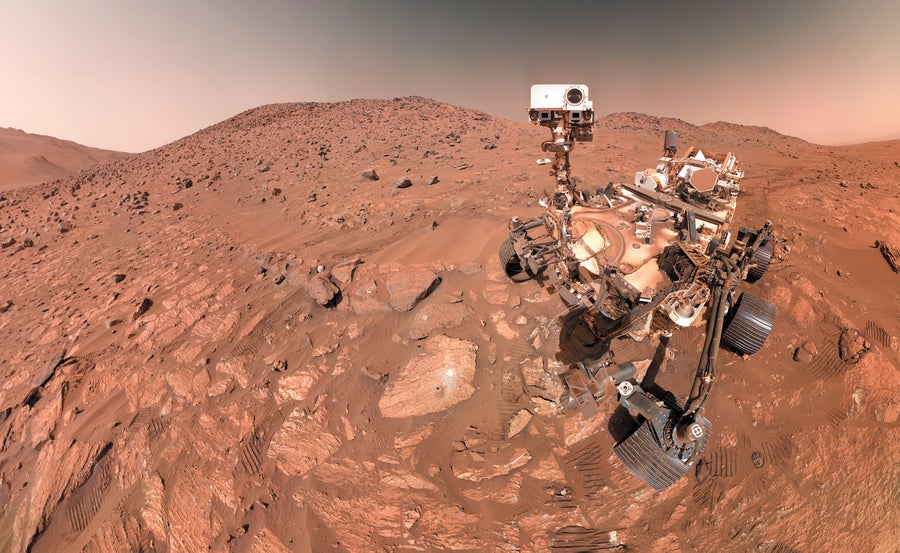
NASA’s Perseverance Mars rover took this selfie on Mars in July 2024. The rover stands next to a rock named Cheyava Falls, which scientists say may hold clues about whether the planet ever hosted microbial life. NASA/JPL-Caltech/MSSS
.
.
Click the link below for the complete article:
.
__________________________________________
December 9, 2025
Business, Food For Thought, Human Interest, Political, Science, Technical amazon, business, Business News, current-events, Future, Hotels, human-rights, medicine, mental-health, research, Science, Science News, technology, Technology News, travel, vacation 1 Comment

Click the link below the picture
.
A man on a plane TikTok’ed about getting a refund after a baby in a nearby aisle cried for 45 minutes. That man was a dick. A few years back, a lady on a South Korea–to–US flight gave out handwritten notes and care packages—earplugs, gum, candies—to atone for flying with a baby who might cry. That woman was a benevolent fool.
I can’t get my head around either of those standards—neither the “I’m sorry I cannot control the behavior of this defenseless human in my arms” position, nor this new “Why has this baby ruined my day?” schtick.
It’s the season of mass travel, December being the month we have to touch base with uncles, aunts, grandparents, and even MAGA-hatted distant cousins, lest we summon bad tidings and bah-humbugs—especially when a newborn’s involved. This time of year, it’s your duty as a parent to serve up your baby, oft dressed in velvet and doily, to cooing relations.
I am a loud person by nature—God blessed me with a voice that carries—but the thought of negatively impacting someone else’s experience with my presence is, by no stretch of the imagination, mortifying. I don’t talk during the movie or use speakerphone for public calls. But I have no qualms about my daughter’s lack of absolute silence in any situation. I’m sure you can Labrador-train a child to be seen and not heard, but a new-ish-born baby is a lasso of foghorns you can’t predict the trigger for, and parenting toddlers, on the whole, is fighting for your fucking life—every minute trying to swerve the carnage mainly seen in disaster movies. Many a traveling parent knows the piercing pain of their kid melting down when they should be buckling up, and shoving Cheeto after Cheeto into their mouth, or a sticky iPad into their stickier hands, to ease the onset of Armageddon. You’ve heard the verging-on-shrill pitch to their voice, the rising panic as their mile-high cub breaks the sound barrier.
To state the blindingly obvious: Babies cry. Without vocab or motor skills, a baby can’t indicate even the smallest discomfort without Niagara-ing into their bibs. If a baby is wet, they cry. If a baby is tired, they cry. If a baby is hungry, they cry. A baby can cry at the scratchy label in a onesie, a slight gust of cold air, the 12-second gap between Ms. Rachel videos. A baby’s Spotify Wrapped is just the sound of them wailing at different pitches.
And it should go without saying that a baby crying isn’t a reflection on the parent or their parenting style. Happy, non-future-serial-killer babies cry. Well-watered, well-tended babies cry. A baby that doesn’t cry may seem aspirational for Christmas travel, but it’s more likely an issue for a medic.
I’m wondering what brings people online to bemoan babies crying on flights. Were they expecting to be shielded from the general public when they purchased their ticket for public travel? Were they hoping to pay for extra soundproofing along with their legroom? There’s something about the echo chamber of social media that has siloed us into hyper-individuals, fixated not only on our personal experience but on the things that threaten it. Rather than co-exist, we have refused to become comfortable with the uncomfortable.
The public-shaming aspect, especially of mothers, carries a certain subtext; it’s about a woman failing to disappear into the passing montage of a man’s day—about making herself known to him without courting his attention. There’s a sense that a woman is meant to carry out her job as a mother in perfect silence, like a fresco of the Madonna and child.
But the people judging babies that cry seem to forget that they were once babies that cried. And in a way, the complainers are still the babies—unable to modify their own emotions, to empathize, to rationalize. Where a baby lacks the development to properly express themselves, the complainers lack the maturity to shut up and noise-cancel. Instead of acting out, what they really need to do is grow up.
.
 Collage by Vogue; Photo: Getty Images
.
.
Click the link below for the complete article:
.
__________________________________________
¡Bienvenido de vuelta viajero!
so looking to the sky ¡ will sing and from my heart to YOU ¡ bring...
CEO and Founder of Nsight Health
https://www.tangietwoods
Catholic News, Prayers, HD Images, Rosary, Music, Videos, Holy Mass, Homily, Saints, Lyrics, Novenas, Retreats, Talks, Devotionals and Many More
Decoding Power. Defying Narratives.
A creative collaboration introducing the art of nature and nature's art.
The Home Of Entertainment News, Reviews and Reactions
Hollow Earth Society
•Whenever you are confronted with an opponent, conquer him with love.(Gandhi)
Algotrader at TRADING-CLUBS.COM
Film and Writing Festival for Comedy. Showcasing best of comedy short films at the FEEDBACK Film Festival. Plus, showcasing best of comedy novels, short stories, poems, screenplays (TV, short, feature) at the festival performed by professional actors.
Peace. Tranquility. Insanity.
Take a ride on the wild side
Découvre des musiques prometteuses (principalement) dans la sphère musicale française.
No tiene que Ser una Pesadilla.
Life in Kana-text (er... CONtext)
Tracking money, power, and meaning across borders.
Where feelings meet metaphors and make questionable choices.
Finding hope and peace through writing, art, photography, and faith in Jesus.
Eyasu
The Community for Wounded Healers: Former Medical Students, Disabled Nurses, and Faith-Fueled Pivots
love each other like you're the lyric to their music
Comprendere il mondo per cambiarlo.
Mid-Life Ponderings
Travel,Tourism, Life style "Now in hundreds of languages for you."
I speak the honest truth. I share my honest opinions. I share my thoughts. A platform to grow and get surprised.
User-generated ratings for ethical consumerism
Travel and Lifestyle Blog
Questo è un piccolo angolo di poesie, canzoni, immagini, video che raccontano le nostre emozioni
“Log your journey to success.” “Where goals turn into progress.”
scrivo per dare forma ai silenzi e anima alle storie che il mondo dimentica.
“Dream deeper. Believe bolder. Live transformed.”
Vichar, Motivation, Kadwi Baat ( विचार दर्शनम्)
Traum zur Realität
Savor. Style. See the world.
معا نحو النجاح
Best Forex Broker Ratings & Reviews
art, writing and music by James McFarlane and other musicians
living life in conscious reality
Freelance poetry writing
Peace 🕊️ | Spiritual 🌠 | 📚 Non-fiction | Motivation🔥 | Self-Love💕
 James' World 2