
On This Day: June 16, 1944
Assorted human interest posts.
June 15, 2025
Business, Food For Thought, Human Interest, Political, Science, Technical amazon, business, Business News, current-events, Future, Hotels, human-rights, medicine, mental-health, research, Science, Science News, technology, Technology News, travel, vacation Leave a comment

 .
.__________________________________________
June 15, 2025
Business, Food For Thought, Human Interest, Political, Science, Technical amazon, business, Business News, current-events, Future, Hotels, human-rights, medicine, mental-health, research, Science, Science News, technology, Technology News, travel, vacation Leave a comment

Click the link below the picture
.
Warnings of a potentially dangerous invasive ant have popped up on news sites and social media this week. You’d be forgiven for thinking a new threat had arrived. But this insect, the Asian needle ant (Brachyponera chinensis), is no newcomer—just a master of remaining inconspicuous.
The ant is getting attention after University of Georgia (UGA) entomologist Dan Suiter issued a warning that its sting can be remarkably painful and sometimes cause a serious allergic reaction called anaphylaxis. The ant is not new or spreading any faster than it used to, Suiter says. Rather, as a UGA Cooperative Extension entomologist, he’s been getting calls about people being stung by the ant and needing hospital care. With summer in full swing, the insect is active, and people are likely to be in the woods or in their gardens where they might encounter it, prompting Suiter to raise awareness of the species.
“By this time last year, I had fielded three calls of people who had been stung by an Asian needle ant—they knew it was an Asian needle ant—and suffered anaphylaxis,” Suiter says. The problem, he adds, is that the insect is small, black, and nondescript. “You’re not thinking that ‘this tiny little creature right here could have consequences if it stung me.’”
The Asian needle ant is native to Japan, Korea, and China. It arrived in the U.S. around or before the 1930s, probably in ships carrying plants and livestock, “before we even realized that is a great way to spread things around,” says Theresa Dellinger, a diagnostician at the Insect Identification Lab at Virginia Tech. It’s not clear precisely where the ant has spread within the U.S., but it’s plentiful in the Southeast and appears to range as far north as Massachusetts, according to sightings on the community science app iNaturalist. It’s not often seen farther west than Missouri, probably because it’s not well-adapted to arid conditions, Dellinger says.
Studies have found that when Asian needle ants move into an area, they outcompete native ants, reducing ant diversity.
These ants don’t lay down pheromone trails to lead their colony to food, so you won’t see them marching in a line like the little black ant (Monomorium minimum). Instead, when an Asian needle ant finds food, it will return to its colony, pick up another worker and physically carry it to the jackpot, says Christopher Hayes, an entomologist at North Carolina State University.
And unlike fire ants, Asian needle ants don’t build big nest mounds. Instead they love nesting in damp wood, such as fallen logs or wet mulch. While they aren’t particularly aggressive, they will sting to protect their nest, making them a danger to the home gardener.
Their sting is initially more painful than a fire ant sting, Hayes says, but also irritatingly persistent, like fiberglass under the skin. The pain can also come and go. Hayes’s two-year-old son recently got a sting. The little boy was fine after a few minutes, Hayes says, but then woke up after midnight that night crying about the pain again.
In their native range, Asian needle ant bites are associated with a 2 percent risk of anaphylaxis compared with a 0.5 to 1.5 percent risk from the bites of fire ants, Hayes says.
.
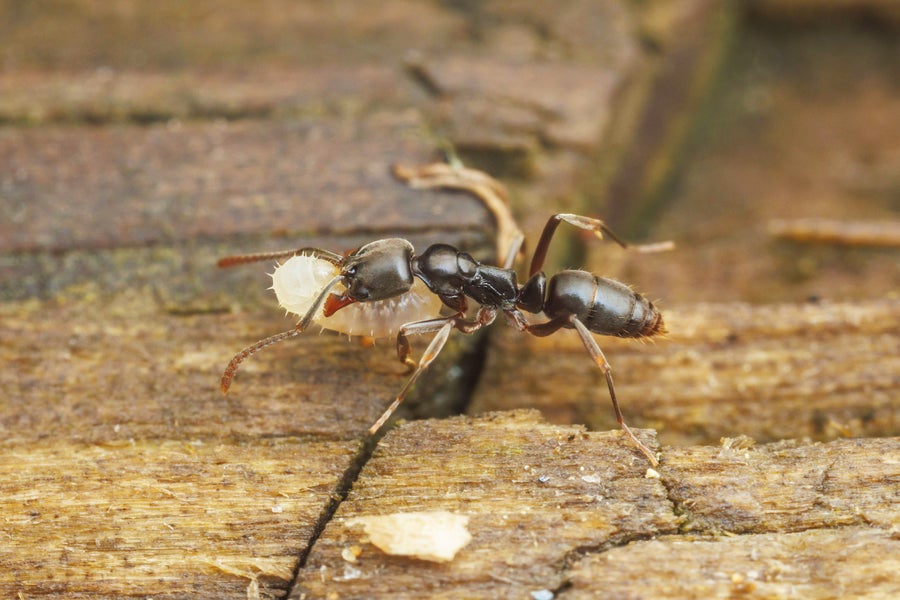
An Asian Needle Ant (Brachyponera chinensis) worker moves a larva from a disturbed nest. Clarence Holmes Wildlife/Alamy Stock Photo
.
.
Click the link below for the complete article:
.
__________________________________________
June 15, 2025
Business, Food For Thought, Human Interest, Political, Science, Technical amazon, business, Business News, current-events, Future, Hotels, human-rights, medicine, mental-health, research, Science, Science News, technology, Technology News, travel, vacation Leave a comment

Click the link below the picture
.
My family tree has always felt more like an orchard. I have two half-siblings who are unrelated to each other, but I’m so close to both of them you’ll never catch me using that term again. Ashley is nine years older than me, and my little brother, Garrett, is 20 years my junior. Now that I’m a mom to a 4-year-old boy, I hear many parents wondering if they should have more kids now, “you know, so they’re close in age.”
I’m not sure where that comes from, this pervasive idea that in order for siblings to have a close relationship, they have to be close in age. That has never been my reality. When I was a baby, our mom had to tell Ashley to stop carrying me everywhere or I’d never learn how to walk. She continued her diligent older sister duties in new ways, though, teaching me to read and write before I’d started preschool, my bubbly big letters matching hers almost exactly.
Early on, we quibbled like all siblings do. When I was a toddler, she convinced me my family had rescued me from a dumpster behind the hospital; that’s why I didn’t look like her or mom. I repaid her on other occasions, like the time I slammed her face into an alphabet peg puzzle. She was trying to convince me the M was a W so I hissed, “Don’t mess with the baby,” and let her have it.
Once everyone’s frontal lobe developed more fully, we didn’t fight much at all. I think this was because, at nine years apart, there was never any competition between us. I coveted everything she owned, sure, from her Abercrombie & Fitch clothes to the Bath & Body Works Cucumber Melon body spray she was allowed to wear to school. It didn’t matter that my mom said it smelled like stale fruit salad and made her roll down her window for the whole drive. To me, Ashley was the epitome of everything pretty and cool, and I wanted to be just like her. When she’d let me sit in her room while she straightened my hair, and I didn’t even care how many times she clamped the tops of my ears with the hot iron in the process, I was at the height of my glory.
Like all siblings, we had secrets just between us. After she’d moved out of the house and gotten a car — a decrepit Ford Taurus with a hole in the bumper — she’d pick me up from fourth grade or drive me to our grandparents’ house. We’d cruise across the causeway between the barrier island and Florida’s mainland, windows down, Ash rapping the lyrics to an absolutely vile Nate Dogg song I knew Mom would loathe. (I tracked it down and put it on my iPod as soon as I got one.)
If you have another baby in five, seven, 10 more years, your firstborn will still be close with their sibling — just not in age.
Sometimes I blabbed her secrets, like once when I was 7 and she had her boyfriend over to hang out when she was supposed to be watching me. I’m pretty sure she’s never told a single one of mine, though. Once she had a job and was all moved in with Jason, her high school sweetheart and now husband, in their first apartment, cobbling together her own life, she still came to all of my award ceremonies, birthday parties, and science fair events. My favorite picture of my college graduation is one my friend snapped of my face on the Jumbotron while crossing the stage, my mom and sister’s hands thrown up to the sky in front of it, both of them screaming, I’m sure.
Then, when I was 20, my little brother was born — my dad and the woman I considered my stepmom had told me she was pregnant shortly after my 19th birthday. I was shocked but excited. I spent my entire spring break hanging around their house, waiting for him to come. When I met him in the hospital, I thought he was the cutest thing I’d ever seen.
.
 You don’t have to have kids close together for them to be close at all.
.
.
Click the link below for the complete article:
.
__________________________________________
June 14, 2025
Business, Food For Thought, Human Interest, Political, Science, Technical amazon, business, Business News, current-events, Future, Hotels, human-rights, medicine, mental-health, research, Science, Science News, technology, Technology News, travel, vacation Leave a comment
Click the link below the picture
.
In the predawn darkness on Friday local time, Israeli military aircraft struck one of Iran’s uranium-enrichment complexes near the city of Natanz. The warheads aimed to do more than shatter concrete; they were meant to buy time, according to news reports. For months, Iran had seemed to be edging ever closer to “breakout,” the point at which its growing stockpile of partially enriched uranium could be converted into fuel for a nuclear bomb. (Iran has denied that it has been pursuing nuclear weapons development.)
But why did the strike occur now? One consideration could involve the way enrichment complexes work. Natural uranium is composed almost entirely of uranium 238, or U-238, an isotope that is relatively “heavy” (meaning it has more neutrons in its nucleus). Only about 0.7 percent is uranium 235 (U-235), a lighter isotope that is capable of sustaining a nuclear chain reaction. That means that in natural uranium, only seven atoms in 1,000 are the lighter, fission-ready U-235; “enrichment” simply means raising the percentage of U-235.
U-235 can be used in warheads because its nucleus can easily be split. The International Atomic Energy Agency uses 25 kilograms of contained U-235 as the benchmark amount deemed sufficient for a first-generation implosion bomb. In such a weapon, the U-235 is surrounded by conventional explosives that, when detonated, compress the isotope. A separate device releases a neutron stream. (Neutrons are the neutral subatomic particle in an atom’s nucleus that adds to their mass.) Each time a neutron strikes a U-235 atom, the atom fissions; it divides and spits out, on average, two or three fresh neutrons, plus a burst of energy in the form of heat and gamma radiation. And the emitted neutrons in turn strike other U-235 nuclei, creating a self-sustaining chain reaction among the U-235 atoms that have been packed together into a critical mass. The result is a nuclear explosion. By contrast, the more common isotope, U-238, usually absorbs slow neutrons without splitting and cannot drive such a devastating chain reaction.
To enrich uranium so that it contains enough U-235, the “yellowcake” uranium powder that comes out of a mine must go through a lengthy process of conversions to transform it from a solid into the gas uranium hexafluoride. First, a series of chemical processes refine the uranium, and then, at high temperatures, each uranium atom is bound to six fluorine atoms. The result, uranium hexafluoride, is unusual: below 56 degrees Celsius (132.8 degrees Fahrenheit) it is a white, waxy solid, but just above that temperature, it sublimates into a dense, invisible gas.
During enrichment, this uranium hexafluoride is loaded into a centrifuge: a metal cylinder that spins at tens of thousands of revolutions per minute, faster than the blades of a jet engine. As the heavier U-238 molecules drift toward the cylinder wall, the lighter U-235 molecules remain closer to the center and are siphoned off. This new, slightly U-235-richer gas is then put into the next centrifuge. The process is repeated 10 to 20 times as ever more enriched gas is sent through a series of centrifuges.
Enrichment is a slow process, but the Iranian government has been working on this for years and already holds roughly 400 kilograms of uranium enriched to 60 percent U-235. This falls short of the 90 percent required for nuclear weapons. But whereas Iran’s first-generation IR-1 centrifuges whirl at about 63,000 revolutions per minute and do relatively modest work, its newer IR-6 models, built from high-strength carbon fiber, spin faster and produce enriched uranium far more quickly.
.
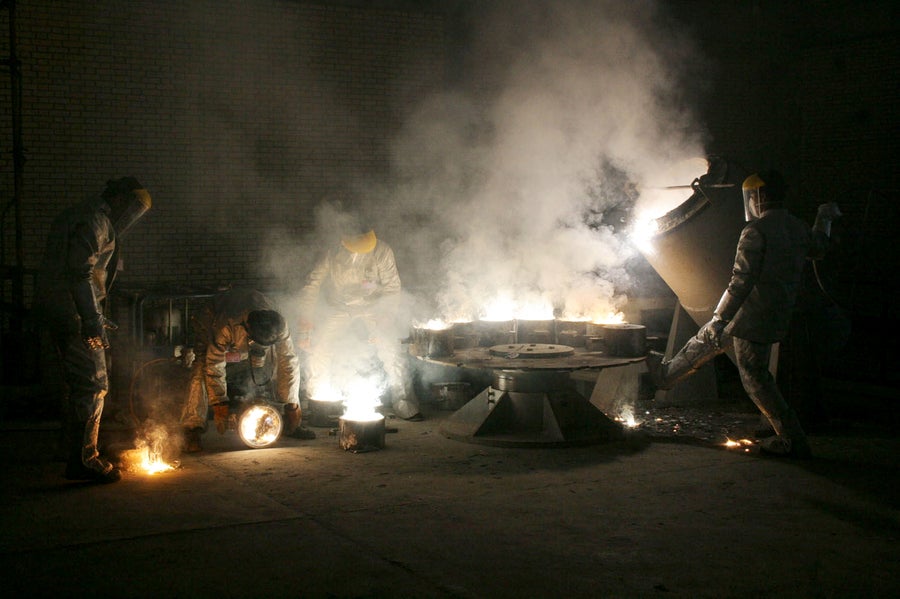
Men work inside of a uranium conversion facility just outside the city of Isfahan, Iran, on March 30, 2005. The facility in Isfahan made hexaflouride gas, which was then enriched by feeding it into centrifuges at a facility in Natanz, Iran. Getty Images
.
.
Click the link below for the complete article:
.
__________________________________________
June 14, 2025
Business, Food For Thought, Human Interest, Political, Science, Technical amazon, business, Business News, current-events, Future, Hotels, human-rights, medicine, mental-health, research, Science, Science News, technology, Technology News, travel, vacation Leave a comment
Click the link below the picture
.
“What’s your support system like?” my doctor asked as I tried to calm my baby. I was at my PCP’s office to get some insight into the persistent elbow pain that was making it difficult for me to open my apartment door or pull the covers over me at night — not to mention feed, hold, and soothe my baby who especially liked to fall asleep in the crook of that injured elbow.
My daughter had arrived six weeks early and needed to be fed in a specific position that required me to hold her head up with my left hand, the weight of her tiny body settling into my joint. But, like a lot of people I encountered in those early days, my doctor was having trouble getting past the single mother thing. “I’m worried about you,” she said, when I made the mistake of mentioning that I wasn’t sleeping. I was worried about me too, but I really needed help with my elbow.
“What’s your support system like?” was the first question almost anyone asked when finding out I was raising a baby without a partner — from potential mom friends at tot gyms to all kinds of medical professionals.
When I was pregnant, I got “what’s your support system like?” from a homeowner who was renting out an upstairs suite in a cohousing community. In cohousing, people usually live in separate houses on shared land, sharing resources. Because buying into a cohousing community can be expensive, I saw renting as a way in for me. But the homeowner balked as we tried to nail down a time for a tour. Instead, she wanted to schedule a call to talk about my support system.
The question was tough for me — it was something I had been asking myself, with some trepidation, since before I had gotten pregnant. Would the life I had made, the seeming haphazard connections collected over the years, be enough to sustain both me and a baby? I didn’t particularly want to get into this with my future landlord or, worse, be evaluated based on my ability to obtain this magic system. I told her that I thought her question was discriminatory (since she was not asking non-parents the same thing), she apologized profusely, and we parted ways.
But the incident jolted me: It was the first of a series of interactions that made me aware that by deciding to have a baby, I had stepped into a role loaded with cultural baggage.
The question about my support system was not about my own trepidations, romantic failures, or giddy hubris in deciding to get pregnant on my own. It was about the asker. “Are you going to need too much from me?” my potential housemate was asking. “Should I pity and worry for you?” my doctor wanted to know. “Can I view you as having agency?” the mom at the tot gym tried to clarify.
“Where do I place you on the scale of superhero to sad sack?” was how the question sounded to me.
“We are seeing the fabric of this country fall apart, and it’s falling apart because of single moms,” Pennsylvania Senate candidate (and future U.S. senator) Rick Santorum said in a speech in 1994. I was a teenager in the 1980s and 1990s when “unwed mothers” were used as cultural (and racial) boogeymen to push through Bill Clinton’s welfare cuts. Single mothers, the rationale went, were a drain on federal resources.
In the intervening years, with the rise of single parents by choice, an alternative narrative has taken hold, one of people who can afford to have babies on their own and are doing just fine. Yet, the words “single mother” remain a powerful cultural and political category that bring up anxieties about the cracks in our social system. And conservatives still seek to punish us, using the flawed logic that this will somehow force people into nuclear family structures.
.
 damircudic/E+/G
.
.
Click the link below for the complete article:
.
__________________________________________
June 14, 2025

How To Be A Better Boss Part 1.
How To Be A Better Boss Part 1.
Faith saved us from the savages that we were, losing faith makes us savages again
Where Trends Meet Truth
https://www.tangietwoods
Freelance poetry writing
Zalai Betti
INOVATION BLOG PEOPLE AND NEWS
Németh György
Konsultan Lingkungan Hidup di Lombok - NTB
Lea Krasznai (LeaArt21) – Idezetek (Idézetek) WordPress (Budapest, Hungary)
Appunti, spunti e passioni in liberta'
Gyorgy Nemeth
تعنى بتقديم نصائح للمعلمين المبتدئين، والطلبة الممتحنين، ومشاركة الاخرين تجربة الادخار في المال، بترشيد الاستهلاك المنزلي، وترتيب البيت، والحفاظ على البيئة، وتشجيع السيارات صديقةالبيئة، والسياحة والاسفار، ونماء رؤوس الاموال، والطب البديل وتشجيع التعليم الرقمي والذكاء الاصطناعي، والعناية بالنحل وتربية الاسماك، والاسثمار في رؤوس الاموال، الزراعة العضوية، والعناية باسنان الرضع، و صحة الحوامل، وتفسير القران
apprendre pour évoluer
Thoughts on books, language, meaning, and the culture around it.
Outdoor Recreation & Adventure in the Great Lakes Region
News, Info, Bio, Articles, Reviews, Lyrics, Technology, Science, Inspiration, Motivation, Philosphy and many more...
Christian Lifestyle Blogger
CEO and president of The Mullins Companies
Two Cultures. One Life. Endless Stories
Real Estate Development Specialist
¡Bienvenido de vuelta viajero!
so looking to the sky ¡ sing and from my heart to YOU ¡ bring...
CEO and Founder of Nsight Health
Catholic News, Prayers, HD Images, Rosary, Music, Videos, Holy Mass, Homily, Saints, Lyrics, Novenas, Retreats, Talks, Devotionals and Many More
Decoding Power. Defying Narratives.
A creative collaboration introducing the art of nature and nature's art.
The Home Of Entertainment News, Reviews and Reactions
•Whenever you are confronted with an opponent, conquer him with love.(Gandhi)
Algotrader at TRADING-CLUBS.COM
Film and Writing Festival for Comedy. Showcasing best of comedy short films at the FEEDBACK Film Festival. Plus, showcasing best of comedy novels, short stories, poems, screenplays (TV, short, feature) at the festival performed by professional actors.
Peace. Tranquility. Insanity.
Take a ride on the wild side
Découvre des musiques prometteuses (principalement) dans la sphère musicale française.
No tiene que Ser una Pesadilla.
Life in Kana-text (er... CONtext)
Where feelings meet metaphors and make questionable choices.
Finding hope and peace through writing, art, photography, and faith in Jesus.
Eyasu
Eyasu The Wonderful
A former medical student's journey through healthcare challenges and personal growth
love each other like you're the lyric to their music

