
On This Day: June 25, 2013
Assorted human interest posts.
June 25, 2025

You showed up steady heart open wideWhile I kept my truth locked away deep insideIts not your laugh or your midnight callsIts not how you caught me through every fallIt’s not the way you held me tightIt’s me who flinched at love’s pure lightYou did your part you gave your allI built a fortress and […]
It’s Me ~Poetry
June 24, 2025
Business, Food For Thought, Human Interest, Political, Science, Technical amazon, business, Business News, current-events, Future, Hotels, human-rights, medicine, mental-health, research, Science, Science News, technology, Technology News, travel, vacation Leave a comment

Click the link below the picture
.
The challenge sounds unreal: How do you blast a hole through a mountain of concrete and granite and then blow up what hides beneath it―all without crossing the nuclear line? The solution is a bomb that weighs 30,000 pounds, about as much as a city bus, but that is compressed into a cylinder roughly 20 feet long and 2.5 feet thick. Since the Israel-Iran conflict broke out last week, much speculation has centered on this weapon: the GBU-57/B, the most powerful nonnuclear bomb that is capable of destroying targets deep below the earth. The question many are asking is whether the U.S.—the only country possessing the bomb—will supply it to Israel.
To understand what the GBU-57/B is and why Israel might want the weapon, it is important to understand the presumed target: Fordo, Iran’s most advanced nuclear enrichment facility, which lies 18 miles northeast of the central city of Qom. According to an Institute for Science and International Security report, the site has the ability to produce enough highly enriched uranium to make a nuclear warhead in the span of mere days. It is also ensconced deep beneath a mountain, under 260 to 300 feet of rock that is reinforced with concrete, and surrounded by a ring of air-defense batteries. After Israel bombed Iraq’s nuclear reactor in 1981 and Syria’s in 2007, Iran decided to spread its nuclear program out over multiple sites, with its crucial elements hidden so deep beneath the earth that not even Israel’s 5,000-pound bunker busters could reach them. Intelligence reports suggest Iran began construction in 2002, while Iran has said that work began in 2007. Tehran acknowledged the site’s existence only in September 2009.
The first three letters in GBU-57/B stand for “guided bomb unit” (a precision bomb that can home in on its target), and it’s the 57th design in the series of such bombs. The second B refers to the bomb’s iteration (designations such as A/B, B/B, C/B, and so on are used for each adjustment made by military engineers). After the U.S.’s 2003 invasion of Iraq, engineers studied bunker strikes with smaller and older GBU models and found that they hadn’t penetrated deeply enough and had done limited damage. The military required a more powerful weapon that would respect the “nuclear taboo,” a widely accepted international consensus that the use of nuclear weapons is morally abhorrent and dangerous because it creates radioactive fallout, invites escalation, and risks driving allies and neutral states into diplomatic revolt. GBU-57/B—also known as a Massive Ordnance Penetrator (MOP)—was a solution. Its Air Force fact sheet sums it up as “a weapon system designed to accomplish a difficult, complicated mission of reaching and destroying our adversaries’ weapons of mass destruction located in well protected facilities.”
When dropped from 50,000 feet, the cruising ceiling for the B-2 Spirit bomber, the GBU-57/B uses sophisticated fins to guide it to its target. While the exact impact velocity is classified, it is estimated to exceed Mach 1—the speed of sound (767 mph). This strike delivers 800 to 900 megajoules (about 758,000 to 853,000 British thermal units) of kinetic energy—comparable to a 285-ton Boeing 747-400 touching down at 170 mph or a 565-ton Amtrak Acela train moving at 120 mph. With the bomb, however, all that energy is concentrated into a tiny area. According to a 2012 Congressional Research Service briefing, the GBU-57/B has been reported to burrow through 200 feet of concrete or bedrock with a density of 5,000 pounds per square inch (comparable to the strength of bridge decks or parking-garage slabs). Then its 5,300-pound explosive charge detonates.
The GBU-57/B is designed to enhance this ability to pierce deep below the surface. Its nose has an ogive shape, like that of a Gothic arch. Just as such arches are known for distributing weight effectively, the bomb’s nose has no sharp corners that cause air drag. Then, upon impact, the rounded shape spreads the initial crushing load gradually through the bomb’s steel casing
instead of concentrating it at one brittle point. This allows the casing to remain intact as it bores into the earth. The casing also has high sectional density. In this context, sectional density refers to the ratio of an object’s mass to the size of the face that first meets whatever surface the object is moving through. A hammer striking a board has high sectional density because it concentrates its mass in a small area; a pillow does not. In the case of the bomb, a great deal of mass and momentum is packed behind a small point. Whereas the ogive nose minimizes drag and structural shock, the high sectional density concentrates velocity and force, allowing the bomb to punch deep into stone.
About one fifth of the warhead’s 5,342-pound total weight is made up of two explosives: 4,590 pounds of AFX-757 plus 752 pounds of PBXN-114. Both create a larger blast than earlier bombs while being sufficiently insensitive to survive the shock of the initial strike. The detonation itself is timed by a specialized fuse that can be programmed from within the bomber cockpit. The fuse “counts” layers of rock or concrete, “hears” the hollow of a tunnel or chamber and then fires a detonator into the smaller PBXN-114 charge so that the main charge explodes only after the bomb has bored well inside the target. The released energy is roughly equivalent to about three to four tons of TNT. But because so much of the bomb’s 30,000 pounds is hardened steel, much of its destructive effect comes from its kinetic punch, delivered at sonic speed.
Though suspected of having nuclear weapons, Israel has so far respected the nuclear taboo. To destroy Fordo without them, it would need both the GBU-57/B and a B-2 Spirit bomber, the only aircraft designed to drop the bomb (it’s capable of releasing two, one from each bay). Otherwise Israel could, in theory, only chip at Fordo’s periphery—by destroying power sources, collapsing entrances or sending saboteurs—while uranium continues to be enriched below. Fordo is so well protected that a Royal United Services Institute op-ed states that “even the GBU-57/B would likely require multiple impacts at the same aiming point to have a good chance of penetrating the facility.” Despite media claims that GBU-57/B bombs were used to strike Houthi targets in Yemen, the U.S. Air Force states that these weapons have never been used in combat and that only a few dozen are stockpiled. So far, the U.S. has refused to hand Israel any of them—or the B-2 Spirit bomber required to drop them and collapse a mountain.
.
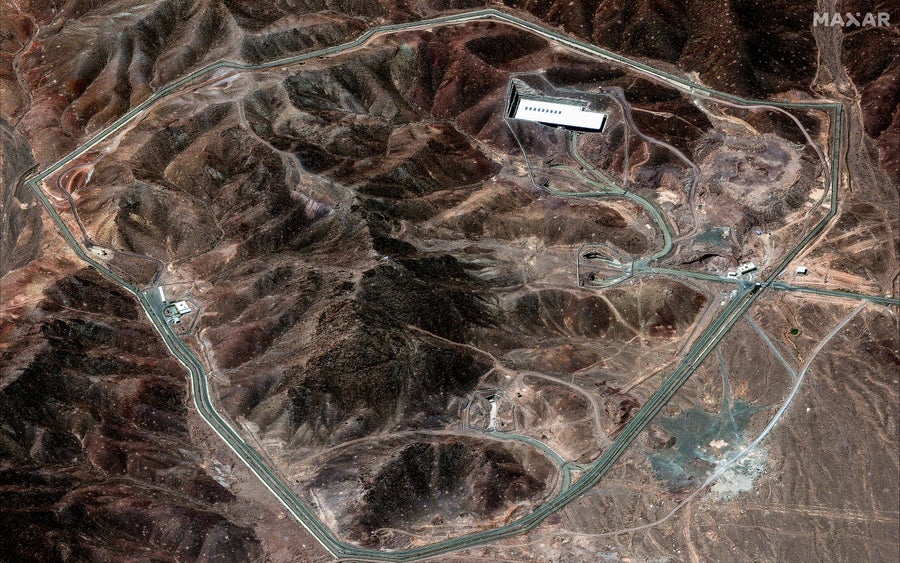
Maxar satellite imagery overview of the Fordo enrichment facility in Iran on June 14, 2025. No visible damage is observed. Maxar Technologies/Getty Images
.
.
Click the link below for the complete article:
.
__________________________________________
June 24, 2025
Business, Food For Thought, Human Interest, Political, Science, Technical amazon, business, Business News, current-events, Future, Hotels, human-rights, medicine, mental-health, research, Science, Science News, technology, Technology News, travel, vacation Leave a comment

Click the link below the picture
.
MAGA doesn’t want him, doesn’t know him, and doesn’t respect him,” President Donald Trump wrote in a lengthy tirade against Thomas Massie, a Republican congressman from Kentucky who has criticized the President over a number of issues from war with Iran to the so-called One Big Beautiful Bill.
“He is a negative force who almost always Votes ‘NO,’ no matter how good something may be. He’s a simple minded ‘grandstander’ who thinks it’s good politics for Iran to have the highest level Nuclear weapon, while at the same time yelling ‘DEATH TO AMERICA’ at every chance they get,” Trump posted on Sunday.
He added: “MAGA should drop this pathetic LOSER, Tom Massie, like the plague!”
Massie responded with a tongue-in-cheek post on X that the President “declared so much War on me today it should require an Act of Congress.” Massie joined last week with a number of Democratic lawmakers to raise the alarm over potential U.S. military intervention in the Middle East without constitutionally-mandated congressional authorization.
While Massie won’t face a reelection contest until 2026, Trump has already unveiled a plan to challenge him and further enforce loyalty within the GOP ranks.
“The good news is that we will have a wonderful American Patriot running against him in the Republican Primary, and I’ll be out in Kentucky campaigning really hard,” Trump added, without naming a prospective primary opponent. “MAGA is not about lazy, grandstanding, nonproductive politicians, of which Thomas Massie is definitely one.”
Massie, who is known for his outspoken libertarian views, has survived primary challenges before and told Axios, which reported on the effort to oust him, that “any serious person considering running should spend money on an independent poll before letting swampy consultants take them for an embarrassing ride.”
Who is Thomas Massie?
Massie, 54, was born in West Virginia and earned bachelor’s and master’s degrees in engineering from MIT in the 1990s before turning to local politics in 2010, when he ran and won the race for Judge Executive of Lewis County, Ky., amid the Tea Party wave.
In 2012, after then-Rep. Geoff Davis announced his retirement in Kentucky’s deep-red 4th congressional district, Massie, who described himself as a “constitutional conservative,” won the Republican primary in a landslide. When Davis resigned early, Massie won the same-day special election and general election to succeed him, taking office two months earlier than his fellow freshmen representatives elected in 2012.
One of Massie’s first moves was to vote in January 2013 against party leader John Boehner for Speaker, opting instead to vote for fellow libertarian Justin Amash. (Boehner narrowly won the speakership but would go on to resign in 2015. Amash would go on to not run for reelection in 2020 and temporarily leave the Republican Party after earning Trump’s wrath for consistent criticism of the President and supporting his impeachment.)
Since then, Massie has made a name for himself by regularly voting against bills, often breaking with his caucus and sometimes siding with Democrats. In 2013, Politico dubbed him “Mr. No.”
In 2016, Massie said he would vote for Trump but do everything he could to “rein him in” if he acts unconstitutionally. In 2017, Massie tried to explain how the same movement that propelled him into office could also propel someone like Trump, telling the Washington Examiner: “All this time, I thought they were voting for libertarian Republicans. But after some soul searching I realized when they voted for Rand and Ron [Paul] and me in these primaries, they weren’t voting for libertarian ideas—they were voting for the craziest son of a b—– in the race. And Donald Trump won best in class.”
During Trump’s first term, Massie was among a small group of Republicans who joined Democrats in trying to override Trump’s veto of legislation that would block his national emergency declaration at the border in 2019. That same year, he was the sole Republican to vote against a resolution opposing the boycott, divestment, and sanctions movement targeting Israel, and he was the sole no-vote across both parties on the Hong Kong Human Rights and Democracy Act.
.
 Rep. Thomas Massie (R, Ky.) speaks to reporters after a House GOP caucus meeting at the U.S. Capitol on June 4, 2025.Kevin Dietsch—Getty Images
.
.
Click the link below for the complete article:
.
__________________________________________
June 24, 2025
Business, Food For Thought, Human Interest, Political, Science, Technical amazon, business, Business News, current-events, Future, Hotels, human-rights, medicine, mental-health, research, Science, Science News, technology, Technology News, travel, vacation Leave a comment

Click the link below the picture
.
The Mona Lisa has been the subject of awe and fascination for centuries, with experts from around the world desperate to solve the mystery behind her iconic, enigmatic smile.
Now, thanks to X-ray technology, scientists have begun to uncover the secrets of Leonardo da Vinci’s legendary portrait, and explain how he was able to create something so mind-bending with just a few strokes of a brush.
The research, published in the Journal of the American Chemical Society on Wednesday, suggests that the Italian Renaissance master may have been in a particularly inventive mood when set about crafting the piece in the early 16th century.
“He was someone who loved to experiment, and each of his paintings is completely different technically,” Victor Gonzalez, the study’s lead author, told the Associated Press..
Gonzalez, who has studied the chemical compositions of dozens of works by Leonardo and other artists, discovered that there was something special about the paint used for the Mona Lisa.
Specifically, the researchers found a rare compound, called plumbonacrite, in Leonardo’s first layer of paint.
The discovery confirmed that Leonardo most likely used lead oxide powder to thicken and help dry his paint as he began working on the portrait.
He is thought to have dried the powder, which has an orange colour, in linseed or walnut oil by heating the mixture to make a thicker, faster-drying paste.
“What you will obtain is an oil that has a very nice golden colour,” Gonzalez said. “It flows more like honey.”
Carmen Bambach, a specialist in Italian art and curator at New York’s Metropolitan Museum of Art, who was not involved in the study, called the research “very exciting”.
She emphasised that any scientifically proven new insights into Leonardo’s painting techniques are “extremely important news for the art world and our larger global society.”
Finding plumbonacrite in the Mona Lisa attests “to Leonardo’s spirit of passionate and constant experimentation as a painter—it is what renders him timeless and modern,” Bambach said.
.
 Secrets revealed
.
.
Click the link below for the complete article:
.
__________________________________________
June 24, 2025
June 24, 2025

Back in March 2024, the Biden administration tried to throw consumers a lifeline. The Consumer Financial Protection Bureau (CFPB) has issued a new rule. This was done under the White House’s watch. The rule will limit late fees on credit cards. No more $32 penalties. From now on, banks could charge just $8. It sounded […]
How Retail Credit Cards Turn Everyday Shoppers into Lifelong Borrowers in America
Faith saved us from the savages that we were, losing faith makes us savages again
Where Trends Meet Truth
https://www.tangietwoods
Freelance poetry writing
Zalai Betti
INOVATION BLOG PEOPLE AND NEWS
Németh György
Konsultan Lingkungan Hidup di Lombok - NTB
Lea Krasznai (LeaArt21) – Idezetek (Idézetek) WordPress (Budapest, Hungary)
Appunti, spunti e passioni in liberta'
Gyorgy Nemeth
تعنى بتقديم نصائح للمعلمين المبتدئين، والطلبة الممتحنين، ومشاركة الاخرين تجربة الادخار في المال، بترشيد الاستهلاك المنزلي، وترتيب البيت، والحفاظ على البيئة، وتشجيع السيارات صديقةالبيئة، والسياحة والاسفار، ونماء رؤوس الاموال، والطب البديل وتشجيع التعليم الرقمي والذكاء الاصطناعي، والعناية بالنحل وتربية الاسماك، والاسثمار في رؤوس الاموال، الزراعة العضوية، والعناية باسنان الرضع، و صحة الحوامل، وتفسير القران
apprendre pour évoluer
Thoughts on books, language, meaning, and the culture around it.
Outdoor Recreation & Adventure in the Great Lakes Region
News, Info, Bio, Articles, Reviews, Lyrics, Technology, Science, Inspiration, Motivation, Philosphy and many more...
Christian Lifestyle Blogger
CEO and president of The Mullins Companies
Two Cultures. One Life. Endless Stories
Real Estate Development Specialist
¡Bienvenido de vuelta viajero!
so looking to the sky ¡ sing and from my heart to YOU ¡ bring...
CEO and Founder of Nsight Health
Catholic News, Prayers, HD Images, Rosary, Music, Videos, Holy Mass, Homily, Saints, Lyrics, Novenas, Retreats, Talks, Devotionals and Many More
Decoding Power. Defying Narratives.
A creative collaboration introducing the art of nature and nature's art.
The Home Of Entertainment News, Reviews and Reactions
•Whenever you are confronted with an opponent, conquer him with love.(Gandhi)
Algotrader at TRADING-CLUBS.COM
Film and Writing Festival for Comedy. Showcasing best of comedy short films at the FEEDBACK Film Festival. Plus, showcasing best of comedy novels, short stories, poems, screenplays (TV, short, feature) at the festival performed by professional actors.
Peace. Tranquility. Insanity.
Take a ride on the wild side
Découvre des musiques prometteuses (principalement) dans la sphère musicale française.
No tiene que Ser una Pesadilla.
Life in Kana-text (er... CONtext)
Where feelings meet metaphors and make questionable choices.
Finding hope and peace through writing, art, photography, and faith in Jesus.
Eyasu
Eyasu The Wonderful
A former medical student's journey through healthcare challenges and personal growth
love each other like you're the lyric to their music

