
On This Day: April 14, 1906
Assorted human interest posts.
April 14, 2025
April 14, 2025
April 13, 2025
Business, Food For Thought, Human Interest, Political, Science, Technical amazon, business, Business News, current-events, Future, Hotels, human-rights, medicine, mental-health, research, Science, Science News, technology, Technology News, travel, vacation Leave a comment

Click the link below the picture
.
The Trump administration is preparing to eliminate the Federal Emergency Management Agency (FEMA), the agency that leads the nation’s disaster response. We predict this move will have the unintended consequence of bankrupting some small towns and accelerating the relocation of people out of high-risk areas. Cutting off the post-disaster financial assistance that FEMA provides to states will drive up taxes, drive down services, and drive out residents and small businesses. This “climate doom loop” poses the very real risk of destroying small-town America.
The number of billion-dollar disasters in the U.S. is increasing. A recent report says FEMA made a disaster declaration somewhere in the U.S. every four days, on average, in 2024. Disasters have displaced anywhere between one million and four million Americans per year in recent years; an estimated 20 percent of these people never return home. Some move in with family and friends, whereas others either cannot afford to return home or they have nothing left to lose by moving elsewhere in the search for a better life.
Then there are significant challenges for local governments associated with accommodating displaced households, whether individuals or families. They must extend resources to accommodate new students in schools and manage crowding-out pressures associated with rapid inflation in home prices and rents. From Chico, Calif., to Orlando, Fla., cities where people have relocated after disasters have faced significant pressures from the influx. After the 2018 Camp Fire all but destroyed the town of Paradise, Calif., 20,000 people moved to Chico. The sudden relocation caused a 21 percent spike in housing prices and triggered a homelessness surge that the city still struggles with seven years later. Disasters are not just local events.
Even California, with one of the largest economies in the world, cannot afford individual assistance grants that shelter and feed its own residents. The state most certainly cannot afford to replace the federal public assistance dollars that repair and replace the basic infrastructure for turning on the lights and flushing the toilets. Without FEMA’s financial support, state and local governments will be forced to borrow more money, increase taxes, and even privatize public infrastructure. Many small towns will be forced to scale back critical services, including closing schools, libraries, park,s and solid waste facilities, because they are limited in how much money they can borrow and how much they can tax residents.
Increased taxes and utility bills on top of skyrocketing insurance costs are already pushing people to move. The situation is so dire with natural disasters and spiraling insurance costs in Louisiana that Moody’s Investor Service is concerned that the ongoing and projected loss of working-age people represents a material credit risk for the state. Even wealthy states such as Florida face significant credit risks without FEMA’s financial assistance, particularly as tax rolls shrink with waning property values in high-risk counties. Florida is only a few catastrophic hurricanes away from an income tax, which would have a chilling impact on its population growth. Florida already experiences more deaths than births, and its future is entirely reliant on people moving to the Sunshine State.
Natural hazards and climate-attributed extreme events are wrecking havoc on communities and local economies across the Sun Belt. People initially moved there for warm weather, but the real reason for the region’s growth since the 1990s has been centered on the readily available supply of affordable housing. Recent research has even found evidence that some people are beginning to move away from the Sunbelt, particularly retirees and younger households who are rethinking where they want to plant their roots in the long term. These people are sensitive to the unexpected costs of disasters and insurance eating into their hard-earned wealth just as they are attempting to retire or build families. When people move, they take their tax revenue with them.
The cost of living will no doubt continue to increase in higher-risk areas across the Sunbelt and beyond, and without FEMA, those costs will skyrocket. FEMA does not just help coordinate recovery. The agency also invests in risk-reduction infrastructure, and it sets rules that offer predictability and keep costs down for insurance policies and mortgages. FEMA also provides grants and affordable loans for infrastructure projects that keep schools safe and hospitals accessible for tens of millions of American households. Without FEMA, municipal bond and mortgage investors on Wall Street will decide who gets to rebuild and who gets left behind.
Those local governments that do begin the long process of rebuilding will still face the erosion of both their local population and their economy. The costs of debris removal, toxic cleanup, and infrastructure recovery are so significant that one in five county governments impacted by disasters have to borrow money and implement public funding cuts while they wait for FEMA assistance. These events drain so much cash that even the City of Los Angeles faced a negative credit outlook from its credit rating agency after recent wildfires, meaning there was concern about the city’s ability to meet financial obligations.
.

An aerial view of a neighborhood destroyed by the Camp Fire in Paradise, California, on Nov. 15, 2018. Carolyn Cole/Los Angeles Times via Getty Images
.
.
Click the link below for the complete article:
.
__________________________________________
April 13, 2025
Business, Food For Thought, Human Interest, Political, Science, Technical amazon, business, Business News, current-events, Future, Hotels, human-rights, medicine, mental-health, research, Science, Science News, technology, Technology News, travel, vacation Leave a comment

Click the link below the picture
.
How can you measure productivity you can’t see? When we try to evaluate whether someone is “killing it” in their role simply by hearing them mansplain their digital transformation strategy or their AI-powered journey of innovation, it’s hard to disentangle facts from fiction, competence from confidence, and talent from, well, BS.
The harder it is to decipher what someone is doing, the easier it is to fake it. Ironically, this means that the more you get paid for doing what you do, because specialized skills and in-demand jobs tend to involve operating in abstract, intellectual, and symbolic processes rather than visible, tangible, observable work, the harder it is to know if you are any good at it.
Welcome to the modern workplace, where the line between working and pretending to work is not just thin, it’s vanishing. This is particularly true with the advent of AI, which produces content indistinguishable from what humans produce, if not better. If knowledge workers are merely promptly AI and instructing the AI agents to work for them, are humans still working?
When work became hard to see
One of the great historical transitions in the knowledge economy is that as work became more “intellectual,” it also became less visible. Unlike a farmer’s harvest or a blacksmith’s horseshoe, knowledge work is abstract. You can’t see a PowerPoint deck’s impact (if we could, we would probably not devote so many hours in our life to create slides), or touch a well-formatted spreadsheet (though we can admire it, sure). And when results are ambiguous, evaluations become subjective. More importantly, the connection between the behaviors people perform or display (typing, thinking, reading, writing) and the desirable work or organizational outcomes (growth, productivity, innovation, performance) is invisible, which allows people to brag about their apparent accomplishments on LinkedIn and their resumés: “during my tenure we increased profits by 25%” . . .. because of you, despite you, or coincidentally while you were there?
The modern office was once thought to be a factory of ideas, but more often, it is a theater of activity. Slack pings, emails sent at 11:47 p.m., and meetings scheduled for no good reason serve as proxies for productivity. As psychologist Adam Grant noted, we confuse responsiveness with competence. Presence—whether physical or digital—is misread as performance, or even talent.
Even performance reviews have become more performative than evaluative. As my colleagues and I have shown, most managers are bad at assessing performance—biased by recent events, likability, and self-confidence. The upshot? It’s easier to reward those who are good at appearing to work than those who are actually working. And our notion of “adding value” is conflated with being rewarding to deal with.
Confidence over competence
It gets worse. As work becomes more cerebral, we also become better at gaming the system. Impression management has become a meta-skill: not the work itself, but the ability to make others believe that we are working, and working well.
This isn’t just anecdotal. Psychological studies repeatedly show that people are poor judges of competence, often mistaking confidence for ability. One study shows that speaking more than others in group settings predicts being selected as leader to that group: Yes, there is an ROI to mansplaining!
In fact, in a world where perception trumps reality, those who can tell a compelling story about their work often outperform those who quietly produce real results. This explains why buzzwords thrive in business: “leveraging synergies” sounds more important than “talking to another department.” And therein lies the tragedy: The more time you devote to pretending to work, which by definition decreases the time you can devote to actually working, the more successful you may be in an organizational setting.
As our skills evolved to navigate complex knowledge ecosystems, so did our capacity to appear productive. This is a uniquely modern skill, honed through LinkedIn updates, Zoom facial expressions, and the subtle art of replying-all. For all the talks of “authenticity” and being yourself at work, as my upcoming book documents, there is hardly ever a reward for being honest and transparent when you are up against masters of deceptions and deception eclipses reality. Those who confess that they prefer to have their achievements speak for themselves are no doubt noble and ethical—but they will generally go unnoticed compared to people who proactively engaged in politics, self-promotion, and sucking up to their boss.
The rise of meaningless work
In Bullshit Jobs, the late anthropologist David Graeber describes a category of work so pointless that even the people doing it can’t justify its existence. Entire industries—corporate compliance, middle management, strategic communications—are filled with people who aren’t sure what their job is for, but are sure it requires a calendar full of meetings.
.
 [Source Photo: Freepik]
.
.
Click the link below for the complete article:
.
__________________________________________
April 13, 2025
“Pity the nation that is full of beliefs and empty of religion.Pity the nation that wears a cloth it does not weaveand eats a bread it does not harvest. Pity the nation that acclaims the bully as hero,and that deems the glittering conqueror bountiful. Pity a nation that despises a passion in its dream,yet submits […]
Nightly Spiritual Quote #408 Spirituality
April 13, 2025
April 12, 2025
Business, Food For Thought, Human Interest, Political, Science, Technical amazon, business, Business News, current-events, Future, Hotels, human-rights, medicine, mental-health, research, Science, Science News, technology, Technology News, travel, vacation Leave a comment
Click the link below the picture
.
Researchers have created the largest and most detailed wiring diagram of a mammalian brain to date, by mapping cells in a cubic millimetre of a mouse’s brain tissue. In a landmark achievement, the diagram also details the activity of individual neurons on a large scale―a neuroscience first.
The high-resolution 3D map contains more than 200,000 brain cells, around 82,000 of which are neurons. It also includes more than 500 million of the neuronal connection points called synapses and more than 4 kilometres of neuronal wiring, all found in a tiny block of tissue in a brain region involved in vision. The only brain map of comparable scale is that of a cubic millimetre of human brain, which included 16,000 neurons and 150 million synapses. The new map also captured the activity of tens of thousands of neurons firing signals and interacting with each other to process visual information.
This brain-activity map, combined with the wiring diagram, marks a milestone in connectomics, a field that aims to show how brains process and organize information. Behind the massive efforts are more than 150 researchers in the Machine Intelligence from Cortical Networks (MICrONS) project, who described their work in a package of eight papers published today in Nature and Nature Methods. The MICrONS project has made its resources available for the neuroscience community online, and other teams are already exploring them in different studies.
“They managed to do something that we haven’t done as a neuroscience community in basically all of our history, which is to be able to map the activity of neurons onto the wiring on a very large population of neurons,” says Mariela Petkova, a neuroscientist at Harvard University in Cambridge, Massachusetts, who is not involved with the project. “We have never seen it at this scale.”
The data “are really stunningly beautiful,” says Forrest Collman, a neuroscientist at the Allen Institute for Brain Science in Seattle, Washington, who co-authored the studies. “Looking at it really gives you an awe about the sense of complexity in the brain that is very much akin to looking up at the stars of night.”
Mouse in a matrix
To create the breakthrough map, researchers first recorded the firing of almost 76,000 neurons in the visual cortex of a mouse as the animal watched various videos, including clips from The Matrix, for two hours. Then they sliced up a cubic millimetre of the mouse’s brain into thousands of tissue slices, each about one four-hundredth the width of a human hair.
The scientists imaged each slice and assembled the images into a 3D map. Finally, they used artificial intelligence and machine-learning algorithms to annotate the neurons, their branching projections, and their synapses. The team also matched the neurons in the map with their recordings of brain cells in action.
Moritz Helmstaedter, a neuroscientist at the Max Planck Institute for Brain Research in Frankfurt, Germany, says “the combination of function and structure at that scale” is unprecedented. It’s “a very impressive endeavour and success”.
Fire together, wire together
The work yielded insights into the basic rules that shape neural circuits in the mouse brain. For example, the authors found that neurons in the cortex that respond to similar types of visual feature—such as certain shapes or directions of movement—often form more connections with one another, no matter how far apart they are, than they do with neurons that specialize in a different type of feature.
.
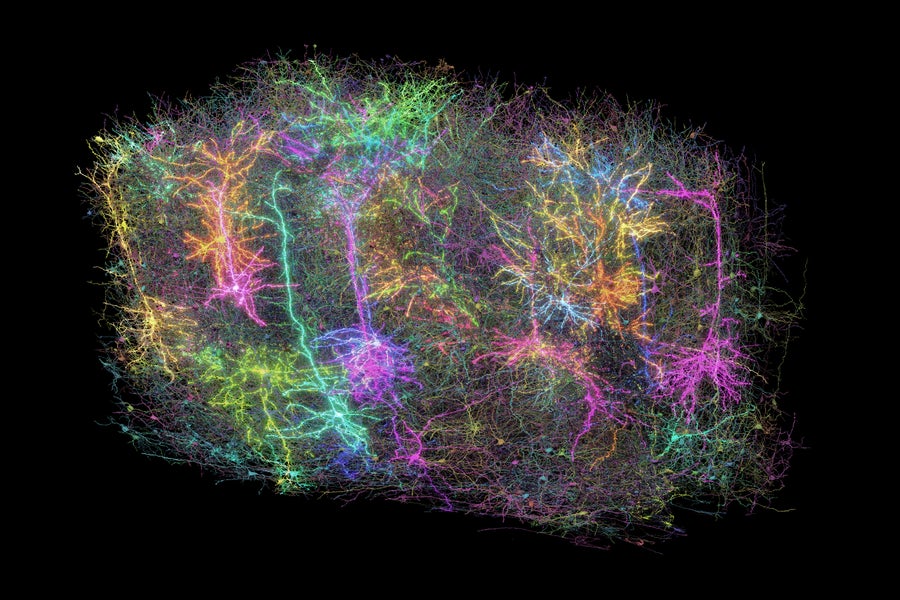
A rendering of more than 1,000 brain cells out of the those reconstructed from analysis of a cubic millimetre of brain tissue from a mouse. Allen Institute
.
.
Click the link below for the complete article:
.
__________________________________________
April 12, 2025
Business, Food For Thought, Human Interest, Political, Science, Technical amazon, business, Business News, current-events, Future, Hotels, human-rights, medicine, mental-health, research, Science, Science News, technology, Technology News, travel, vacation Leave a comment

Click the link below the picture
.
There was a time when entering couples therapy was seen as the death knell of a relationship – a last-ditch attempt to save a partnership beyond salvation.
“People are afraid that once you’ve gone to couples therapy, you’re on a negative track,” says Dr Matthew Siblo, a licensed professional counselor in Washington, DC.
Now, couples therapy is more commonplace. One 2023 survey found that 37% of US couples who live together have been to couples therapy. In 2022, nearly 30% of UK therapists reported a rise in the number of inquiries for couples counseling.
It’s also more successful. “Success, how we define it, is the couple establishing a closer friendship, a closer sense of connection … and better conflict management,” says Dr Julie Gottman, a clinical psychologist and co-founder of the Gottman Institute. According to Gottman, the success rate of couples therapy used to be about 17%. Now, the Gottman Institute’s methods have about a 75% success rate.
But what about when a relationship truly seems to be on its last legs? Will a couples therapist ever tell a pair to break up?
“I would not, personally,” says Siblo.
Siblo says he has never directly told a couple that he thinks they should break up, because he doesn’t think it would be appropriate or productive.
“I’m there to create a space of greater understanding,” he says. If that leads to people deciding to separate, Siblo can help them navigate that process. But telling a couple their relationship is not viable risks distracting them from the issues at hand; the focus becomes the therapist’s opinion rather than the pair’s relationship. Not only that, it could end up pushing the couple closer together by uniting them against a common enemy: the therapist.
“It would backfire,” Siblo says.
Telling clients what to do puts them in an “infantilized position”, says Gottman. If a couple is at a complete loss on how to move forward, Gottman might present them with several different options – including separation, in some cases – and talk them through each.
The goal is to empathize and disarm some of the defensiveness or critical ways of communicating
Gottman has intervened more directly in certain situations, she says, including cases involving domestic violence. There are two types of domestic violence, Gottman explains.
Roughly 80% is “situational”, meaning both people are involved and the violence is mild to moderate – for example, pushing, shoving or slapping. In these cases, Gottman says, “both people really want to change” and “they both might feel deeply ashamed and guilty”. Situational domestic violence is often the result of both partners getting emotionally “flooded” – going into fight-or-flight mode – during conflict. This dynamic can be successfully resolved with proper couples therapy, Gottman says.
But in the 20% of cases that are “characterological” – meaning there’s a clear victim and a perpetrator who takes no responsibility for the violence and inflicts major injuries – Gottman says intervention is appropriate.
“It’s crucial that the couple break up and the [victim], typically the wife, get somewhere safe,” she says.
In these instances, Gottman says she talks to the couple separately, and works with the victims on a safety plan to extricate themselves and any children from the relationships.
.
 Couples therapy has become more commonplace; a 2023 survey found that 37% of US couples who live together had tried it. Illustration: Angelica Alzona/Guardian Design
.
.
Click the link below for the complete article:
.
__________________________________________
https://www.tangietwoods
¡Bienvenido de vuelta viajero!
so looking to the sky ¡ will sing and from my heart to YOU ¡ bring...
CEO and Founder of Nsight Health
Catholic News, Prayers, HD Images, Rosary, Music, Videos, Holy Mass, Homily, Saints, Lyrics, Novenas, Retreats, Talks, Devotionals and Many More
Decoding Power. Defying Narratives.
A creative collaboration introducing the art of nature and nature's art.
The Home Of Entertainment News, Reviews and Reactions
Hollow Earth Society
•Whenever you are confronted with an opponent, conquer him with love.(Gandhi)
Algotrader at TRADING-CLUBS.COM
Film and Writing Festival for Comedy. Showcasing best of comedy short films at the FEEDBACK Film Festival. Plus, showcasing best of comedy novels, short stories, poems, screenplays (TV, short, feature) at the festival performed by professional actors.
Peace. Tranquility. Insanity.
Take a ride on the wild side
Découvre des musiques prometteuses (principalement) dans la sphère musicale française.
No tiene que Ser una Pesadilla.
Life in Kana-text (er... CONtext)
Where feelings meet metaphors and make questionable choices.
Finding hope and peace through writing, art, photography, and faith in Jesus.
Eyasu
The Community for Wounded Healers: Former Medical Students, Disabled Nurses, and Faith-Fueled Pivots
love each other like you're the lyric to their music
Comprendere il mondo per cambiarlo.
Mid-Life Ponderings
Travel,Tourism, Life style "Now in hundreds of languages for you."
I speak the honest truth. I share my honest opinions. I share my thoughts. A platform to grow and get surprised.
User-generated ratings for ethical consumerism
Travel and Lifestyle Blog
Questo è un piccolo angolo di poesie, canzoni, immagini, video che raccontano le nostre emozioni
“Log your journey to success.” “Where goals turn into progress.”
scrivo per dare forma ai silenzi e anima alle storie che il mondo dimentica.
“Dream deeper. Believe bolder. Live transformed.”
Vichar, Motivation, Kadwi Baat ( विचार दर्शनम्)
Traum zur Realität
Savor. Style. See the world.
معا نحو النجاح
Best Forex Broker Ratings & Reviews
art, writing and music by James McFarlane and other musicians
living life in conscious reality
Freelance poetry writing
Peace 🕊️ | Spiritual 🌠 | 📚 Non-fiction | Motivation🔥 | Self-Love💕
Reiseberichte & Naturfotografie
 James' World 2