“The Amateur” is a vigilante spy action film directed by James Hawes and written by Ken Nolan and Gary Spinelli. It is based on Robert Littell’s 1981 novel of the same name. The Film was previously adapted into a Canadian film and ultimately released by 20th Century Studios in the United States. As a huge […]
THE AMATEUR (2025) – My rating: 8.5/10
THE AMATEUR (2025) – My rating: 8.5/10
April 18, 2025

What Defines a Star?
April 17, 2025
Business, Food For Thought, Human Interest, Political, Science, Technical amazon, business, Business News, current-events, Future, Hotels, human-rights, medicine, mental-health, research, Science, Science News, technology, Technology News, travel, vacation 2 Comments

Click the link below the picture
.
I love simple questions that wind up having complicated—or at least not straightforward—answers. Astronomers twist themselves into knots, for example, trying to define what a planet is, even though it seems like you’d know one when you see it. The same is true for moons; in fact, the International Astronomical Union, the official keeper of names and definitions for celestial objects, doesn’t even try to declare what a moon is. That’s probably for the best because that, too, is not so easy.
What about stars, though? Do they also confound any sort of palatable definition?
In a very broad sense, a star is simply one of those twinkling points of light you can see in the night sky. But that’s not terribly satisfying in either lexicological or physical terms. After all, we also know the sun is a star—but, by definition, we never see it in Earth’s night sky, and it’s certainly not a dot (unless you’re viewing it from well past Pluto, that is).
If such a basic definition leaves us a bit dry, then perhaps we can do better. From centuries of scientific observations and theoretical physics, we can say more. Stars are massive, hot and roughly spherical. They’re held together by their own gravity, and they consist of plasma (gas heated so much that electrons are stripped from its constituent atoms). And, of course, they’re luminous. They shine, which is probably their most basic characteristic.
That’s descriptive, certainly, but still doesn’t really tell us what a star is. What makes one different from, say, a planet? Can there be a smallest star or a biggest one?
To sensibly answer such questions, we need to understand the core mechanism that makes a star luminous in the first place. Then we can use that understanding to better define what is or isn’t a star.
Historically, astronomers were in the dark about this for quite some time. Many mechanisms were proposed, but it wasn’t until the early 20th century that quantum mechanics came to the rescue and introduced humanity (for better or worse) to the concept of nuclear fusion. In this process, subatomic particles such as protons and neutrons—and even entire atomic nuclei—could be smashed together, fusing to form heavier nuclei and releasing an enormous amount of energy.
In a star’s core, fusion takes terrific temperature and pressure that is provided by the crushing gravity of the star’s overlying mass. For a star to be relatively stable, the outward force of the energy generated by fusion in its core must be balanced by the inward pull of the star’s gravity.
There are a couple of different pathways for fusion to occur in stars like the sun, but in the end they both yield essentially the same result: four hydrogen nuclei (each a single proton) plus various other subatomic particles fuse together to form a helium nucleus, and this process blasts out a lot of high-energy radiation as a byproduct. In the sun, this process converts about 620 million metric tons of hydrogen into helium every second. That creates enough energy to, well, power a star.
.
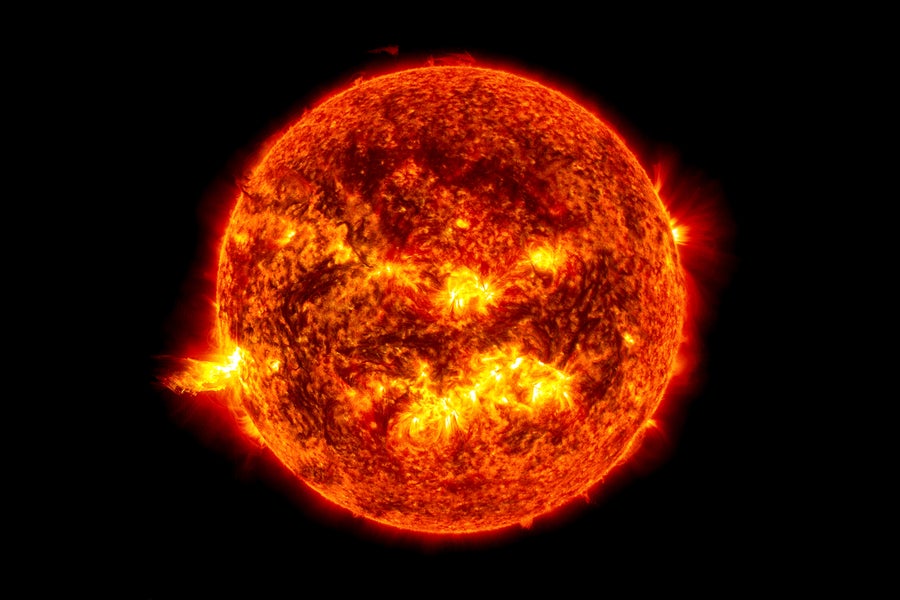
A view of our sun, as seen by NASA’s Solar Dynamics Observatory. NASA/Goddard/SDO
.
.
Click the link below for the complete article:
.
__________________________________________
5 signs you’re being talked over in meetings, and how to stop it for good
April 17, 2025
Business, Food For Thought, Human Interest, Political, Science, Technical amazon, business, Business News, current-events, Future, Hotels, human-rights, medicine, mental-health, research, Science, Science News, technology, Technology News, travel, vacation Leave a comment

Click the link below the picture
.
You’re mid-sentence in a meeting, sharing an idea or outlining a strategy you’ve been thinking through for weeks, then it happens. Someone jumps in, cuts you off, and shifts the conversation. You fade out while they take the spotlight.
It’s frustrating, but even more so when it’s subtle. Maybe you weren’t shouted over, but you were redirected, ignored, or sidelined. Over time, it takes a toll on confidence, clarity, and leadership presence.
So, how do you know it’s happening—and how do you stop it? Here are five signs you’re being talked over in meetings, plus practical strategies to reclaim your voice and authority.
1. You’re constantly “circling back” to what you were saying.
If you often hear yourself say, “As I was saying earlier,” or, “Just to finish that thought,” you’re probably being interrupted more than you realize. These polite reentries signal you’ve been cut off—and trained to work around it.
What to do: Don’t just circle back—own the space. Use direct language. “I’d like to finish my point before we move on,” or, “I wasn’t finished with that thought—let me complete it.” It’s not rude. It’s reclaiming your airtime.
2. You’re the idea originator, but someone else gets the credit.
You suggest something early in the meeting. Ten minutes later, someone repeats it—and suddenly it’s a brilliant new direction. This isn’t just annoying—it’s a visibility issue.
What to do: Speak up—gracefully but clearly. Stating, “Thanks for building on my idea from earlier,” signals ownership without confrontation. And when others do this to your colleagues, amplify them, too. It builds a culture of mutual respect.
3. You’re interrupted before you finish a full sentence.
This one is easy to spot—but easy to dismiss. If you rarely get through your full thought before someone else jumps in, you’ve been conditioned to shrink your communication. You may start to self-edit, speak faster, or say less.
What to do: Pause, then continue. “I’d like to finish my point,” is powerful and direct. And don’t speed up or apologize. Take your time. If someone consistently interrupts you, address it privately: “I’ve noticed I’m often cut off mid-thought. Can we be more mindful of giving each other space?”
.
 [Source Illustration: Freepik]
.
.
Click the link below for the complete article:
.
__________________________________________
On This Day: April 17, 1915
April 17, 2025
DROP (2025) – My rating: 8/10
April 17, 2025
Drop is a thriller directed by Christopher Landon and written by Jillian Jacobs and Chris Roach. In the film, a widowed mother receives threatening messages on her cell phone during her first date in years, causing her to fear people in her surroundings and her safety. The suspenseful and engaging trailers led me to the […]
DROP (2025) – My rating: 8/10
Why Trump Axed a Bedrock U.S. Climate Program
April 16, 2025
Business, Food For Thought, Human Interest, Political, Science, Technical amazon, business, Business News, current-events, Future, Hotels, human-rights, medicine, mental-health, research, Science, Science News, technology, Technology News, travel, vacation Leave a comment
Click the link below the picture
.
CLIMATEWIRE | The Trump administration is dismantling a 35-year-old effort to track global climate change that was used to shape regulations and policies across the government.
Federal employees at the U.S. Global Change Research Program were removed from their positions Tuesday, and a government contract with ICF International, which has supported the National Climate Assessment for years, was severed, according to two former officials who were granted anonymity to avoid reprisals.
The move marks a key step by the administration to undermine federal climate research as it rolls back environmental regulations and promotes additional fossil fuel production.
The program was established by Congress in 1990 and signed into law by President George H.W. Bush. In addition to climate science, it focused on land productivity, water resources, fisheries, ecosystems, and the atmosphere. Its most visible product was the National Climate Assessment, a Congress-mandated report that comes out every four years and is used to help shape environmental rules, legislation, and infrastructure projects.
Decades ago, the program identified how a depleted ozone layer was harming Americans, leading to regulations to address the issue.
The next version of the National Climate Assessment is due late next year or in early 2027.
The changes mirror the writings of Russ Vought, director of the White House Office of Management and Budget, who wants to eliminate the program so its work can’t be used to bolster federal climate regulations in court battles.
Vought wrote a chapter in Project 2025, the conservative blueprint that has been closely followed by President Donald Trump, in which he outlined how to “reshape the U.S. Global Change Research Program (USGCRP) and related climate change research programs.”
The chapter spells out how the program could make it harder to enact pro-industry policy and fight court battles that challenge environmental regulations. The USGCRP would “be confined to a more limited advisory role,” he wrote.
“USGCRP actions can frustrate successful litigation defense in ways that the career bureaucracy should not be permitted to control,” the chapter said.
Under Vought’s proposal, OMB would help select researchers to produce a National Climate Assessment that relies on a small pool of scientists who question humanity’s contributions to climate change and give equal weight to industry-produced studies.
.

U.S. President Donald Trump listens to a question as he visits Chez What Furniture Store, which was damaged during Hurricane Helene on September 30, 2024, in Valdosta, Georgia. Michael M. Santiago/Getty Images
.
.
Click the link below for the complete article:
.
__________________________________________
Hypocrisy Quotes
April 16, 2025
Business, Food For Thought, Human Interest, Political, Science, Technical amazon, business, Business News, current-events, Future, Hotels, human-rights, medicine, mental-health, research, Science, Science News, technology, Technology News, travel, vacation Leave a comment

Click the link below the picture
.
Hypocrisy has been quite frequent in this election cycle! Here is a hypocrisy quote.
.
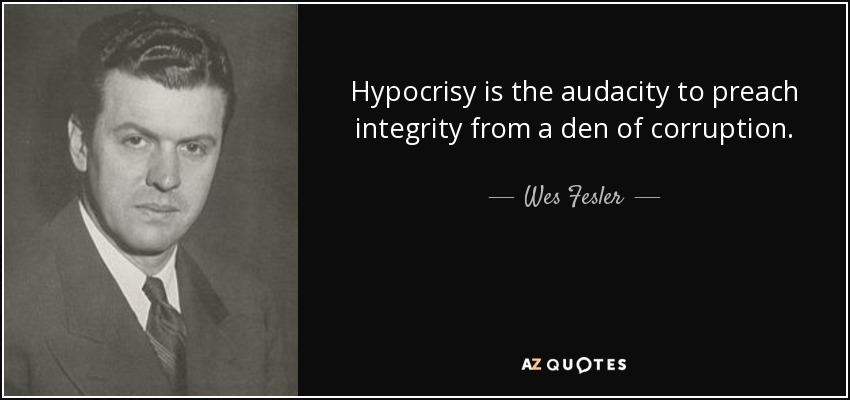
Hypocrisy is the audacity to preach integrity from a den of corruption. Wes Fesler
.
.
Click the link below for the article:
.
__________________________________________
 James' World 2