
11th United States Colored Infantry Regiment (New)
Assorted human interest posts.
February 11, 2026
February 11, 2026
February 11, 2026
It Was Just an Accident (Persian: یک تصادف ساده, romanized: Yek tasādof-e sāde; French: Un simple accident) is a thriller written and directed by Jafar Panahi. The film is a co-production between Iran, France, and Luxembourg. It Was Just an Accident was theatrically released in France on 1 October 2025 by Memento Distribution. The film […]
IT WAS JUST AN ACCIDENT (2025) – My rating 8/10
February 11, 2026

Hollywood legend Chuck Norris shares how faith in God transformed his life and revealed that God’s plan was greater than his own success. Veteran Hollywood actor and martial arts icon Chuck Norris has shared a powerful testimony about how his life changed when he discovered that God’s plan was far greater than his personal ambitions […]
HOLLYWOOD ACTOR CHUCK NORRIS REVEALS HOW GOD’S PLAN WAS GREATER THAN HIS OWN
February 11, 2026
If I Had Legs I’d Kick You is a psychological comedy-drama, written and directed by Mary Bronstein. The film had its world premiere at the Sundance Film Festival on January 24, 2025, and a domestic release by A24 on October 10, 2025, to positive reviews. The film’s performance received universal acclaim, earning a Silver Bear […]
IF I HAD LEGS I’D KICK YOU (2025) – My rating: 7/10
February 11, 2026
Blue Moon is a 2025 American biographical comedy-drama directed by Richard Linklater and written by Robert Kaplow, inspired by the letters of Elizabeth Weiland to Lorenz Hart. It tells the story of Lorenz Hart’s struggles with alcoholism and mental health as he tries to save face during the opening of “Oklahoma!“, a new musical by […]
BLUE MOON (2025) – My rating: 8/10
February 10, 2026
Business, Food For Thought, Human Interest, Political, Science, Technical amazon, business, Business News, current-events, Future, Hotels, human-rights, medicine, mental-health, research, Science, Science News, technology, Technology News, travel, vacation Leave a comment

Click the link below the picture
.
The big bang wasn’t a bang in the traditional sense—but it was nonetheless the start of important things: for one, space; another, time. Thirdly, it began the conditions and processes that eventually resulted in us humans, who can sit here and wonder about space and time. The Big Bang was, effectively, the beginning of the universe. According to the logic of human brains, it seems like there must have been something before the Big Bang, even if “before” is the wrong word because there was no time until after.
The good news for us is that physicists do have ways of thinking about—and even empirically studying—the origins of the origin of the universe. Counterintuitive and impossible as it may seem, cosmologists are even making progress in determining which wild ideas might peel back the veil on that early era, even though it remains inaccessible to telescopes.
For millennia, what happened before and at the beginning of the universe was not a question scientists could even scratch at. Cosmological queries were the dominion of philosophers, says Jenann Ismael—herself a philosopher of physics at Johns Hopkins University. The most fundamental query, of course, is where we come from—a question as popular among philosophers as it is with the rest of us. Other questions, Ismael says, include doozies such as “What are space and time? Does time have a beginning? Does space have boundaries?”
Even after cosmology became a hard science, the field was a bit sketchy, Ismael says. “The science was one-and-a-half facts,” she adds. The sentiment, she says, is usually attributed to physicist James Jeans. But that has changed in the past century or so as the philosophers’ musings have wandered into the realm of theory, experiment, and data. “These old conceptual questions are arising in ways that have new angles, a new spin, and a new framework,” Ismael continues.
It’s unclear whether science as a discipline—and scientists as people—will ever be able to answer some questions definitively. After all, no one can “see” before the Big Bang, and no one will ever be able to—at least not directly. But the current and future universe, researchers are learning, may contain clues about the distant past.
And as scientists push the boundaries of what can be known, they are testing their theories about the before before—the only way to get closer to potential truth. “I’m happy to listen to any framework, but I only start taking it seriously when it produces a clean observational target that a real instrument can go after,” says Brian Keating, a cosmologist at the University of California, San Diego. “If there isn’t a discriminant you can measure, you’re doing metaphysics with equations.”
Here are three ideas that he and other scientists take seriously about the cosmos’s ultimate origins.
The No-Boundary Proposal
Quantum mechanics is the physics of the extremely small, ruled by statistics and uncertainty. It’s also what may have shaped the early universe. To understand the quantum cosmos, scientists calculate the probability of a given output from a certain input.
In cosmology, the “output” is the universe as it looks today. “The question is: What should the input be?” says Jean-Luc Lehners, former head of the Theoretical Cosmology group at the Max Planck Institute for Gravitational Physics (Albert Einstein Institute) in Germany.
Physicists can break up the problem into chunks of outputs and inputs. If they consider the modern universe to be the output, they can try to figure out what input might have produced it. Then they can step backward by taking that input as a new output and determine what conditions earlier in the universe might have produced that state, and so on. They can theoretically (if they have a lot of time on their hands) do that forever, going in steps to reach the before before—and even before that.
That infinite regression, however, didn’t make sense to physicists Stephen Hawking and James Hartle, who worked on the question together in the 1980s. They decided to eliminate the universe’s ultimate input—its “beginning.” Instead, they formed a model of the universe called the no-boundary proposal. They suggested time and space form a closed, rounded surface: a four-dimensional hemisphere of spacetime.
Does that not make sense? Try this: imagine the universe like the globe of Earth. The big bang is the North Pole. There is no “before” it, just as there is no north of north. Before becomes irrelevant as a concept. “It’s almost like a Zen idea,” Lehners says. And it’s one he’s toying with in calculations to see if he can re-create the universe we see today from a round place with no north of north.
“The no-boundary proposal has a decent amount of support, or at least interest, within the physics community,” says Sean Carroll, a professor of natural philosophy at Johns Hopkins University. He notes that some scientists worry about how well-defined the idea is, but he finds it to be a “natural starting point,” given what we know about quantum gravity.
A Bouncing, Cyclic Cosmos
Paul Steinhardt, a physicist at Princeton University, has another idea about what happened before the universe as we know it began. It stands in opposition to an idea that he helped shape: this concept suggests that, after the Big Bang, spacetime expanded very quickly for a very short period of time called inflation. The inflation scenario is meant to explain why the universe looks flat and similar in every place our telescopes can look.
After helping to establish inflation theory, however, Steinhardt started doubt the idea—in part because it has required constant tweaking to keep it consistent with our measurements of the cosmos. “It’s really hard to think of a historical example where that actually led to what turns out to be the right answer,” Steinhardt says. “Almost always, that’s a sign that the Titanic is sinking.”
Time to get in a lifeboat, he thought. So he came up with a cyclic universe: one that balloons significantly in size, as ours seems to be doing now, then shrinks a little and then starts expanding all over again. “When people think about contracting universes, they’re usually thinking about things coming to a crunch,” Steinhardt says—the cosmos collapsing back down into an infinitesimally small point. That’s not what Steinhardt is talking about: he thinks the universe perhaps contracts slowly—to a smaller fraction of its size but not to nothing. That shrinking smooths things out in ways inflation fails to explain, he says, while still producing a cosmos that appears flat and the same in all directions.
Steinhardt adds that what looks like a big bang is actually not: the universe expands, then slowly contracts, and then quickly goes back to expanding. The fast transition between contraction and expansion is not a bang but a “big bounce.”
teinhardt hopes to test this idea not just by examining the past but also by taking data from the present and watching the future carefully. “It makes an obvious prediction, which is that the current phase of accelerated expansion can’t continue forever,” Steinhardt says. “It must end.” This idea, in turn, raises a new question: “Could it already be in the process of ending now?” he asks.
Our measurements about how the universe is expanding come from relatively faraway objects that emitted their light a long time ago. Things could have changed, and we might not know yet because the effects would be hard to measure. “We’d have to look at objects very close by in order to detect it,” Steinhardt says. That’s not cosmologists’ forte, and they would have to develop new techniques and instruments to look nearby for such effects.
Even more intriguingly, Steinhardt says that because “nothing bad happens to space” during the contraction and bounce, information—even objects such as black holes—can pass from before the bounce to after. “There might be things in our observable universe which are from before,” he says. Keep an eye out.
Mirror Universe
Another big idea about the before before is of interest to Latham Boyle, a researcher at the Higgs Center for Theoretical Physics at the University of Edinburgh, who was formerly Steinhardt’s graduate student. Like the big bounce concept, Boyle’s favored proposal is pretty simple conceptually—and it similarly eschews inflation. “There’s the universe after the big bang and the universe before the big bang,” he says, “and they’re kind of mirror copies of one another.”
Picture this, Boyle says, like the points of two ice cream cones touching each other, with their contact representing the Big Bang. “Time marches away from the big bang in both directions,” he says. On our side, it goes forward; on the mirror side, it goes backward. What happened before the Big Bang is the reflected opposite of what happened after. And that doesn’t just include time: here, there is matter; there, there is antimatter. Here, left is left; there, left is right.
Boyle has ideas for observations that could support (or nullify) his theory, which is called the CPT-symmetric (charge-parity-time-symmetric) universe. For one, a CPT-symmetric universe wouldn’t have sent gravitational waves shimmering through space from the beginning of the universe, as classical cosmology theories predict. Astronomers have been hunting for such signals. If these waves are eventually detected, that would rule this idea out.
Boyle’s hypothesis also predicts that dark matter could be explained by a particular kind of neutrino. He hopes cosmological instruments will reveal more information about neutrinos soon. The model’s connection to particle physics, among other aspects, makes this idea intriguing, Carroll says.
“What I like here is the economy,” Keating says, “and the fact that it sticks its neck out,” focusing on the kinds of specific, physical predictions experimentalists like him need.
The Test of Time
Each of these scientists is attached to their own idea. But Lehners, interviewed late last year, isn’t confident any of them will stand the test of time—whatever time is. “I think it’s completely preposterous that, in the year 2025, we should understand the beginning of the universe,” he says. “Why not in the year 2,000,025 or whatever?”
nd even if researchers think they are getting close, they could be approaching a false summit: that frustrating place that looks, when you’re hiking, like the top of the mountain but is actually a mere bump blocking your view of the true peak—or your view of what you think is the true peak but is, in fact, just another bump. “In general, I think that it’s extremely plausible that there was something before the big bang,” Carroll says, “but it’s also very plausible that the big bang was truly the beginning. There’s too much we’re just unsure about, and I am a bit skeptical that the state of the art is good enough to allow us to draw any firm experimental or observational conclusions out of any of these models.”
But cosmologists aren’t studying the ultimate origins because they think the mystery will be resolved in their lifetime. Lehner imagines himself as part of an intergenerational project helping humanity trek closer and closer to a truth we may never find.
Studying such a physically and philosophically inaccessible topic is fundamentally different from other types of science—those quests at least exist in our plane of space and time. It almost seems like the question isn’t actually within the realm of science. But science often involves probing things we cannot access, at least at the start, philosopher of physics Ismael says. Scientists predicted atoms before we could see them, and black holes and dark matter still lie beyond our ability to detect directly—yet investigating them is clearly scientific. “I think the benchmark for what counts as science has moved,” she says. And it will continue to—including, perhaps, backward to the before that may not be a before.
.
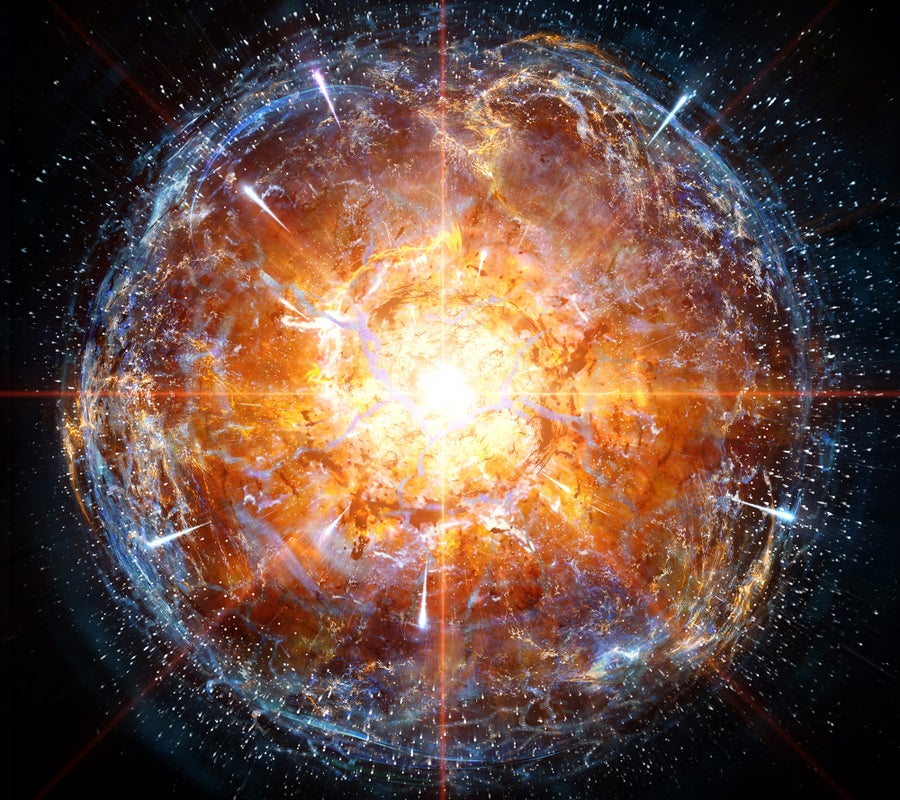 All About Space/Getty Images
.
.
Click the link below for the complete article:
.
__________________________________________
February 10, 2026
Business, Food For Thought, Human Interest, Political, Science, Technical amazon, business, Business News, current-events, Future, Hotels, human-rights, medicine, mental-health, research, Science, Science News, technology, Technology News, travel, vacation Leave a comment

Click the link below the picture
.
With the Milano Cortina Olympics officially under way, it’s time to spend the next two weeks becoming ridiculously obsessed with a group of elite winter athletes. Oh, but there are so many sports and so many cuties, and your boss says it’s “unprofessional” to have Peacock streaming on your second monitor all day? I’ve got you. Here, all the stars, moments, and cafeteria dispatches you should know about from the Winter Olympics.
Tomàs-Llorenç Guarino Sabaté
There was a point last week when it looked like Guarino Sabaté wasn’t going to be allowed to perform his Minions-inspired short program. However, if enough people get upset about something, suddenly a “copyright-clearance issue” can disappear. Thankfully for all of us, Guarino Sabaté took to the ice in his full Minions regalia and had a blast doing it.
Sturla Holm Lægreid
Men will really air out your business on the world stage instead of going to therapy! After winning a bronze medal, Norwegian biathlete Sturla Holm Lægreid told the Norwegian Broadcasting Corporation that he cheated on his girlfriend three months ago and came clean just before the Games. “I told her a week ago. And it’s been the worst week of my life,” Lægreid said. The athlete admitted that she dumped him (good for her) and that he hoped “committing social suicide” by coming clean on TV “might show her how much I love her.” I hope he has a backup plan.
Team USA’s first gold medal at the Games came from downhill skier Breezy Johnson. Unfortunately, it broke almost immediately. Following her podium ceremony, Johnson’s medal became disconnected from its ribbon and broke into three pieces. This may be something for the International Olympic Committee to look into — Alysa Liu’s gold medal also broke almost immediately. Hopefully, they have hot-glue guns in Italy.
The Curling Baby!
Switzerland’s mixed-doubles curling team is a married couple: Briar Schwaller-Hürlimann and Yannick Schwaller. That is already cute, but they brought their 18-month-old, River, to the Olympics as well. To make matters even cuter, the kid clearly has a knack for his parents’ sport. A not-insignificant chunk of NBC’s curling coverage was focused on River, who already handles the broom like a pro.
.
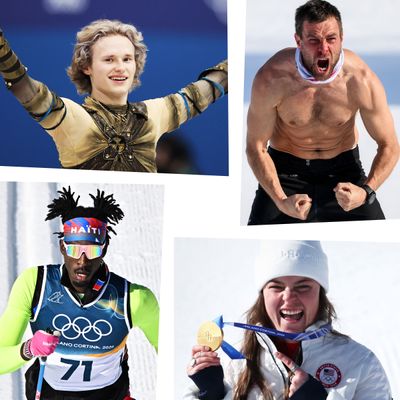
Photo-Illustration: by The Cut; Photos: Getty Images
.
.
Click the link below for the complete article (plus associated videos and post):
.
__________________________________________
February 10, 2026
Business, Food For Thought, Human Interest, Political, Science, Technical amazon, business, Business News, current-events, Future, Hotels, human-rights, medicine, mental-health, research, Science, Science News, technology, Technology News, travel, vacation Leave a comment

Click the link below the picture
.
After it became known that Jeffrey Epstein was under investigation in the 2000s, one of the first calls the Palm Beach police received was from Donald J. Trump, the local police chief at the time told the F.B.I. more than a decade later.
Mr. Trump reportedly told the chief, Michael Reiter, “Thank goodness you’re stopping him, everyone has known he’s been doing this,” according to a document recounting their conversation that is part of the tranche of Epstein files released by the Justice Department.
Mr. Trump said it was known in New York circles that Mr. Epstein was disgusting and suggested that the police also focus their investigation on Mr. Epstein’s associate Ghislaine Maxwell, according to the memo. “She is evil,” Mr. Trump reportedly said.
Mr. Trump also told the police chief that he was around Mr. Epstein once when teenagers were present and that he “got the hell out of there,” according to Mr. Reiter’s account.
The former chief described his conversation with Mr. Trump to the F.B.I. in October 2019, two months after Mr. Epstein was found dead in his jail cell while awaiting trial on federal sex trafficking charges, the memo shows. Mr. Reiter told The Miami Herald, which reported on the document earlier, that the call with Mr. Trump occurred in July 2006.
The account highlights the shifting explanations Mr. Trump has given about what he knew — and didn’t know — about Mr. Epstein and Ms. Maxwell. He has denied knowledge of Mr. Epstein abusing underage girls, but also said last year that the financier “stole” young women who worked at his Mar-a-Lago club. The White House has said Mr. Trump barred Mr. Epstein from the club “for being a creep.”
After Ms. Maxwell was arrested, Mr. Trump did not raise any concerns about her behavior. “I just wish her well, frankly,” Mr. Trump said of Ms. Maxwell in 2020. “I’ve met her numerous times over the years, especially since I lived in Palm Beach.”
Karoline Leavitt, the White House press secretary, said she could not confirm the call had taken place but that, if it had, it would corroborate Mr. Trump’s statements that he had kicked Mr. Epstein out of Mar-a-Lago.
She said the phone call “may or may not have happened in 2006 — I don’t know the answer to that question.”
“What I’m telling you is that what President Trump has always said is that he kicked Jeffrey Epstein out of his Mar-a-Lago club, because Jeffrey Epstein was a creep,” she added. “And that remains true, and this call, if it did happen, corroborates exactly what President Trump has said from the beginning.”
In the F.B.I.’s written account of the interview with Mr. Reiter, Mr. Trump is depicted as someone eager to relay to the police his concerns about Mr. Epstein’s conduct.
But in July 2019, shortly after Mr. Epstein’s arrest, Mr. Trump was asked by reporters if he had “any suspicions” that Mr. Epstein “was molesting young women, underaged women.”
“No, I had no idea. I had no idea,” Mr. Trump said at the time. “I haven’t spoken to him in many, many years. But I had — I didn’t have no idea.”
The White House on Tuesday referred questions about Mr. Reiter’s account to the Justice Department. The Justice Department, in a statement, said it had not corroborated the chief’s recollection of the conversation: “We are not aware of any corroborating evidence that the president contacted law enforcement 20 years ago.”
Mr. Reiter declined to comment.
Speaker Mike Johnson last year described Mr. Trump as an “informant” against Mr. Epstein. Mr. Johnson later clarified his remarks, saying he was not sure he used the right word, but that “President Trump was never a hindrance to the Epstein investigation. He was trying to assist in that.”
Mr. Trump has said that he “didn’t know” why Mr. Epstein was recruiting employees from Mar-a-Lago, but claimed that he threw him out of the club amid a dispute over stealing spa workers.
But other documents in the Epstein files appear to undercut that account, according to Representative Jamie Raskin, Democrat of Maryland, who reviewed unredacted portions of the documents this week.
“Epstein’s lawyers synopsized and quoted Trump as saying that Jeffrey Epstein was not a member of his club at Mar-a-Lago, but he was a guest at Mar-a-Lago, and he had never been asked to leave,” Mr. Raskin said.
“It seems to be at odds with some things that President Trump has been saying recently about how he had kicked Jeffrey Epstein out of the club,” he added.
Revelations about Mr. Trump’s connections to Mr. Epstein have been a constant source of headache for the White House as it has tried to distance the president from the notorious sex offender.
Mr. Trump was friendly for at least 15 years with Mr. Epstein, and they were repeatedly spotted together at parties. But Mr. Trump has frequently tried to downplay their relationship.
Mr. Trump has said that the men broke off contact years ago, though there have been several explanations for the falling out.
In 2002, Mr. Trump told New York magazine, “I’ve known Jeff for 15 years. Terrific guy. He’s a lot of fun to be with. It is even said that he likes beautiful women as much as I do, and many of them are on the younger side.”
But two years after Mr. Trump called Mr. Epstein a “terrific guy,” the two men became rivals over an oceanfront Palm Beach mansion that had fallen into foreclosure.
Mr. Epstein pleaded guilty in 2008 to soliciting prostitution involving a minor.
After being indicted on federal sex trafficking charges in 2019, he hanged himself in his jail cell that year, according to local and federal authorities. Ms. Maxwell, his longtime confidante, is serving a 20-year prison sentence after being convicted in 2021 of conspiring with Mr. Epstein for nearly a decade to aid in his abuse.
She recently invoked her Fifth Amendment right against self-incrimination under questioning from the House Oversight Committee.
.

The former police chief’s account highlights the inconsistent statements President Trump has made over the years about his relationship with both Jeffrey Epstein and Ghislaine Maxwell. Credit…Kenny Holston/The New York Times
.
.
Click the link below for the complete article:
.
__________________________________________
¡Bienvenido de vuelta viajero!
so looking to the sky ¡ will sing and from my heart to YOU ¡ bring...
CEO and Founder of Nsight Health
https://www.tangietwoods
Catholic News, Prayers, HD Images, Rosary, Music, Videos, Holy Mass, Homily, Saints, Lyrics, Novenas, Retreats, Talks, Devotionals and Many More
Decoding Power. Defying Narratives.
A creative collaboration introducing the art of nature and nature's art.
The Home Of Entertainment News, Reviews and Reactions
Hollow Earth Society
•Whenever you are confronted with an opponent, conquer him with love.(Gandhi)
Algotrader at TRADING-CLUBS.COM
Film and Writing Festival for Comedy. Showcasing best of comedy short films at the FEEDBACK Film Festival. Plus, showcasing best of comedy novels, short stories, poems, screenplays (TV, short, feature) at the festival performed by professional actors.
Peace. Tranquility. Insanity.
Take a ride on the wild side
Découvre des musiques prometteuses (principalement) dans la sphère musicale française.
No tiene que Ser una Pesadilla.
Life in Kana-text (er... CONtext)
Tracking money, power, and meaning across borders.
Where feelings meet metaphors and make questionable choices.
Finding hope and peace through writing, art, photography, and faith in Jesus.
Eyasu
The Community for Wounded Healers: Former Medical Students, Disabled Nurses, and Faith-Fueled Pivots
love each other like you're the lyric to their music
Comprendere il mondo per cambiarlo.
Mid-Life Ponderings
Travel,Tourism, Life style "Now in hundreds of languages for you."
I speak the honest truth. I share my honest opinions. I share my thoughts. A platform to grow and get surprised.
User-generated ratings for ethical consumerism
Travel and Lifestyle Blog
Questo è un piccolo angolo di poesie, canzoni, immagini, video che raccontano le nostre emozioni
“Log your journey to success.” “Where goals turn into progress.”
scrivo per dare forma ai silenzi e anima alle storie che il mondo dimentica.
“Dream deeper. Believe bolder. Live transformed.”
Vichar, Motivation, Kadwi Baat ( विचार दर्शनम्)
Traum zur Realität
Savor. Style. See the world.
معا نحو النجاح
Best Forex Broker Ratings & Reviews
art, writing and music by James McFarlane and other musicians
living life in conscious reality
Freelance poetry writing
Peace 🕊️ | Spiritual 🌠 | 📚 Non-fiction | Motivation🔥 | Self-Love💕
 James' World 2