
First Black Speaker of South Carolina House of Representatives, K. Leroy Irvis
Assorted human interest posts.
June 19, 2025

Ever felt like throwing in the towel after a setback?Don’t! Think of failure not as a stop sign, but a vital part of your journey. Every stumble, every mistake, is actually a hidden lesson, guiding you closer to your goal. It’s like learning to ride a bike, you fall, you get back up, and eventually, […]
True me.. Tap-2166..
June 18, 2025
Business, Food For Thought, Human Interest, Political, Science, Technical amazon, business, Business News, current-events, Future, Hotels, human-rights, medicine, mental-health, research, Science, Science News, technology, Technology News, travel, vacation Leave a comment

Click the link below the picture
.
Ole Ginnerup Schytz, an engineer in Denmark’s sleepy Vindelev agricultural area, had used a metal detector only a handful of times when he found a bent clump of metal in a friend’s barley field. He figured it was the lid from a container of tinned fish and tossed it in his junk bag with the other bits of farm trash that had set his metal detector beeping: rusty nails, screws, scrap iron. A few paces away he dug up another shiny circle. Someone had clearly enjoyed a lot of tinned fish here—into the sack it went. But when Ginnerup found a third metal round, he stopped to take a closer look. Wiping the mud from its surface, he suddenly found himself face-to-face with a Roman emperor. At that point he had to admit “they weren’t food cans,” Ginnerup recalls with a chuckle.
After a brief intermission for an online Teams meeting for work that December day in 2020, Ginnerup dug up 14 glittering gold disks—some as big as saucers—that archaeologists say were buried about 1,500 years ago, during a time of chaos after ash clouds from a distant volcanic eruption created a miniature ice age. Four medallions feature Roman emperors, and several bear intricate geometric patterns. But the real showstopper is an amulet called a bracteate with two stylized designs: a man in profile, his long hair pulled back in a braid, and a horse in full gallop. An expert in ancient runes says she was awestruck when she finally made out the inscription on top: “He is Odin’s man.”
These embossed runes are the oldest known written mention of Odin, the Norse god of war and ruler of Valhalla. Ginnerup’s bracteate, which archaeologists describe as the most significant Danish find in centuries, extended the worship of Odin back 150 years—and it’s all because Ginnerup received a metal detector as a birthday present from his father-in-law.
Many other European countries have prohibited or heavily restricted hobbyist metal detecting, but Denmark has embraced it, creating a system for members of the public to hand over finds to government archaeologists. The result has been an embarrassment of riches, with more than 20,000 items turned in annually in recent years. The curators assigned to identify and catalog the artifacts can’t dream of keeping up, but the fruits of their collective labor are clear: whereas neighboring countries have only vague sketches of the past, metal detectorists have filled in the ancient map of Denmark with temple complexes, trade routes and settlements that would have otherwise been lost to history.“
Private detectorists have rocketed Denmark ahead of its neighbors in archaeological research,” says Torben Trier Christiansen, curator of archaeology at Denmark’s North Jutland Museums. “There’s nothing ‘amateur’ about them.”
Denmark has been inhabited since the end of the last ice age, when nomadic hunter-gatherers from southern Europe arrived following the migration of reindeer and retreating glaciers as early as 12,500 years ago. The ancestors of modern ethnic Danes showed up some 5,000 years ago, journeying from the steppes of what is now Ukraine and southwestern Russia. Their descendants lived in small farming communities across Scandinavia for thousands of years, building megaliths and barrows for their honored dead and making human sacrifices in bogs to appease their gods.
In the early centuries of the common era, these farming communities coalesced into a series of Germanic tribes—the Cimbri, the Teutons, the Jutes, the Angles, and the Danes—who became skilled seafarers, explorers, and metalworkers. Because precious metals—including silver, gold, and the components of bronze—do not occur naturally in what is now Denmark, its denizens had to barter for or steal these metals from abroad. They traded extensively with the Roman Empire, which never reached as far north as Scandinavia.
.
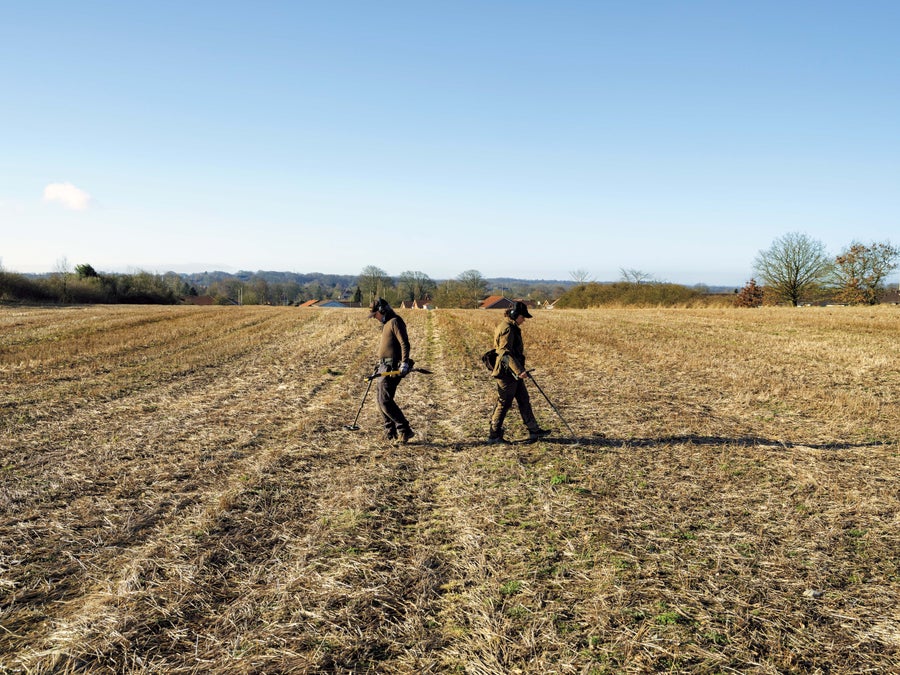
Kristen Nedergaard Driøe (left) and Marie Aagard Larsen (right) swing their metal detectors over a field where grain is typically grown in southern Denmark. Alastair Philip Wiper
.
.
Click the link below for the complete article:
.
__________________________________________
June 18, 2025
Business, Food For Thought, Human Interest, Political, Science, Technical amazon, business, Business News, current-events, Future, Hotels, human-rights, medicine, mental-health, research, Science, Science News, technology, Technology News, travel, vacation Leave a comment

Click the link below the picture
.
The “Godfather of AI” says that some fields are safer than others when it comes to being replaced by AI.
Geoffrey Hinton, 78, is often referred to as the Godfather of AI due to his pioneering work on neural networks, which began in the late 1970s. He won the 2024 Nobel Prize in Physics for his work on machine learning and is currently a professor emeritus in computer science at the University of Toronto.
In a recent interview on the podcast “Diary of a CEO” that aired on Monday, Hinton said AI has the potential to cause mass joblessness.
“I think for mundane intellectual labor, AI is just going to replace everybody,” Hinton said. “Mundane intellectual labor” refers to white-collar jobs. He specified that the replacement would take the form of “a person and an AI assistant” doing the work that “ten people did previously.”
Hinton gave one example, noting that paralegals were at risk of losing their jobs to AI, and said that he would be “terrified” to work in a call center right now, due to the potential for automation. However, he pointed out that blue-collar work would take a longer time to be replaced by AI.
“I’d say it’s going to be a long time before it [AI] is as good at physical manipulation,” Hinton said in the podcast. “So, a good bet would be to be a plumber.”
In the interview, Hinton also challenged the notion that AI would create new jobs, stating that if AI automated intellectual tasks, there would be few jobs left for people to do.
“You’d have to be very skilled to have a job that it [AI] just couldn’t do,” Hinton said.
AI has the potential to decrease hiring, especially for entry-level jobs. A report released last month from venture capital firm SignalFire found that big tech companies have stopped hiring new graduates for entry-level roles as much as they did in the past, and AI is a significant reason for the decline.
The report found that the percentage of new graduate hires at companies like Meta and Google dropped by 25% from 2023 to 2024, reaching just 7% in 2024.
It’s not just the tech industry — Wall Street also shows signs of being impacted by AI. In March, Morgan Stanley announced layoffs of 2,000 employees, intending to replace some with AI. A report released in January from Bloomberg Intelligence showed that AI could cause as many as 200,000 job cuts across 93 major banks, including Citigroup and JPMorgan, within the next five years.
.
 Geoffrey Hinton. Photo By Ramsey Cardy/Sportsfile for Collision via Getty Images
.
.
Click the link below for the complete article:
.
__________________________________________
June 17, 2025
Business, Food For Thought, Human Interest, Political, Science, Technical amazon, business, Business News, current-events, Future, Hotels, human-rights, medicine, mental-health, research, Science, Science News, technology, Technology News, travel, vacation Leave a comment
Click the link below the picture
.
Astrophysics is, as many astrophysicists will tell you, the story of everything. The nature and evolution of stars, galaxies, galaxy clusters, dark matter, and dark energy—and our attempts to understand these things—allow us to pose the ultimate questions and reach for the ultimate answers. But the practitioners of these arts, as the late astronomer Vera Rubin wrote in her autobiography’s preface, “too seldom stress the enormity of our ignorance.”
“No one promised that we would live in the era that would unravel the mysteries of the cosmos,” Rubin wrote. And yet a new observatory named for her, opening its eyes soon, will get us closer than ever before to unraveling some of them. This will be possible because the Vera C. Rubin Observatory will do something revolutionary, rare, and relatively old-fashioned: it will just look out at the universe and see what there is to see.
Perched on a mountaintop in the Chilean Andes, the telescope is fully assembled and operating, although scientists are not able to use it just yet. A few weeks of testing remain to ensure that its camera—the largest in astronomical history, with a more than 1.5-meter lens—is working as it should. Engineers are monitoring how Earth’s gravity causes the telescope’s three huge glass mirrors to sag and how this slight slumping will affect the collection and measurement of individual photons, including those that have traveled for billions of light-years to reach us. They are also monitoring how the 350-metric-ton telescope will rapidly pan across seven full moons’ worth of sky, stabilize and go completely still, and take two 15-second exposures before doing it all over again all night long.
In this fashion, the scope plans to canvas the entire sky visible from Earth’s Southern Hemisphere every three nights, remaking an all-sky map over and over again and noticing how it changes. And computer scientists are finalizing plans for how to sift through 20 terabytes of data every night, which is 350 times more than the data collected by the vaunted James Webb Space Telescope each day. Others are making sure interesting objects or sudden cosmic surprises aren’t missed among Rubin Observatory’s constant stream of images. Software will search for differences between each map and send out an alert about each one; there could be as many as 10 million alerts a night about potential new objects or changes in the maps.
From finding Earth-grazing asteroids and tiny failed stars called brown dwarfs to studying the strangely smooth rotation of entire galaxies sculpted by dark matter, the Rubin Observatory’s mission will encompass the entire spectrum of visible-light astronomy. The telescope will continue mapping the sky for 10 years. It may be better poised to answer astrophysicists’ deepest questions than any observatory built to date.
“The potential for discovery is immense,” said Christian Aganze, a galactic archaeologist at Stanford University, who will use the observatory’s data to study the history of the Milky Way.
The Rubin Observatory’s Mission
The observatory’s goal was not always so broad. Originally named the Large Synoptic Survey Telescope (LSST), the Rubin Observatory was initially proposed as a dark-matter hunter. Vera Rubin found the first hard evidence for what we now call dark matter, a gargantuan amount of invisible material that shapes the universe and the way galaxies move through it. She and her colleague, the late astronomer Kent Ford, were studying the dynamics of galaxies when they made the discovery in the 1970s.
.

View of Rubin Observatory at sunset in May 2024. The 8.4-meter Simonyi Survey Telescope at Rubin Observatory, equipped with the LSST camera, the largest digital camera in the world, will take enormous images of the Southern Hemisphere sky, covering the entire sky every few nights. Olivier Bonin/SLAC National Accelerator Laboratory
.
.
Click the link below for the complete article:
.
__________________________________________
June 17, 2025
Business, Food For Thought, Human Interest, Political, Science, Technical amazon, business, Business News, current-events, Future, Hotels, human-rights, medicine, mental-health, research, Science, Science News, technology, Technology News, travel, vacation Leave a comment

Click the link below the picture
.
A doctor in Florida has used a robot to remotely perform surgery on a cancer patient thousands of miles away in Africa.
Vipul Patel, the medical director of the Global Robotic Institute at Orlando’s Advent Health, recently performed a prostatectomy, which removes part or all of the prostate, on Fernando da Silva of Angola, ABC News reported in an exclusive story from medical correspondent Dr. Darien Sutton on Tuesday.
Da Silva, 67, was diagnosed with prostate cancer in March, and in June, Patel cut out the cancer using transcontinental robotic telesurgery. The surgery was a success, according to ABC News.
Prostate cancer is very prevalent in Africa, Patel told the network, adding, “In the past, they really haven’t monitored it well or they haven’t had treatments.”
“We’ve been working on this really for two years,” Patel said. “We traveled the globe, looking at the right technologies.”
Da Silva was the first patient in a human clinical trial approved by the Food and Drug Administration to test this technology.
Surgeons have used a multimillion-dollar robot to operate on patients using “enhanced visuals and nimble controls” before, ABC News reported, but they are often near their patients when operating the machine.
Patel used fiber optic cables to test the technology at a long distance from his patient. “There was no perceptible delay in my brain,” the doctor said.
His surgical team was in the operating room with Da Silva just in case they had to jump in.
“We made sure we had plan A, B, C, and D. I always have my team where the patient is,” the doctor said.
In case something went awry with the telecommunications, “the team would just take over and finish the case and do it safely,” he said.
Reflecting on the surgery, Patel called it “a small step for a surgeon, but it was huge leap for health care.”
.
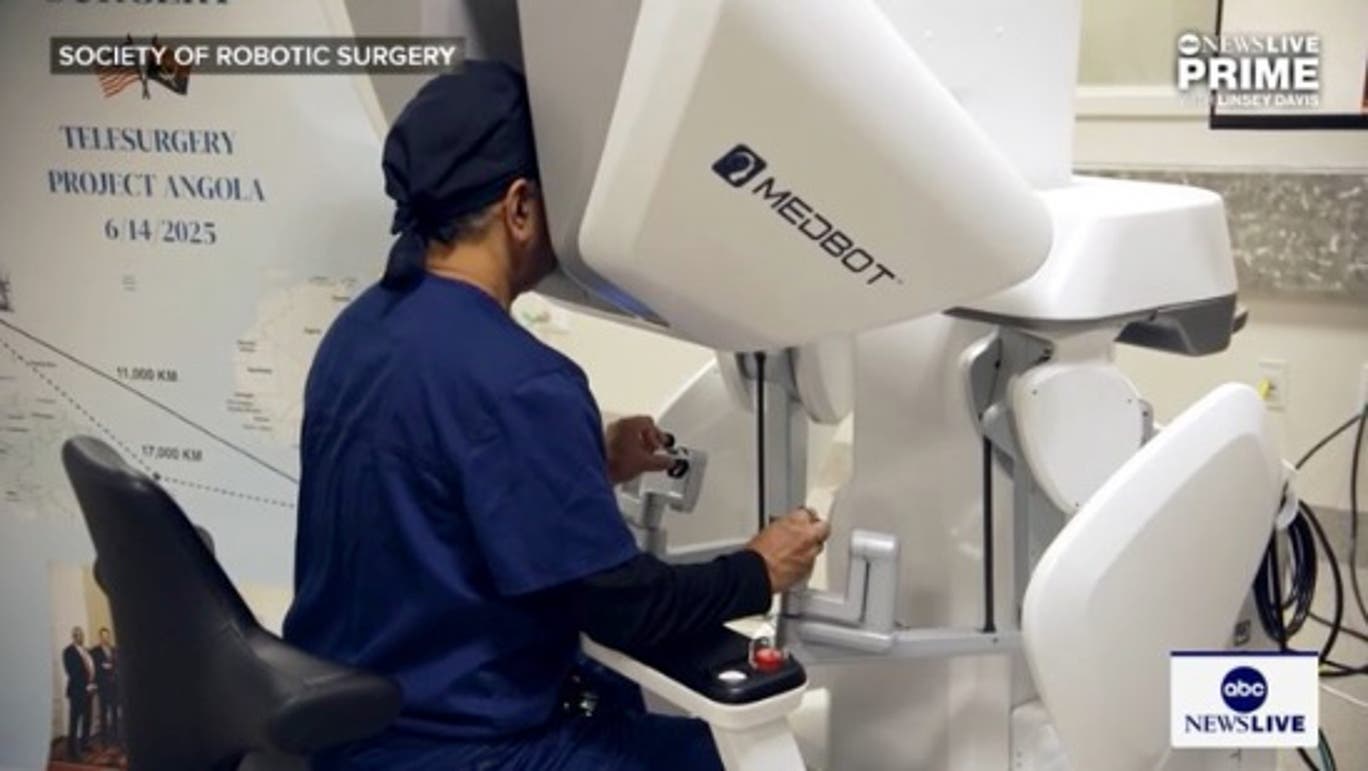 Dr. Vipul Patel in Florida used a robot to remotely perform surgery on a cancer patient thousands of miles away in Africa
.
.
Click the link below for the complete article:
.
__________________________________________
https://www.tangietwoods
¡Bienvenido de vuelta viajero!
so looking to the sky ¡ will sing and from my heart to YOU ¡ bring...
CEO and Founder of Nsight Health
Catholic News, Prayers, HD Images, Rosary, Music, Videos, Holy Mass, Homily, Saints, Lyrics, Novenas, Retreats, Talks, Devotionals and Many More
Decoding Power. Defying Narratives.
A creative collaboration introducing the art of nature and nature's art.
The Home Of Entertainment News, Reviews and Reactions
Hollow Earth Society
•Whenever you are confronted with an opponent, conquer him with love.(Gandhi)
Algotrader at TRADING-CLUBS.COM
Film and Writing Festival for Comedy. Showcasing best of comedy short films at the FEEDBACK Film Festival. Plus, showcasing best of comedy novels, short stories, poems, screenplays (TV, short, feature) at the festival performed by professional actors.
Peace. Tranquility. Insanity.
Take a ride on the wild side
Découvre des musiques prometteuses (principalement) dans la sphère musicale française.
No tiene que Ser una Pesadilla.
Life in Kana-text (er... CONtext)
Where feelings meet metaphors and make questionable choices.
Finding hope and peace through writing, art, photography, and faith in Jesus.
Eyasu
The Community for Wounded Healers: Former Medical Students, Disabled Nurses, and Faith-Fueled Pivots
love each other like you're the lyric to their music
Comprendere il mondo per cambiarlo.
Mid-Life Ponderings
Travel,Tourism, Life style "Now in hundreds of languages for you."
I speak the honest truth. I share my honest opinions. I share my thoughts. A platform to grow and get surprised.
User-generated ratings for ethical consumerism
Travel and Lifestyle Blog
Questo è un piccolo angolo di poesie, canzoni, immagini, video che raccontano le nostre emozioni
“Log your journey to success.” “Where goals turn into progress.”
scrivo per dare forma ai silenzi e anima alle storie che il mondo dimentica.
“Dream deeper. Believe bolder. Live transformed.”
Vichar, Motivation, Kadwi Baat ( विचार दर्शनम्)
Traum zur Realität
Savor. Style. See the world.
معا نحو النجاح
Best Forex Broker Ratings & Reviews
art, writing and music by James McFarlane and other musicians
living life in conscious reality
Freelance poetry writing
Peace 🕊️ | Spiritual 🌠 | 📚 Non-fiction | Motivation🔥 | Self-Love💕
Reiseberichte & Naturfotografie
 James' World 2