
Packed in Ships Like Sardines by Tangie T. Woods
Assorted human interest posts.
July 12, 2025
July 11, 2025
Business, Food For Thought, Human Interest, Political, Science, Technical amazon, business, Business News, current-events, Future, Hotels, human-rights, medicine, mental-health, research, Science, Science News, technology, Technology News, travel, vacation Leave a comment

Click the link below the picture
.
Grant cancellations and budget reductions at the National Institutes of Health have put millions of dollars in research for promising new cancer treatments, tuberculosis therapies, and much more in jeopardy. Our elected officials could intervene if all Americans, not just academics, were to send a clear signal that they should. Instead, much of the public has shrugged its shoulders.
University and Princeton University. The Department of Education has opened investigations into 60 universities over allegations of antisemitism, using these inquiries to justify funding cuts and impose policy mandates. The administration has also placed international students under scrutiny, threatening visa revocations and deportations for those participating in campus protests deemed hostile to government interests. The administration has detained foreign-born academics such as Kseniia Petrova, a researcher at Harvard, who was recently released after she was placed in criminal custody for failing to declare research materials at customs.
Collectively, we’re witnessing unprecedented attempts to bully academic institutions with the administration’s ideological aims. These attempts challenge long-standing norms of academic freedom—that is, the ability of a teacher or researcher in higher education to investigate and discuss subjects without fear of political interference. Our elected officials should stand up for scientific research and those who produce it in the face of politically motivated attacks. But public apathy is making it easier for legislators to ignore the problem.
In late March, we worked with YouGov to conduct a nationally representative online survey of 1,500 U.S. adults. We found that while few Americans actively support the president’s attacks on science, many more are unbothered by them.
For example, 65 percent of Americans either have no position (31 percent) or outright support (34 percent) the possibility that the Trump administration might revoke federal funding to universities that support “pro-Palestine / anti-Israel protests”. That possibility became very real on April 21, when the NIH suggested making grant awards conditional on compliance with anti-boycott provisions regarding Israeli companies . Similarly, a majority (67 percent) either take no issue with or outright support revoking funding to universities (like the White House did to the University of Pennsylvania) that allow transgender athletes to compete.
More urgently, defunding and censoring science could have dramatically negative consequences for all Americans. Canceling research on vaccine communication hinders not just our preparedness for future pandemics, but also our response to seasonal flu and COVID. Curtailing studies of health disparities weakens efforts to improve maternal mortality rates, particularly in communities of color, people who have low income and gender-diverse communities. Cutting international academic exchange isolates the U.S. from global scientific collaboration, including partnerships with entities, such as the World Health Organization, that are trying to promote access to lifesaving medical treatments and preventatives.
The costs of academic repression, in other words, are not confined to elite institutions—they are borne by everyone. Yet very few Americans seem to be concerned.
Why is that so? Politically motivated distrust in academic institutions, particularly on the ideological right, may help explain the attitude and why the Trump administration is taking these actions.
.

The John W. Weeks Bridge at Harvard University in Cambridge, Massachusetts. Joe Daniel Price
.
.
Click the link below for the complete article:
.
__________________________________________
July 11, 2025
Business, Food For Thought, Human Interest, Science, Technical amazon, business, Business News, current-events, Future, Hotels, human-rights, medicine, mental-health, research, Science, Science News, technology, Technology News, travel, vacation Leave a comment

Click the link below the picture
.
People are not born racist. As former U.S. President Barack Obama, quoting Nelson Mandela, former president of South Africa, tweeted shortly after the tragic events in Charlottesville August 12, 2017 in which the university town was overtaken by white supremacists and hate groups, resulting in the killing of a counter protester, Heather Heyer, “No one is born hating another person because of the color of his skin or his background or his religion. People must learn to hate, and if they can learn to hate, they can be taught to love, for love comes more naturally to the human heart than its opposite.”
Very young children do not naturally choose friends based on the color of their skin. In a video created by the BBC children’s network CBeebies, Everyone’s Welcome, pairs of children explain the differences between themselves without referring to the color of their skin or ethnicity, even though those differences exist. As Nick Arnold writes in What Adults Can Learn About Discrimination From Kids, according to Sally Palmer, Ph.D., lecturer in the Department of Human Psychology and Human Development at University College London, it is not that they don’t notice the color of their skin, it is that the color of their skin is not what is important to them.
Racism is Learned
Racism is learned behavior. A 2012 study by Harvard University researchers showed that children as young as three years of age can adopt racist behavior when exposed to it, even though they may not understand “why.” According to renowned social psychologist Mazarin Banaji, Ph.D., children are quick to pick up on racist and prejudicial cues from adults and their environment. When white children were shown faces of different skin colors with ambiguous facial expressions, they showed a pro-white bias. This was determined by the fact that they ascribed a happy face to a perceived white skin color and an angry face to a face that they perceived to be black or brown. In the study, Black children who were tested showed no color-bias. Banaji maintains that racial bias can be unlearned, though, when children are in situations where they are exposed to diversity and they witness and are part of positive interactions between different groups of people acting as equals.
Racism is learned by the example of one’s parents, caregivers, and other influential adults, through personal experience, and through the systems of our society that promulgate it, both explicitly and implicitly. These implicit biases permeate not only our individual decisions but also our societal structure. The New York Times has created a series of informative videos explaining implicit biases.
There are Different Types of Racism
According to social science, there are seven main forms of racism: representational, ideological, discursive, interactional, institutional, structural, and systemic. Racism can be defined in other ways as well — reverse racism, subtle racism, internalized racism, colorism.
In 1968, the day after Martin Luther King was shot, the anti-racism expert and former third-grade teacher, Jane Elliott, devised a now-famous but then-controversial experiment for her all-white third-grade class in Iowa to teach the children about racism, in which she separated them by eye color into blue and brown, and showed extreme favoritism toward the group with blue eyes. She has conducted this experiment repeatedly for different groups since then, including the audience for an Oprah Winfrey show in 1992, known as The Anti-Racism Experiment That Transformed an Oprah Show. People in the audience were separated by eye color; those with blue eyes were discriminated against while those with brown eyes were treated favorably. The reactions of the audience were illuminating, showing how quickly some people came to identify with their eye color group and behave prejudicially, and what it felt like to be the ones who were being treated unfairly.
There are Different Types of Racism
According to social science, there are seven main forms of racism: representational, ideological, discursive, interactional, institutional, structural, and systemic. Racism can be defined in other ways as well — reverse racism, subtle racism, internalized racism, colorism.
In 1968, the day after Martin Luther King was shot, the anti-racism expert and former third-grade teacher, Jane Elliott, devised a now-famous but then-controversial experiment for her all-white third-grade class in Iowa to teach the children about racism, in which she separated them by eye color into blue and brown, and showed extreme favoritism toward the group with blue eyes. She has conducted this experiment repeatedly for different groups since then, including the audience for an Oprah Winfrey show in 1992, known as The Anti-Racism Experiment That Transformed an Oprah Show. People in the audience were separated by eye color; those with blue eyes were discriminated against while those with brown eyes were treated favorably. The reactions of the audience were illuminating, showing how quickly some people came to identify with their eye color group and behave prejudicially, and what it felt like to be the ones who were being treated unfairly.
Microaggressions are another expression of racism. As explained in Racial Microagressions in Everyday Life, “Racial microaggressions are brief and commonplace daily verbal, behavioral, or environmental indignities, whether intentional or unintentional, that communicate hostile, derogatory, or negative racial slights and insults toward people of color.” An example of microaggression falls under “assumption of criminal status” and includes someone crossing to the other side of the street to avoid a person of color. This list of microagressions serves as a tool to recognize them and the messages they send.
Unlearning RacismRacism in the extreme is manifested by groups such as the KKK and other white supremacist groups. Christoper Picciolini is the founder of the group Life After Hate. Picciolini is a former member of a hate group, as are all the members of Life After Hate. On Face the Nation in Aug. 2017, Picciolini said that the people who are radicalized and join hate groups are “not motivated by ideology” but rather “a search for identity, community, and purpose.” He stated that “if there’s a brokenness underneath that person, they tend to search for those in really negative pathways.” As this group proves, even extreme racism can be unlearned, and the mission of this organization is to help counter violent extremism and to help those participating in hate groups find pathways out of them.
Congressman John Lewis, a prominent Civil Rights leader, said, “The scars and stains of racism are still deeply embedded in the American society.”
But as experience shows us, and leaders remind us, what people learn, they can also unlearn, including racism. While racial progress is real, so is racism. The need for anti-racist education is also real.
Following are some anti-racism resources that may be of interest to educators, parents, caregivers, church groups, and individuals for use in schools, churches, businesses, organizations, and for self-assessment and awareness.
.
:max_bytes(150000):strip_icc()/TeachingAnti-Racism-59a4732b6f53ba0011b9eb30.jpg) Multi-ethnic young adults’ hands holding pieces from the same puzzle. Nullplus/E+/Getty Images
Multi-ethnic young adults’ hands holding pieces from the same puzzle. Nullplus/E+/Getty Images
.
.
Click the link below for the complete article:
.
__________________________________________
July 11, 2025
Business, Food For Thought, Human Interest, Political, Science, Technical amazon, business, Business News, current-events, Future, Hotels, human-rights, medicine, mental-health, research, Science, Science News, technology, Technology News, travel, vacation Leave a comment

Click the link below the picture
.
President Donald Trump wants to cut NASA’s budget by 24%, but senators on both sides of the aisle claim that would have devastating consequences on the agency’s ability to advance vital scientific research, Bloomberg reported.
In addition, the president is seeking to slash NASA’s science portfolio funding “nearly in half” while canceling “dozens of science missions,” the report stated.
But during an appropriations committee hearing this week, Republicans and Democrats alike dismissed Trump’s cuts, and proposed their own $24.9 billion budget for 2026, which is “roughly” the same amount NASA received for 2025.
Want more breaking political news? Click for the latest headlines at Raw Story.
Sen. Chris Van Hollen (D-MD) told Bloomberg, “We rejected cuts that would have devastated NASA science by 47% and would have terminated 55 operating and planned missions.” Instead, he said, “We provide $7.3 billion” to fund those measures.
“Senators also rejected the Trump administration’s call to cancel NASA’s giant Space Launch System (SLS) rocket and Orion crew capsule, the centerpieces of the Artemis program to return humans to the moon,” according to the report.
These proposed cancellations seem at odds with Trump’s first-term moonshot goal, where he directed “NASA to land humans on the moon within five years ‘by any means necessary.’”
Now, in his desire to cut government “waste, fraud, and abuse,” Trump’s proposed budget is all for phasing out “the grossly expensive and delayed” SLS and Orion programs “after their third flights.” But Sen. Ted Cruz (R-TX) made a provision in Trump’s “big, beautiful” tax bill to provide an extra $4.1 billion so SLS could be used up through its fourth and fifth flights.
Sen. Jerry Moran (R-KS) said the bipartisan bill “reflects an ambitious approach to space exploration, prioritizing the agency’s flagship program, Artemis, and rejecting premature termination of systems like SLS and Orion before commercial replacements are ready.”
On Wednesday, Trump announced that he was appointing Transportation Secretary Sean Duffy, a former Fox News host, to serve as Interim Administrator of NASA.”
.
.
.
Click the link below for the complete article:
.
__________________________________________
July 11, 2025
July 10, 2025
Business, Food For Thought, Human Interest, Political, Science, Technical amazon, business, Business News, current-events, Future, Hotels, human-rights, medicine, mental-health, research, Science, Science News, technology, Technology News, travel, vacation Leave a comment
Click the link below the picture
.
As the days heat up in the Northern Hemisphere, so do meats at summer barbecues. But the amount of heat you use to cook different meats matters—not only for taste but for health.
Each type of protein—beef, pork, poultry and others—has to reach a recommended minimum temperature to be considered safe to eat. A chicken breast, for example, needs to be heated to at least 73.9 degrees Celsius (165 degrees Fahrenheit) throughout, while a steak or pork chop should reach 62.8 degrees C (145 degrees F). Where do these recommendations come from? And why must some meats be cooked to a higher temperature than others?
Temperature thresholds exist because raw foods, including meat, eggs, and even vegetables and other kinds of produce, can sometimes harbor illness-causing microbes, says University of Delaware food microbiologist Kalmia Kniel. Just as the human body houses billions of microorganisms, Kniel notes, animals also “have a naturally occurring community of bacteria that colonizes their gut and skin.” Most of those microbes are harmless to the animals and people, she says, but some bacteria strains can make people sick. Microbes that an animal picks up from its environment or that are introduced during meat processing can also pose health risks, Kniel says.
Food poisoning can be caused by viruses or parasites, but the most common culprits are bacteria such as Salmonella, Escherichia coli, Campylobacter, Listeria and Clostridium—often found on or inside animals. These microbes flourish at temperatures between 4.4 and 60 degrees C (40 to 140 degrees F), often doubling in number in as little as 20 minutes. People who eat foods contaminated with these bacteria often experience nausea, vomiting, diarrhea, stomach cramps and fever. Most people recover within a few days, but in rare cases, food poisoning can be fatal.
Cooking meat is one way to kill those harmful microbes. Throughout the 1970s and 1980s, scientists across multiple U.S. agencies, including the Food and Drug Administration, the Department of Agriculture and the Centers for Disease Control and Prevention, turned laboratories into test kitchens to figure out the meat temperature guidelines we use today, says Donald Schaffner, a food microbiologist at Rutgers University. Researchers inoculated various foods, from roast beef and chicken thighs to eggs and leftover casseroles, with bacteria and then prepared the dishes with different culinary methods—say, grilling versus microwaving or roasting. The final guidelines were based on the time it took for a specific temperature to reduce the bacteria by 90 percent.*
Recommendations differ based on factors such as the cut of a given type of meat. Steak or pork, for instance, have dense muscle fibers that are relatively difficult for bacteria to penetrate—and searing the meat kills most microbes lingering on the surface. Ground meat, by contrast, is typically made up of lower-quality cuts from multiple animals, and grinding the meat into bits disperses those surface-dwelling bacteria throughout products such as a burger patty or sausage link. This requires an internal temperature that’s a few degrees higher: 71.1 degrees C (160 degrees F). Poultry also needs to be cooked to a higher temperature (165 degrees F) because it is more likely to be contaminated internally, particularly with illness-causing Salmonella strains that are part of the animals’ natural microbiome.
Temperature guidance has mostly remained the same over the years, Schaffner says, only changing once: in 2011 the USDA lowered the temperature recommendation for pork from 71.1 degrees C (160 degrees F) to 62.8 degrees C (145 degrees F), following the farming industry’s successful campaign to reduce the prevalence of the nematode Trichinella spiralis in pigs. People who ingest the parasite’s larvae through undercooked meat can contract trichinosis, also called trichinellosis, a gastrointestinal disease that causes muscle pain as the larvae migrate into muscle tissue.
Beyond safely cooking meats, there are other steps people can take to keep harmful bacteria out of their meals. Using separate cutting boards and utensils for raw and cooked meat, along with washing hands between cooking tasks, minimizes cross-contamination. Avoid leaving foods out in ambient temperatures for long periods to prevent bacteria from proliferating. Kniel also says the spongy absorber (called the “meat diaper”) at the bottom of most meat packages is a major source of bacteria; always use a separate container and throw the meat diaper away with minimal contact.
Kniel and Schaffner agree that using a good meat thermometer is among the best ways to prepare food safely. Specifically, look for digital thermometers that measure the temperature at the tip of the probe rather than dial thermometers, which typically average the temperature across the length of the probe. “You really want to know if the inside of your meat is fully cooked, and so knowing the temperature in the thickest part is most important,” Kniel says. “Someone may not want to add the extra step to use [a digital thermometer], but it’s the easiest way to make sure your product is cooked well.”
.
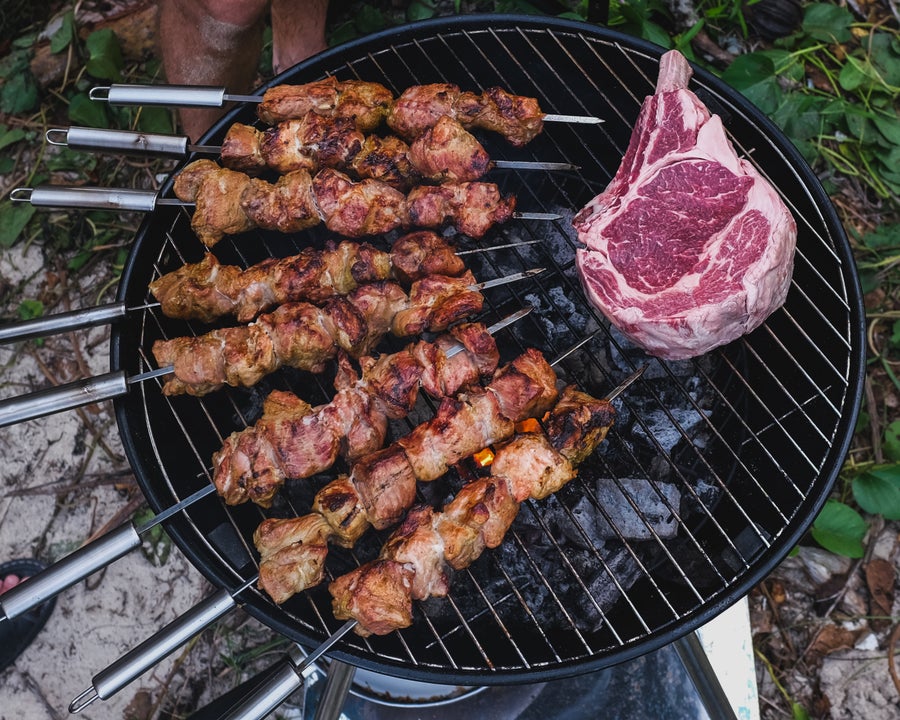
Juicy skewers of marinated meat are grilled alongside a large, raw rib eye steak on a charcoal barbecue. Every type of meat has its own required cooking temperature. Evgeniia Biriukova/Getty Images
.
.
Click the link below for the complete article:
.
__________________________________________
July 10, 2025
Business, Food For Thought, Human Interest, Political, Science, Technical amazon, business, Business News, current-events, Future, Hotels, human-rights, medicine, mental-health, research, Science, Science News, technology, Technology News, travel, vacation Leave a comment

Click the link below the picture
.
We put together a list of the best, most profitable small business ideas for entrepreneurs to pursue in 2025.
Many people dream of starting their own business. Running an enterprise in your home, garage or on the go means you can take more control over your professional goals, set more ambitious financial targets and achieve a more desirable work-life balance.
But what if you’re ready to start a business but don’t know what type of services to provide? You’ve come to the right place if you need profitable business ideas. Below, find a detailed breakdown of 63 small business ideas — from financial services to physical labor and creative contracting — to help you chart a path forward.
Some of these opportunities require more experience or credentials than others. Some can be started from home for cheap, while others require dedicated office space and capital investment. To ensure you choose the right business venture for yourself, it’s crucial to consider a few factors before you pursue a sole proprietorship.
How do you determine the best small business idea?
Consider your current skill set and credentials.
For instance, if you already have a CPA license, venturing out as a freelance accountant (as detailed below) would be a natural avenue to explore. If you have experience as a writer, you might consider editorial services, or if you’ve spent years working in the food and beverage industry, you could explore catering or becoming a personal chef.
As you explore your options, consider if you’ll need to secure special licenses (for example, hairstylists and electricians) or if the work requires additional education and credentialing.
Determine the goals of your small business.
For some people, starting a small business means leaving their full-time gig and committing to the new endeavor. For others, a part-time business provides meaningful supplemental income and can be managed in addition to other work. Consider how much money you’re hoping to earn from the business, how many clients or customers you’ll need to be profitable, and how many hours you’ll need to work each week to make it feasible.
Think about capital costs, as well as growth: Will launching the business require the purchase of equipment or other serious financial investment? Do you plan to hire employees? Will you expand to multiple locations? At the outset, it’s a good idea to create a formal business plan.
Study your location and identify what’s most feasible there.
Finding customers and clients is essential to any small business, so conduct a market analysis before you open shop. For instance, your boat cleaning business will be significantly more successful if you live near a coast, and your side hustle as an interpreter will likely be more profitable if you live in a diverse community.
You should also research what businesses already exist. Is there a dearth of dependable landscapers in your market? Is there a glut of professional photographers in your town? Answering these questions will help you determine the viability of your idea.
Decide if you want to run a business online or in person.
The digital age has created many opportunities for entrepreneurs to run a business from behind a laptop, meaning their enterprise can go wherever they choose. That’s not for everyone, though. If you want to run a brick-and-mortar shop at the heart of your community or are more comfortable interacting with customers and clients in person, launch a business that will allow you to achieve those goals.
Financial and Business Service Ideas
1. Accounting and Tax Services
Experience, training or licensing may be needed
At some point, most people seek the advice of a good bookkeeper or accountant, whether to prepare for tax season, get advice for starting a business or simply plan for the future. If you’re already a Certified Public Accountant, you can earn good money by going out on your own.
If you’re not already trained as an accountant or licensed by the state you live in, you’ll want to explore the recommended educational prerequisites and plan to obtain the appropriate credentials. Most tax preparation franchises offer courses, seminars, and training to get you ready to work for them.
You’ll also want to think about the types of services you’ll provide:
- Do you want to simply do bookkeeping for small businesses?
- Or do you also want to prepare balance sheets, income statements and other financial reports?
Other specializations can include tax accounting — a huge area of potential work.
2. Business Consulting
Has expansion possibilities
With a consulting business, you can work with a wide range of businesses on a variety of business problems. You could help new entities get off the ground by creating business plans, conducting market research, and organizing a management structure.
Depending on your level of experience, you could also help large organizations through difficult transitions and periods of restructuring or outline a successful exit strategy by providing executive-level advice and guidance on an array of matters core to the business’ mission.
A good calendar app will likely come in handy as time-tracking is crucial to accurate billing.
.
 Entrepreneurs
.
.
Click the link below for the complete article:
.
__________________________________________
https://www.tangietwoods
¡Bienvenido de vuelta viajero!
so looking to the sky ¡ will sing and from my heart to YOU ¡ bring...
CEO and Founder of Nsight Health
Catholic News, Prayers, HD Images, Rosary, Music, Videos, Holy Mass, Homily, Saints, Lyrics, Novenas, Retreats, Talks, Devotionals and Many More
Decoding Power. Defying Narratives.
A creative collaboration introducing the art of nature and nature's art.
The Home Of Entertainment News, Reviews and Reactions
Hollow Earth Society
•Whenever you are confronted with an opponent, conquer him with love.(Gandhi)
Algotrader at TRADING-CLUBS.COM
Film and Writing Festival for Comedy. Showcasing best of comedy short films at the FEEDBACK Film Festival. Plus, showcasing best of comedy novels, short stories, poems, screenplays (TV, short, feature) at the festival performed by professional actors.
Peace. Tranquility. Insanity.
Take a ride on the wild side
Découvre des musiques prometteuses (principalement) dans la sphère musicale française.
No tiene que Ser una Pesadilla.
Life in Kana-text (er... CONtext)
Where feelings meet metaphors and make questionable choices.
Finding hope and peace through writing, art, photography, and faith in Jesus.
Eyasu
The Community for Wounded Healers: Former Medical Students, Disabled Nurses, and Faith-Fueled Pivots
love each other like you're the lyric to their music
Comprendere il mondo per cambiarlo.
Mid-Life Ponderings
Travel,Tourism, Life style "Now in hundreds of languages for you."
I speak the honest truth. I share my honest opinions. I share my thoughts. A platform to grow and get surprised.
User-generated ratings for ethical consumerism
Travel and Lifestyle Blog
Questo è un piccolo angolo di poesie, canzoni, immagini, video che raccontano le nostre emozioni
“Log your journey to success.” “Where goals turn into progress.”
scrivo per dare forma ai silenzi e anima alle storie che il mondo dimentica.
“Dream deeper. Believe bolder. Live transformed.”
Vichar, Motivation, Kadwi Baat ( विचार दर्शनम्)
Traum zur Realität
Savor. Style. See the world.
معا نحو النجاح
Best Forex Broker Ratings & Reviews
art, writing and music by James McFarlane and other musicians
living life in conscious reality
Freelance poetry writing
Peace 🕊️ | Spiritual 🌠 | 📚 Non-fiction | Motivation🔥 | Self-Love💕
Reiseberichte & Naturfotografie
 James' World 2